
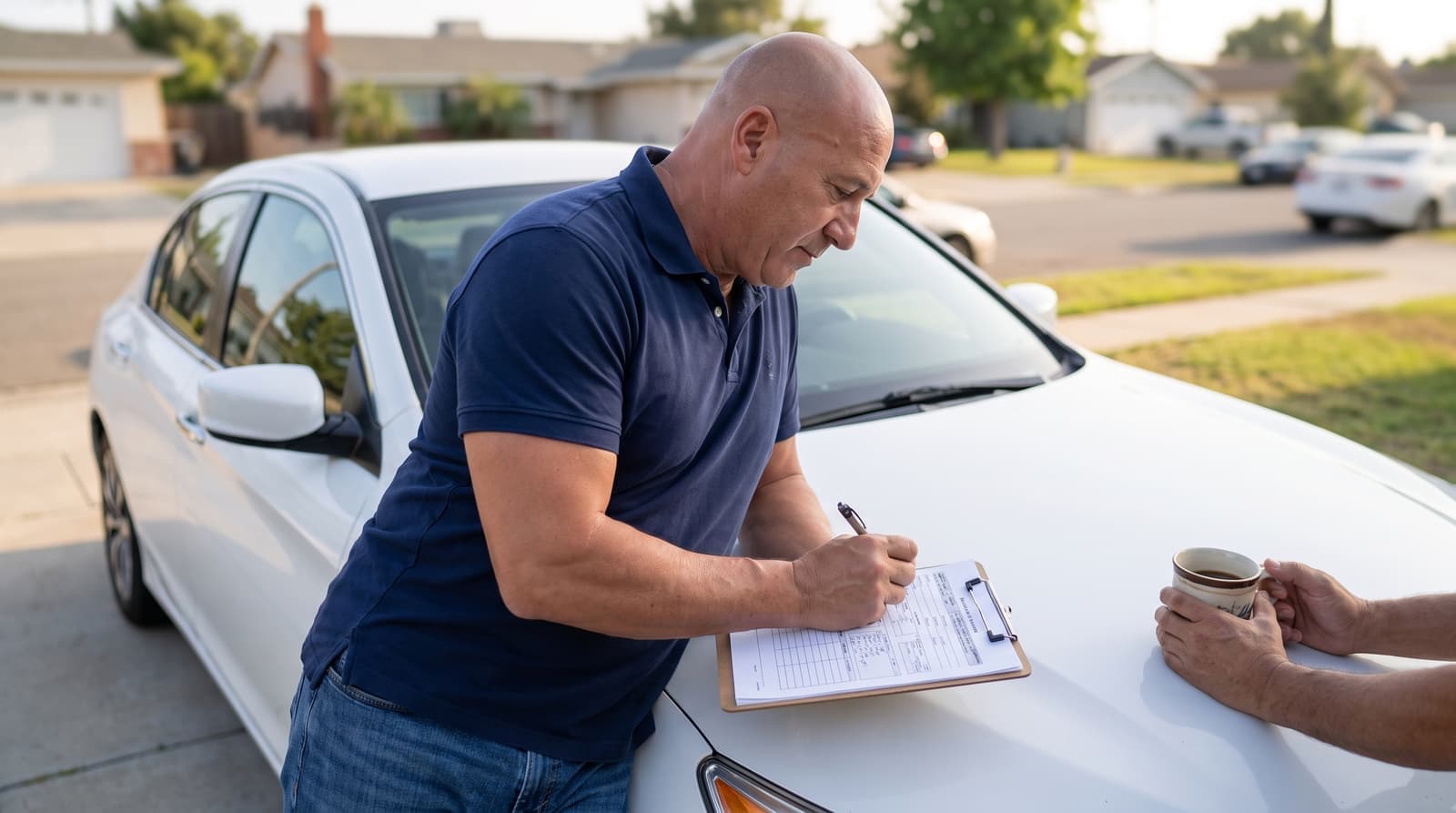
To replace a lost California title, you file DMV form REG 227, the Application for Replacement or Transfer of Title. The current version is REV. 9/2024, the fee is $28, and you don't need a notary unless a lienholder has to sign. The DMV says titles usually arrive by mail within 15 to 30 days.
If you're selling the car, you don't have to wait for the new pink slip. The same form has a second box that replaces the title and transfers the car to your buyer in one filing. Below is every section of the current form, what goes in each box, and the extra form that rides along when you sell.
Quick answer
- The form: REG 227 (REV. 9/2024), free from dmv.ca.gov. Older copies say "Duplicate"; that's the 2017 revision.
- Fee: $28, per the DMV's published fee schedule.
- Notary? Only Section 5, when a lienholder releases interest.
- Which box: "Replacement Title" to keep the car (Sections 1 to 3). "Transfer of Title with Replacement" to sell it (you complete 1 to 4, your buyer completes 6 and 7).
- Lien? The REG 227 cannot release an electronic lien. Your lender does that.
- Timeline: 15 to 30 days by mail. If your address doesn't match the DMV's records, you file in person.
- Selling? A REG 262 goes with the transfer to report the odometer reading.
What is the REG 227, and which version should you use?
The REG 227 replaces a California Certificate of Title (the document most of us still call the pink slip) when it's lost, stolen, damaged, or never arrived. It's also the form that transfers ownership when there's no title to sign.
Use the version the DMV serves today at dmv.ca.gov/portal/file/reg-227-pdf. The footer should read REG 227 (REV. 9/2024). Check it, because Google's top result for "reg 227" is still a REV. 8/2017 PDF titled "Application for Duplicate or Transfer of Title." That's why "duplicate title," "replacement title" and "pink slip replacement" all mean the same form. I'd print the current one; there's no reason to hand a DMV clerk a 2017 revision.
Read one line before you sign. Section 3 prints it in capitals: "WARNING: Issuance of a replacement title cancels the original title." If the old pink slip turns up after you file, it's void, so look one more time first.
Which box do you check at the top of the REG 227?
| Box at the top | Who fills in what | Use it when |
|---|---|---|
| Replacement Title | The owner completes Sections 1 to 3 | You're keeping the car and want the paper back |
| Transfer of Title with Replacement | The seller completes Sections 1 to 4; the new owner completes Sections 6 and 7 "as needed" | You're selling or giving the car away and the title is missing |
The second box is the one people miss. You don't replace the title, wait a month, and then sign it over. One REG 227 does both jobs.
Directly above the boxes the form also prints: "This form cannot be used to release a lien on a vehicle with an Electronic Lien Title (ELT)." If a bank is involved, read the lien section below first.
I buy cars from your driveway.
I’m Joe Yavetz, a licensed California dealer. I come to your house, look at the car, write you a check the same day, and handle the DMV paperwork. The number I give you is the number you get. No fine print. Lost pink slip? Tell me what paperwork you still have and I'll tell you whether the REG 227 route works for your car.
★ 5.0 · 48 Google reviewsSan Fernando Valley, Ventura County & West L.A.
How do you fill out the REG 227, section by section?
The 9/2024 form has eight sections on two pages. Page one is the current owner's side. Page two opens "THIS SIDE FOR NEW OWNERS" with the instruction "Complete transfer within 10 days of taking possession of vehicle."
| Section | What to write | The mistake to avoid |
|---|---|---|
| Top block | Plate, the full 17-character VIN, year and make. Page two asks for all three again. | Copying the VIN from memory. Use the car or the registration card, and fill in page two's vehicle line too. |
| 1. Registered owner(s) of record | Your true full name "as it appears on the Title/Registration," DL/ID number and state, any co-owner, physical address, county, mailing address | The DMV checks name, address and DL/ID against its records (VIRP §20.000). A nickname or a newer address turns a mailed application into an office visit. |
| 2. Legal owner of record | The bank, finance company or person holding a lien, with its address. Blank if there's no lien. | Writing your own name here. The form says "Do not enter name of owners above." |
| 3. Missing title statement | Check one: Lost, Stolen, Illegible/Mutilated (attach the old title), Not Received from Prior Owner, or Not Received from DMV (allow 30 days from issue date). Print, sign, date, phone. | Checking a box that isn't true. You're indemnifying the DMV under penalty of perjury. |
| 4. Registered owner(s) release | For a sale only. Each owner prints, signs and dates. | Missing a co-owner. Joined by AND (a "/" on DMV records), every owner signs. A business signs as "ABC CO., by JOHN SMITH." |
| 5. Legal owner release | The lienholder's authorized agent signs. Must be notarized. | Using it for an ELT lien, or for a non-ELT lender on a car 2 model years old or newer. Neither is allowed. |
| 6. New registered owner(s) | Buyer's true full name as on their DL/ID, DL/ID number, date purchased, and purchase price, or the Gift or Trade box with market value. Address, county, every new owner's signature. | A buyer receiving the car from a qualified relative also files a REG 256 for the use-tax exemption. |
| 7. New legal owner | The buyer's lender and its ELT number, if any. Otherwise write "None." | Leaving it blank. The form asks for "None." |
| 8. Dealer's release | Licensed dealers only: dealership, buyer, date sold, report-of-sale number, dealer and salesperson numbers | Private sellers leave it alone. |
The three rules printed inside Section 3
- Your address doesn't match the DMV's records. Then "you must file this application in person," with the original or a photocopy of your registration card or renewal notice, plus your driver license or ID.
- The title was replaced in the last 90 days. Then "a CHP vehicle verification is required," a separate appointment, with the car present.
- The right person signs the statement. Usually the registered owner; the buyer signs if the buyer lost it, and a person with power of attorney may sign it (VIRP §20.010).
Does the REG 227 need to be notarized?
Only when a lienholder signs. The DMV's FAQ says: "If the vehicle has a legal owner/lienholder, then section 5 of the REG 227 needs to be notarized. If the registration does not show a legal owner/lienholder, notarization is not required."
Your signatures in Sections 3 and 4 and your buyer's in Section 6 are not notarized. The penalty-of-perjury line above them is what gives them weight. For the lienholder, the DMV's manual requires the notarized release on vehicles three model years old or older (VIRP §20.010; notary rules in §20.055). Newer cars go a different way.
What if there's a lien, or the title shows a bank?
It depends on how your lender holds the title and how old the car is.
- Electronic lien (ELT). The REG 227 can't release it. The lender releases it once the loan is paid.
- Paper lien, car 3 model years old or older. The lender signs Section 5, notarized.
- Paper lien, car 2 model years old or newer. Section 5 and the REG 166 lien release can't be used. The lender "must apply for a replacement title first, and then release interest on the actual title." Your lender sets that timeline.
- Loan paid off, then the title went missing. Same age split: a notarized lender release on an older car, a lender-filed application on a newer one (VIRP §20.020).
If you're selling a car you still owe on, the payoff matters more than the title. If you owe more than the car is worth, you cover the difference. The breakdown is in selling a car you still owe money on.
How much does a duplicate title cost in California?
$28. The DMV's fee schedule (VIRP Appendix 1F) lists "Certificate of Title" at $28 under "Replacements/Substitute Fees (VC §9265)." I checked it on September 24, 2026.
Figures of $20, $23 and $27 still circulate (including in Google's AI answer and a May 2025 reply from the DMV's own social account), but the fee schedule reads $28.
If you're selling, the buyer also pays the $15 transfer fee (Appendix 1F, VC §9255) plus use tax. And unpaid renewal fees or parking tickets don't have to be cleared to issue a replacement title only (VIRP §20.000). For the whole-sale view, see the no-title cost table.
How long does a replacement title take, and what if it never arrives?
The DMV says titles "usually arrive by mail within 15–30 days."
The fastest way. If you're selling, don't wait at all: the Transfer of Title with Replacement box moves the sale on the same form. If you're keeping the car, file and wait for the mail. I don't quote a rush option; the DMV doesn't publish a current procedure for one.
If it never shows up. Section 3 has a box for this: "Not Received from DMV (Allow 30 days from issue date)." After 30 days, file a new REG 227 with that box checked.
Can you apply for a replacement title online, or do you have to go in?
There are three ways to file:
- Online through the DMV Virtual Office's Replacement Title service. Have your driver license or ID, the last 5 digits of the VIN, and the plate number. The page lists no fee or eligibility rules, and I haven't been able to confirm whether it takes cars with a lien on record.
- By mail to DMV, PO Box 942869, Sacramento, CA 94269, the address on the DMV's title transfers page.
- In person at a DMV office. If your address doesn't match the DMV's records, Section 3 makes this the only option.
Private sites offering to "order your title online" charge a service fee on top of the DMV's. If you want to do it yourself, go through dmv.ca.gov.
Selling with a REG 227: what goes in the envelope?
Can you sell a car in California if you lost the title? Yes. You check the Transfer of Title with Replacement box and complete Sections 1 through 4, and your buyer completes Section 6 (and 7 if financing). The sale side, including why private buyers get nervous, is in selling a car without the title in California.
The part other guides skip is the odometer. When a REG 227 transfers ownership, the DMV also requires "a Vehicle/Vessel Transfer and Reassignment Form (REG 262) to report the odometer mileage" (VIRP §20.010), completed by seller and buyer (§5.070, §5.075). In 2026, odometer disclosure applies to model year 2011 and newer; 2010 and older are exempt (49 CFR §580.17). You won't find a REG 262 PDF: the DMV says to call 1-800-777-0133 to have one mailed.
| Document | Who signs | Why |
|---|---|---|
| REG 227, Transfer of Title with Replacement | Seller (1 to 4), buyer (6, 7), lienholder (5, notarized) if any | Replaces the title and transfers it |
| REG 262 | Seller and buyer | Odometer reading |
| Bill of sale (REG 135) | Seller | Records price and date |
| REG 256 | Buyer, for a family transfer or gift | Use-tax exemption |
After the handover, the seller files the REG 138 release of liability within 5 days (Vehicle Code §5900); here's what to do after selling a car in California. If the title turns up before you file, signing it over is simpler: how to fill out a California title when selling. Every form in a California sale is listed in how to sell a car in California.
Can you sell to a licensed dealer with a REG 227?
Yes. It's the same form with one more section in play.
You still sign your parts. Sections 1, 3 and 4 (and the REG 262) are yours. The DMV issues a replacement to the registered owner of record, so no dealer signs those for you, and anyone promising to "get the title for you" without your signature is being loose with the truth.
The dealer doesn't title the car in its own name. Under Vehicle Code §5906, a dealer holding a vehicle for resale isn't required to apply for transfer. When the car is resold, the dealer completes Section 8.
The in-person trip can go away. The owner "is not required to appear in person with proof of ownership for the vehicle and acceptable photo ID" when the application "is submitted by or through" a dealer or the dealer's agent (VIRP §20.000). That's the rule that otherwise sends a seller with an old address to a DMV office.
Whether a given car can go this way depends on the paperwork you have and what the vehicle history shows. When someone calls me about a lost title, I start by looking at that paperwork. A lot of these I can buy, and when I can, we fill out the forms together at your place and I handle the DMV side. When I can't, I'll tell you which form you need and where it goes. Before you give anyone your signature, you can verify a California dealer's license in a couple of minutes.
How do you file for a lost title that's not in your name?
The DMV's rule: the REG 227 "may be submitted by someone other than the RO of record, but it must be signed by the RO" (VIRP §20.000). What happens next depends on why the owner can't sign.
- The owner has died. A REG 5 affidavit goes in with the REG 227. See transferring a car after the owner dies.
- The owner is alive but can't handle it, often a parent. A power of attorney normally can't sign a certification about what the owner knows, but the DMV makes an exception for "disposition of the original California Certificate of Title on an Application for Duplicate or Transfer of Title (REG 227)" (VIRP §1.125). The attorney-in-fact can also disclose odometer mileage. See selling a parent's car with power of attorney.
- You bought it and the seller never signed. A transfer still needs the registered owner's release in Section 4. If the seller is gone, you're looking at a bonded title (REG 5057).
- The car is in a trust. The DMV treats the trustee as the registered owner. If the record shows no trustee or a different one, a REG 256 stating the appointment is accepted, and trust documents aren't required.
- The registration says "Nontransferable/No California Title Issued." The REG 227 can't be used. Get a title from the state where the car was last titled.
The DMV decides each application on its own facts, and I'm a dealer, not a lawyer. On a call I can tell you which of these you're dealing with and what paperwork it takes.
What are the deadlines and fees after you file?
| Who | What | When or how much | Source |
|---|---|---|---|
| Buyer | Complete the transfer | Within 10 days of taking possession | REG 227, page 2; VC §5902 |
| Buyer | Transfer fee | $15, paid within 30 days of the transfer date to avoid a late penalty | Appendix 1F (VC §9255); VIRP §11.015 |
| Seller | File the REG 138 release of liability | Within 5 days of the sale | VC §5900 |
A car parked long enough to lose its title has often let its registration lapse too. That has its own rules: selling a car with expired registration in California.
Frequently asked questions
How much is a replacement title in California?
$28. The DMV's fee schedule, VIRP Appendix 1F, lists "Certificate of Title" at $28 under Replacements/Substitute Fees (VC §9265). The $20, $23 and $27 figures you see elsewhere do not match the current fee schedule.
Does the REG 227 need to be notarized?
Only Section 5, the lienholder's release. The DMV requires notarization if the vehicle has a legal owner or lienholder, and not otherwise. The owner's and buyer's signatures are not notarized.
How long does a replacement California title take?
The DMV says titles usually arrive by mail within 15 to 30 days. If you are selling, you do not have to wait: the Transfer of Title with Replacement box completes the sale on the same form.
Can I fill out the REG 227 online?
You can request a replacement title online through the DMV Virtual Office with your driver license or ID, the last 5 digits of the VIN, and the plate number. The paper REG 227 is mailed or filed in person, and in person is required if your address does not match the DMV's records.
Can I sell my car with a REG 227 instead of the title?
Yes. Check the Transfer of Title with Replacement box, complete Sections 1 through 4, and have the buyer complete Section 6 (and 7 if financing). A REG 262 goes with it to report the odometer reading.
How do I get a title for a car that isn't in my name?
Anyone can submit the REG 227, but the registered owner must sign it. If the owner has died, a REG 5 affidavit goes with it. A person holding the owner's power of attorney can sign for a living owner. If a seller disappeared without signing, the remaining route is usually a bonded title.
Can someone with power of attorney sign the REG 227?
Yes. The DMV generally bars a power of attorney from signing certifications about the owner's knowledge, but it makes an exception for the REG 227 statement about what happened to the original title. The attorney-in-fact can also disclose odometer mileage.
Can I get a digital copy of my car title in California?
The DMV does not list a downloadable title for owners. You can request a replacement online through the Virtual Office, but the title itself arrives by mail, usually within 15 to 30 days.
A lost pink slip is paperwork, and paperwork is the part I handle. CurbSold comes to your driveway in West L.A., the San Fernando Valley and Ventura County. Call or text me at (818) 325-7535, tell me what paperwork you still have and whether there's a lender on the car, and I'll tell you where you stand. If I can buy it, we handle the forms together at your place. If I can't, you'll still know which form to file. Here's how selling a car without a title works with me.
Sources
- California DMV, Application for Replacement or Transfer of Title, REG 227 (REV. 9/2024)
- California DMV, Vehicle Industry Registration Procedures Manual (VIRP), Appendix 1F, Fees (checked September 24, 2026)
- California DMV, Title Transfers and Changes, including the REG 227 notarization FAQ
- California DMV, VIRP §20.000 Application for Duplicate or Transfer of Title (REG 227)
- California DMV, VIRP §20.010 Certificates of Title and Transfer of Ownership
- California DMV, VIRP §20.020 Certificates of Title Lost After Release by the Lienholder
- California DMV, VIRP §20.055 Notarized Lienholder Signatures for Replacement Certificates of Title
- California DMV, VIRP §1.125 Signature by Power of Attorney
- California DMV, VIRP §5.070 Transfers and §5.075 Vehicle/Vessel Transfer and Reassignment Form (REG 262)
- California DMV, VIRP §11.015 Basic Transfer Requirements
- California DMV Virtual Office, Replacement Title
- 49 CFR §580.17, odometer disclosure exemptions
- California Vehicle Code §§5900, 5902, 5906, 9255, 9265