
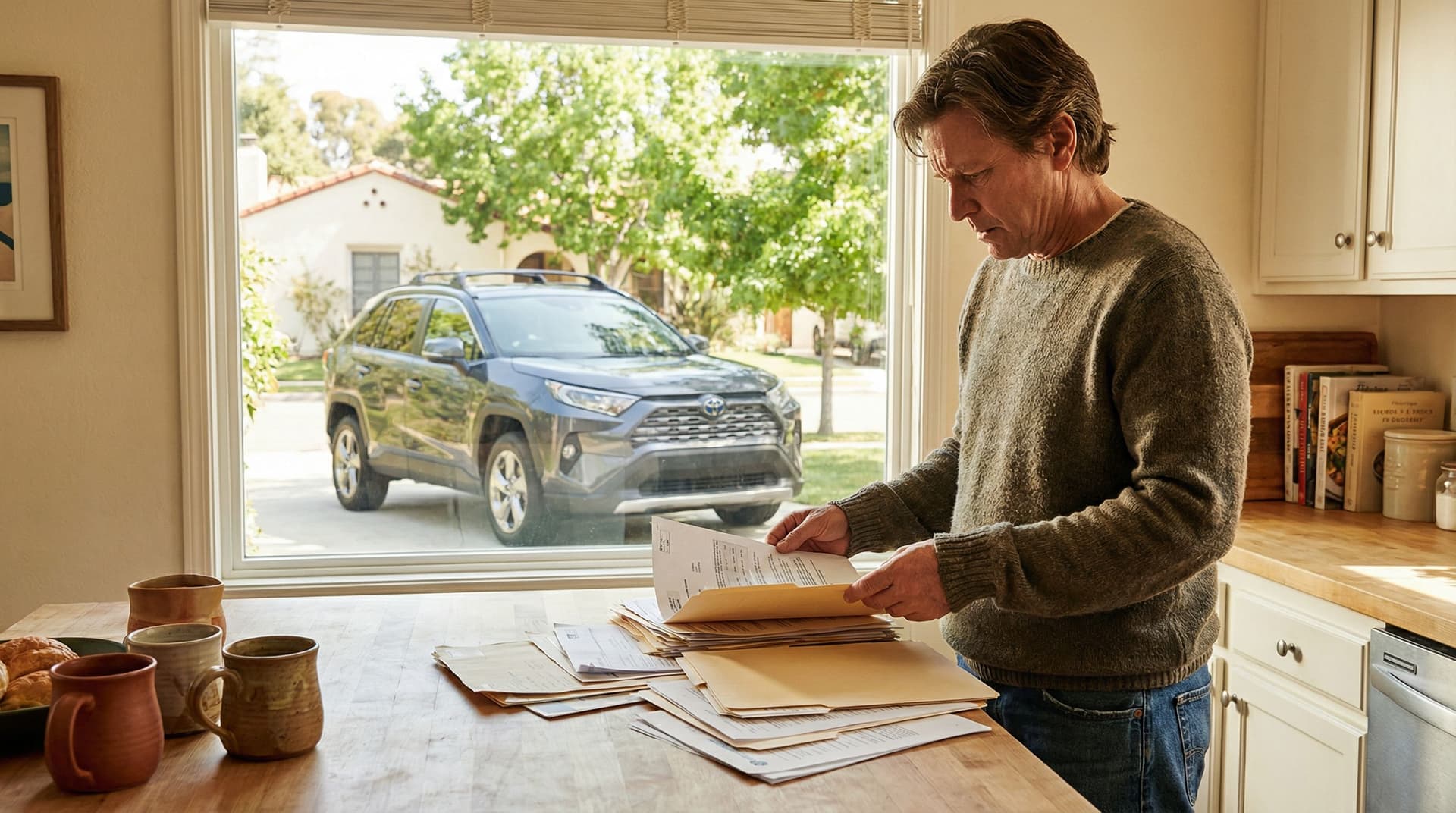
Yes, you can sell a car in California without the title in your hand. What you cannot do is transfer ownership without title paperwork, and those are two different things. The form that fixes it is the REG 227, the Application for Replacement or Transfer of Title. It costs $28, and the replacement mails in 15 to 30 days.
Here is the part that saves people a month: the same form has a box for selling the car at the same time you replace the title. You do not have to wait for the new one to show up before you can sell.
I buy cars in driveways for a living, and missing titles come up most weeks. The pink slip went into a junk drawer during a move in 2019. The bank still has it. Dad passed and nobody knows where he filed anything. Every one of those has a path, and none of them are as bad as they look on a DMV website.
Quick answer:
- Lost title: file a REG 227. $28, and the replacement mails in 15 to 30 days
- Selling before it arrives: check the second box on the REG 227. You sign Sections 1 through 4, your buyer signs 6 and 7, and one filing does both jobs
- Bill of sale: records the price and the date. It does not transfer ownership in California
- Selling to a dealer: you still sign the replacement application yourself. The dealer carries the filing, so the DMV wait is not yours
- Bonded title: only for a car with no traceable owner. Required when the car is worth $5,000 or more and you have no ownership evidence at all
- Lien on the car: the REG 227 cannot release an electronic lien. The lender has to do that part
Can you sell a car in California if you lost the title?
Yes, and this is the most common version of the problem by a wide margin.
California will not transfer ownership on a handshake. Under Vehicle Code section 5600, no title passes until the endorsed certificate or the transfer documents actually reach the DMV. That is the whole rule, and it is why a missing pink slip stops a sale cold until you deal with it.
The fix is a replacement title, and the only thing standing between you and one is a one-page form.
One thing to know before you file. The form warns you directly: issuing a replacement cancels the original. If the old title turns up in a shoebox three weeks later, it is scrap paper. Sign the REG 227 when you have actually given up looking.
How do you get a replacement title in California?
You file a REG 227, the Application for Replacement or Transfer of Title. Note the name. The DMV retired "Duplicate" from the form title in the 2021 revision, and half the guides online still use the old wording, which is a decent signal of how recently they were checked.
The numbers:
- Fee: $28, per the DMV's fee schedule, VIRP Appendix 1F (listed as Certificate of Title under Replacements)
- Timeline: the DMV states titles usually arrive by mail within 15 to 30 days
- What you need: your driver's license or ID number, the VIN, and the plate number
- Where: a DMV field office, by mail, or online
There is no same-day replacement title in California. A field office will take your application over the counter and get it into the system that day, which is worth doing if your paperwork has anything unusual in it. The title itself still mails on the DMV's clock. If somebody promises you a title in 72 hours, ask them which DMV page says so.
The REG 227 has two boxes at the top. Replacement Title (Sections 1 to 3) is for keeping the car. Transfer of Title with Replacement lets you sell it in the same filing: you complete Sections 1 through 4, your buyer completes 6 and 7. Three things send one back more than anything else: an address that does not match the DMV record (that forces an in-person filing), a title already replaced in the last 90 days (CHP verification first), and a lien the form cannot release (any electronic lien, and paper liens on cars two model years old or newer). A transfer also needs a REG 262 for the odometer. Here is the full REG 227 walkthrough, section by section.
Once the replacement arrives, you sign it and sell the car normally. Our field guide to filling out a California title when selling covers exactly which boxes to sign and the mistakes that void a title, and if the terminology is what is tripping you up, the California pink slip explainer sorts out what the pink slip actually is and is not.
Can you sell a car to a dealer without the title in hand?
This is the question I get on the phone more than any other, so let me answer the part nobody else will.
I cannot apply for your replacement title for you. The DMV issues a replacement to the registered owner of record, and that is you. Your name goes in Section 1. Your signature goes in Section 3, under penalty of perjury, saying the title is gone. Your signature goes in Section 4, releasing the car. Nobody signs those for you, not me, not CarMax, not anybody. Any buyer who tells you they will "take care of the whole thing" is either being loose with words or doing something you do not want to be attached to.
What actually changes when you sell to a licensed dealer is who carries the paperwork and who waits.
A dealer does not have to put the car in its own name. Under Vehicle Code section 5906, a dealer holding a vehicle for resale is not required to apply for transfer. That is Section 8 on the form, the dealer's release of acquired vehicle, which carries a dealership name, a dealer number and a report-of-sale number. It is the only section on the REG 227 a private party can never use. The car moves from you to me to its next owner without a title ever being cut in my name, and when I do resell it, Vehicle Code section 4456 puts the 30-day filing deadline on me, with the fees.
A private buyer has a much worse version of this. They hand you cash for a car with no title, then they have 10 days from taking possession to complete the transfer themselves, on a form they did not fill out, with a stranger's signature they have to trust. That is why private buyers go quiet the moment you mention the title is missing. It is not that they think you are lying. It is that the risk is entirely theirs.
So the honest version, which is shorter than the pitch: you still sign your own replacement application. I bring the form and fill it out with you so it does not come back rejected, and if the deal can be done, I handle the DMV side. You are not buying a legal shortcut. You are buying the difference between doing DMV paperwork alone and having somebody who does it every week do it with you.
Trading it in is the same transaction with a different name. Section 6 of the REG 227 has a Trade checkbox right next to Gift, with a line for market value. A dealership taking your car on trade with no title is doing exactly what is described above, just netting the number against a car you are driving off in. If a dealer tells you a trade-in is impossible without the title in hand, that is their policy, not California law.
If you want this handled rather than explained, here is how selling a car without a title works with me, or just call.
I buy cars from your driveway.
I’m Joe Yavetz, a licensed California dealer. I come to your house, look at the car, write you a check the same day, and handle the DMV paperwork. The number I give you is the number you get. No fine print. No title in hand? Tell me about the car and I’ll tell you exactly where you stand.
★ 5.0 · 48 Google reviewsSan Fernando Valley, Ventura County & West L.A.
Does a bill of sale work if you do not have the title?
No, and this is the single most expensive misunderstanding in this whole topic.
A California bill of sale, form REG 135, does real work. It records the purchase price, which is what the use tax gets calculated on. It records the date, which matters if a ticket shows up. It gives both people a receipt. Keep one on every sale.
What it does not do is transfer ownership. Under Vehicle Code section 5600, no title passes until the endorsed certificate or the transfer documents reach the DMV. A bill of sale is neither. Two people can sign one, shake hands, and hand over keys and cash, and the DMV's position is that the seller still owns that car.
I have met the people on the wrong end of this. Somebody bought a truck in 2021 with cash and a handwritten receipt, the seller has since moved out of state and does not answer, and now there is no way to register it and no way to sell it. Their options are small claims court with the receipt as evidence, or the bonded title process below. Neither is quick.
The one document that genuinely protects you as a seller is different: the Notice of Release of Liability, REG 138, filed within five days of the sale under Vehicle Code section 5900. That is what takes your name off the car for tickets and tolls while the buyer's paperwork works through the system. There is more on that in what to do after selling a car in California.
What is a bonded title, and when do you actually need one?
A bonded title is for a car nobody can prove they own. Abandoned vehicles, a barn find with no paperwork, a car bought years ago on a handshake from someone unreachable. If you are the registered owner and you simply lost the paper, this section is not about you. File the REG 227 and skip ahead.
California's version runs on a Motor Vehicle Ownership Surety Bond, form REG 5057, under Vehicle Code sections 4157 and 38050. The DMV requires it when the normal ownership evidence is unavailable and the vehicle is worth $5,000 or more, or when a release from the lienholder cannot be obtained.
Two details worth having right, because most write-ups get them wrong:
- The bond equals the market value of the vehicle, and the DMV defines that precisely: the midpoint between the wholesale and retail values in a recognized valuation handbook. Not a multiple of it.
- A REG 256, Statement of Facts, has to go with it, written by you, explaining why a bond is being submitted instead of a title.
My honest read after watching a few of these: the process is worth it on a car with real value and rarely worth it under about $4,000. The bond premium, the paperwork, and the DMV verification eat a cheap car's entire value. On a collector vehicle or a clean truck, it pencils out fine.
You can sell a bonded title car normally once it issues. Disclose the bonded status to your buyer. The bond runs for three years under Vehicle Code section 4158, which protects anyone who turns up in that window with a claim. It comes off earlier only if the car leaves California and you surrender the certificate of ownership.
What if the title is in somebody else's name?
Three versions of this come up, and each has its own path.
The bank has it. When you finance a car, the lender holds the title until the loan clears. Pay off the balance and the lender releases it, electronically in most cases now. Or sell to a dealer who handles the payoff directly: I contact your lender, get the payoff figure, send them the balance, and write you a check for whatever the car is worth above it. If you owe more than the car is worth you cover the gap, and there is no way around that part. The full breakdown is in selling a car you still owe money on. If a title lender holds it instead of a bank, the same guide covers that too.
The owner passed away. California has a route that skips probate entirely for most families. If the estate qualifies, a REG 5 affidavit transfers the vehicle after a 40-day wait from the date of death, and vehicles are excluded from the small-estate calculation altogether. If the title is also missing, the REG 5 and the REG 227 go in together. The full walkthrough is in transferring a car title after death in California.
You bought it and the seller never signed over. This is the bill-of-sale trap above. Small claims with your receipt, or the bonded title process, and neither is fast. The lesson for next time is simple: never hand over money without a signed title or a signed REG 227 in the same moment.
What it costs and how long it takes
| Situation | Form | Cost | Timeline |
|---|---|---|---|
| Lost title, keeping the car | REG 227, box 1 | $28 | 15 to 30 days by mail |
| Lost title, selling now | REG 227, box 2 | $28 | Sale completes the day you both sign |
| Owner is deceased | REG 5 + REG 227 | $28 + certified death certificate | 40-day wait from date of death |
| Lien on the car | Lender release | Payoff balance | Set by your lender, typically days |
| No provable owner | REG 5057 + REG 256 | Bond premium, set on market value | Weeks to months |
| Selling to a licensed dealer | REG 227, Sections 1 to 4 and 8 | $28, and the dealer files it | The dealer handles the DMV side |
One more thing worth mentioning, because these two problems travel together. A car that has been parked long enough for the title to go missing has usually been parked long enough for the registration to lapse too. That is a separate set of rules, and a better outcome than most people expect, in selling a car with expired registration in California.
If you just want it handled
Call or text me at (818) 325-7535. I am a licensed dealer, I come to you in the San Fernando Valley, Ventura County, and West L.A., and I deal with title paperwork most weeks of the year.
Tell me two things on the phone: whether you are the registered owner on the DMV's records, and whether there is a lender on the car. Those two answers decide almost everything. If it is something I can buy, we fill out the REG 227 together at your place, and I handle the DMV side. If it is not, I will tell you which form you need and where to take it, and you can go do it without me. Either way you will hang up knowing where you stand, which is more than the DMV website gives you.
Frequently Asked Questions
Can I sell my car in California without the title?
Yes. You file a REG 227, the Application for Replacement or Transfer of Title, and check the box for Transfer of Title with Replacement. You complete Sections 1 through 4 and your buyer completes Sections 6 and 7, which replaces the missing title and transfers ownership in one filing. The fee is $28. What you cannot do is transfer ownership with a bill of sale alone.
Can I sell a car in California if I lost the title?
Yes. A lost title is the most common version of this and the easiest to fix. File a REG 227 with the DMV for $28 and the replacement mails in 15 to 30 days, or use the same form to replace and sell at the same time if you do not want to wait. Be sure before you file: issuing a replacement cancels the original title permanently.
Where can I sell my car if I have no title?
Your realistic options are a private buyer willing to sign a REG 227 with you at the time of sale, or a licensed dealer. Most private buyers decline, because they carry all the risk and have only 10 days from taking possession to complete the transfer themselves. A licensed dealer can take the car into inventory without titling it in the dealer's name under Vehicle Code section 5906, which is why dealers handle missing-title sales more comfortably than individuals do.
What happens if you sell a car and the buyer does not transfer the title?
You stay the registered owner on the DMV's records, which means tickets, tolls and liability keep pointing at you. The protection is the Notice of Release of Liability, form REG 138, filed within five days of the sale under Vehicle Code section 5900. It does not transfer ownership, but it timestamps the date you handed the car over and moves the responsibility to the buyer from that day.
How do you fill out the REG 227 to sell a car?
Check the second box at the top, Transfer of Title with Replacement. You complete Sections 1 through 4, your buyer completes Section 6 within 10 days (and Section 7 if financing), and a REG 262 goes with it for the odometer reading. Every field is covered in our REG 227 walkthrough.
Can I sell my car without a title to a dealership?
Usually yes, and it is the path with the least friction, but the seller still signs the replacement application. No dealer can apply for your replacement title on your behalf, because the DMV issues it to the registered owner of record. What a licensed dealer adds is Section 8 of the REG 227, the dealer's release of acquired vehicle, which lets the car pass to its next owner without a title being issued in the dealer's name. Many large buyers, CarMax and Carvana included, require the title in hand as a matter of policy rather than law.
Can I trade in my car without the title?
Yes. Section 6 of the REG 227 has a Trade checkbox next to Gift, with a line for market value, so the DMV plainly contemplates it. The paperwork is identical to a straight sale. Whether a specific dealership will do it is a policy question at that dealership, not a legal one.
Does a bill of sale transfer ownership in California?
No. A bill of sale, form REG 135, records the price and the date and gives both parties a receipt. Under Vehicle Code section 5600 no title passes until the endorsed certificate or the transfer documents reach the DMV, and a bill of sale is neither. Keep one on every sale, but never treat it as the transfer itself.
Can a dealer sell a car without a title?
A dealer needs proper title documentation to transfer a car to a retail buyer, but it does not need a title issued in the dealership's own name. Vehicle Code section 5906 exempts a dealer holding a vehicle for resale from applying for transfer, and Vehicle Code section 4456 gives the dealer 30 days from the sale to submit the application with all fees. That is why a dealer can buy a car whose replacement title is still in process.
How much does a bonded title cost in California?
The bond amount equals the vehicle's market value, which the DMV defines as the midpoint between the wholesale and retail values in a recognized valuation handbook. The premium you pay a surety company is a fraction of that, and there is a $28 DMV fee plus a verification on top. A bond is required when ownership evidence is unavailable and the vehicle is worth $5,000 or more, under Vehicle Code sections 4157 and 38050, and it is filed on form REG 5057 with a REG 256 explaining why.
Can I sell a car with a bonded title in California?
Yes. A bonded title transfers like any other California title. Disclose the bonded status to your buyer. Vehicle Code section 4158 keeps the bond in force for three years, which protects anyone who files an ownership claim in that window. It does not block a sale, though it can affect what the car is worth.
Does a replacement California title look different from the original?
It carries the same legal weight and works identically for selling or transferring. The document is marked to show it is a replacement, and issuing it cancels the original, which is why an old title that turns up afterward is worthless.
What if the previous owner will not sign the title over?
Your options are narrow. Small claims court with your bill of sale as evidence, or the bonded title process if the vehicle qualifies. Both take time and neither is certain. This is the reason never to hand over money without a signed title or a signed REG 227 in the same moment.
Can I sell a car with a salvage title in California?
Yes, with disclosure. Salvage status has to be disclosed to the buyer. The car cannot be registered and driven again until it is revived, and the DMV's revived salvage checklist asks for a REG 343 application, proof of ownership, a REG 31 vehicle verification or a CHP Certificate of Inspection (CHP 97C), and an electronic Vehicle Safety Systems Inspection certificate. Note the last one: the old paper brake and lamp certificate was replaced by the electronic VSSI, so guides still telling you to get "brake and light certification" are describing a process the DMV retired.