
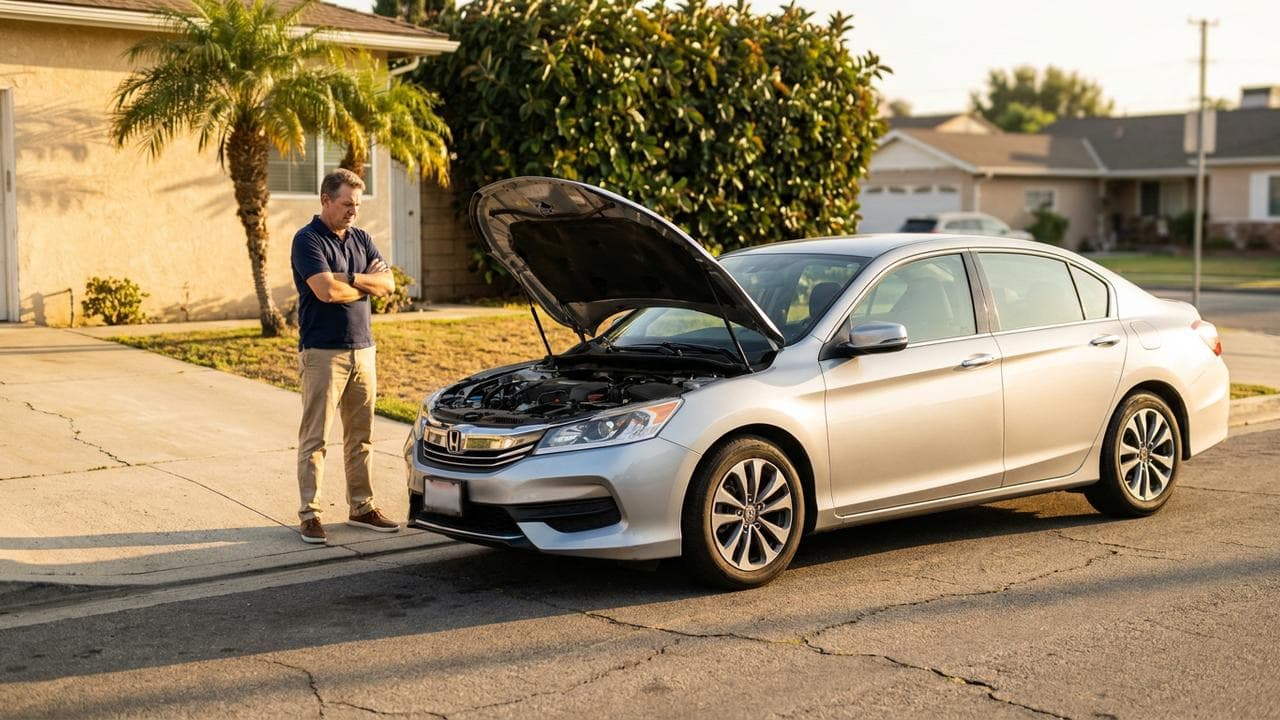
Most people I see with a transmission problem think their car is worthless. And a lot of the services that will quote them online are happy to let them keep thinking that, because the lower your expectations, the easier they are to meet.
The truth is more complicated. Some transmission problems are $400 fixes. Some are $8,000 jobs that make the car a parts car. And some land right in the middle, where the answer depends on specific numbers about your specific vehicle.
I am a licensed dealer in California. I have bought over 50,000 cars, and a good number had transmission issues. Here is what you actually need to know.
Quick answer:
- Transmission replacement in California runs $3,500-$8,000 at most shops in 2026, depending on the vehicle and whether it is a rebuild or full replacement.
- A bad transmission drops a car's value 40-60% compared to a running comp, because buyers price in the repair cost plus their risk and labor.
- Not all transmission problems are equal. A solenoid failure costs $300-$850 to fix. A blown torque converter is $600-$1,800. A full transmission rebuild or replacement is $2,200-$8,000.
- There are three honest answers when you have a transmission problem: buy it as-is, fix it first, or, if neither makes sense, send you to someone in my network who specializes in these situations.
- Joe takes no referral fees or affiliate revenue from any third party. If he can't buy your car, the advice he gives you is purely in your interest.
- Dealers like CarMax will appraise your car regardless of transmission condition, but the offer reflects salvage or auction pricing, not retail value.
What Does "Bad Transmission" Actually Mean?
This is where most conversations go wrong. "Bad transmission" covers a wide range of problems, and the cost difference between them is enormous. Before you decide anything, it helps to know what you are actually dealing with.
Slipping Transmission
The car shifts unexpectedly, loses power between gears, or the RPMs climb without the car accelerating the way they should. Often caused by low or degraded transmission fluid, worn clutch packs, or a failing shift solenoid. Minor slipping caught early can cost $200-$500 to address (fluid change, solenoid replacement). If the underlying clutch material has worn through, you are looking at a rebuild.
Hard or Erratic Shifts
The car jerks, bangs, or hesitates when changing gears. This can be a valve body issue, solenoid failure, or internal pressure problem. Solenoid replacements run $300-$850. Valve body repairs are $400-$900. Neither requires removing the entire transmission.
Torque Converter Failure
The torque converter sits between the engine and the transmission. When it fails, you get shuddering, whining, or the car slipping out of drive at low speeds. Torque converter replacement costs $600-$1,800 in California because it requires pulling the transmission to access it. Parts themselves are $150-$500; the rest is labor.
Complete Transmission Failure
The transmission will not engage, slips into neutral on its own, or makes grinding, clunking, or burning noises. At this stage, you need either a full rebuild ($2,200-$3,400 in California at an independent shop) or a remanufactured/replacement transmission ($3,500-$8,000 depending on the vehicle and whether you are at a dealer or independent shop).
California labor rates run $120-$180 per hour, compared to a national average closer to $75-$150. That difference adds up fast on a job that takes 8-15 hours. A transmission job that costs $4,000 in Georgia can run $6,500 in the San Fernando Valley.
The type of transmission also matters. Continuously variable transmissions (CVTs), found in most modern Nissans, Subarus, and some Hondas, are expensive to replace and often cannot be rebuilt. Expect $4,500-$8,000 for a CVT replacement.
The Repair vs. Sell Math: When Does It Make Sense to Fix?
Here is the framework. A transmission repair makes sense to do before selling only when both of these are true:
- The repair cost is less than the increase in sale price the repair creates
- The car has enough value after repair to justify the investment
That second condition is the one people miss. If your car is worth $5,000 running and $2,500 with a bad transmission, a $3,000 repair does not make you whole. You spend $3,000 to recover $2,500. You are down $500.
The math works in your favor only when the car is worth substantially more running. A 2019 Toyota Camry with 95,000 miles might be worth $16,000 in good working order and $9,000 with a known transmission failure. If the repair is $3,500, you spend $3,500 to recover $7,000 in value. That math is compelling.
Here is a rough guide:
| Running Value | Transmission Repair Cost | Fix Before Selling? |
|---|---|---|
| Under $5,000 | Any amount | No, repair cost exceeds or matches recovery |
| $5,000-$10,000 | Over $2,500 | Probably not, margins too thin |
| $5,000-$10,000 | Under $2,000 | Possibly, run the specific numbers |
| $10,000-$20,000 | Under $4,000 | Usually yes, recovery is meaningful |
| Over $20,000 | Under $5,000 | Almost always yes |
A few caveats. These are rough guidelines, not guarantees. The actual recovery depends on what a buyer in your market is willing to pay. And high-value vehicles with severe transmission failure often go to the manufacturer's dealer network or wholesale buyers anyway, where the math changes again.
One more thing: if your car is already at high mileage, the fix-first math gets harder. A $4,000 transmission repair on a car with 175,000 miles is a different risk calculation than the same repair on a car with 60,000 miles. See our guide to selling a high-mileage car for how mileage interacts with repair decisions.
I buy cars from your driveway.
I’m Joe Yavetz, a licensed California dealer. I come to your house, look at the car, write you a check the same day, and handle the DMV paperwork. The number I give you is the number you get. No fine print.
★ 5.0 · 46 Google reviewsSan Fernando Valley, Ventura County & West L.A.
Who Actually Buys Cars with Bad Transmissions?
There are five realistic buyers for a car with a transmission problem. They are not created equal.
Private Buyers (Facebook Marketplace, Craigslist)
They exist, and some will pay more than a junkyard, but the pool is narrow. Private buyers who take on transmission problems are typically mechanics, car hobbyists, or people with specific DIY skills who know what the repair will cost them. Expect a 40-60% discount from what a running version of your car would sell for privately. A car worth $12,000 running might get $5,000-$7,000 offers from private buyers who know what they are buying.
The process is slower and more work. You will deal with skeptical buyers, lowball offers, and people who use the transmission problem as leverage to push the price down even further after they commit. Full disclosure is legally required in California: you must tell buyers about known defects. Hiding a transmission problem is fraud regardless of what the bill of sale says.
Licensed Dealers
Most franchise dealers will not buy a car with a documented transmission failure unless it is a trade-in they can wholesale immediately. The economics do not work for them. But independent licensed dealers who specialize in buying used vehicles are a different story. Some buy vehicles with known mechanical issues, factor the repair cost into the offer, and have relationships with wholesale channels that let them move the car.
The offer will reflect the repair cost plus their margin and risk. Do not expect retail money. But a fair dealer will show you how they got their number, and a firm offer at your door saves you weeks of private sale effort.
Salvage Yards and Junk Buyers
They will take almost anything. For cars with blown transmissions that are not worth fixing, salvage buyers pay based on the vehicle's scrap metal value plus whatever parts have resale value. For a typical sedan with a bad transmission, expect $200-$500. For a truck or SUV, $400-$800, since they weigh more and have more valuable components.
Peddle, CarBrain, and similar services operate in this category. They give online quotes and arrange free pickup. They are legitimate and fast. The price reflects salvage-level value, not a meaningful premium over junkyard pricing, but convenient.
CarMax
CarMax will appraise your car regardless of transmission condition. Their offer on a vehicle with a known transmission failure reflects what they will get at the wholesale auction they send it to, minus their costs and margin. That is a real number. It is just not a retail number.
The MaxOffer app generates a CarMax offer based on real market data. I use that same tool when buying cars. If CarMax gives you an offer, I match or beat it. Guaranteed. That applies to cars with mechanical issues too, on the ones I can buy.
Online Instant-Offer Services (Carvana, Shift, etc.)
Most of these will reject or drastically reduce offers on vehicles with active transmission problems. Carvana, for instance, requires the vehicle to be in working condition for most of their vehicle types. If you receive an online quote and then disclose the transmission issue during their inspection, expect the offer to drop substantially or be withdrawn. Some services are more transparent about this than others.
How I Approach a Car with a Bad Transmission
When someone calls me about a car with a transmission problem, I try to get specific before I say anything. "Bad transmission" is not enough to give you a real answer. I want to know what type of failure, what the car is, how many miles, and whether anyone has actually diagnosed it with a code reader or just described the symptoms.
From there, I end up with one of three answers:
Answer 1: Yes, I will buy it. I factor the repair cost into my offer. The offer reflects what the car is worth running, minus a realistic estimate of what the transmission repair will cost a buyer. My advantage here is that 30 years in this business has given me a pretty good eye for what an actual repair will cost, better than an algorithm that adds a flat penalty for "transmission issues." I show you how I got the number. You see the reasoning.
Answer 2: You should fix it first. Sometimes the math is clear. If your car has a $700 solenoid problem and is otherwise worth $18,000, the right answer is to fix the solenoid and sell it running. I will tell you that directly, even though it means I might not buy the car today. It is not in your interest for me to buy a $17,300 car as a problem vehicle for $10,000 when a $700 repair puts you back to full value.
Answer 3: Here is who to call. Some cars I cannot buy, either because the repair cost is too high relative to the vehicle's value for my economics to work, or because the situation requires a specialist. Over 30 years, I have built a network: transmission specialists who sometimes buy problem vehicles they can fix and resell, salvage operators who pay fair scrap prices, auction contacts who handle specific vehicle types. I will point you toward the right one.
I take no referral fees or affiliate revenue from any of these contacts. None. The referral is because it is genuinely the best path for your situation, not because there is a check coming back to me. That is worth saying explicitly because it is not how most of this industry works.
If you want to understand what your car might be worth before calling anyone, our free listing tool at curbsold.com/free-listings generates listings for five platforms and gives you an estimate range of what a dealer would pay. It is worth knowing the number before you walk into any conversation.
What to Do Right Now
If your car has a bad transmission, here is the practical sequence:
Get an actual diagnosis, not just symptoms. A check engine light with transmission codes is not the same as a complete failure. Many transmission "problems" are solenoid or sensor issues that cost $300-$800 to fix. Before you make any decision, have someone pull the codes. Most shops do this for free or for a small fee.
Get a repair estimate. Call an independent transmission shop (not a dealer). Ask for a written estimate. California shops are required to give you a written estimate before beginning work. Get a second opinion if the number is above $3,000. Prices vary significantly.
Run the math. Look up what your car is worth running (Kelley Blue Book Fair Condition value, or look at comparable cars selling on Facebook Marketplace in your area). Subtract the repair estimate. If the resulting number still makes the repair worthwhile, fix it. If not, sell as-is and tell buyers what the repair estimate is. Specificity makes you more credible and attracts more serious buyers.
Disclose everything. In California, you must disclose known mechanical defects. Hiding a transmission problem in a private sale is fraud. It also comes back to you. Put the issue in writing, get a signed acknowledgment from the buyer, and keep a copy. For more on California's as-is sale rules, see our guide to selling a car as-is in California.
Give me a call at (818) 325-7535. I will tell you what I think, even if the honest answer is that someone else is a better fit for your situation.
If you want to understand the full value picture before you sell, what is my car worth gives context on how dealers actually calculate values on problem vehicles.
And if the transmission problem is on a car you inherited, see our guide to the REG 5 transfer after a death for the title and probate considerations that apply on top of the mechanical question.
Frequently Asked Questions
How much does a transmission replacement cost in California in 2026?
Transmission replacement in California runs $3,500-$8,000 for a remanufactured unit at an independent shop, and $4,500-$9,000+ at a dealership. California labor rates of $120-$180 per hour are 20-40% higher than the national average. A rebuild (using the existing transmission case with new internal components) runs $2,200-$3,400. CVT transmissions found in many Nissan, Subaru, and Honda models cost $4,500-$8,000 to replace because they cannot be rebuilt the same way a conventional automatic can.
How much does a bad transmission lower a car's value?
A documented transmission failure typically drops a car's value 40-60% compared to a running comp in the same condition. A private buyer will price in the repair cost plus their risk premium and labor. A dealer or salvage buyer will price in the repair cost plus their margin. On a $12,000 running car, realistic offers with a bad transmission range from $5,000 to $8,000 depending on the buyer type and severity of the failure.
Will a dealership accept a trade-in with a bad transmission?
Most franchise dealerships will accept a trade-in with a transmission problem, but their offer reflects wholesale auction value, not retail. The car goes straight to auction or to a wholesaler, and your trade-in value reflects that. If you are trading in to purchase another vehicle, the dealer may be more flexible. If you are selling outright, a specialized buyer or licensed independent dealer who buys problem vehicles will likely give you a better number than a franchise dealer trade-in.
How do you sell a car with a blown transmission?
Disclose the problem, get a written repair estimate from a transmission shop, and use that number as a reference point in all your conversations. Your options are: private sale (slowest, but some buyers pay more for project cars), licensed dealer who buys problem vehicles (fastest, fair pricing based on the math), salvage or junk buyers (fast, low price), or online services like Peddle or CarBrain (convenient, salvage-level pricing). Do not hide the problem. California requires disclosure of known defects, and a signed acknowledgment protects you legally.
Is it worth fixing a transmission before selling a car?
It depends on the specific numbers. The repair makes sense when the increase in sale price exceeds the repair cost, and when the car is worth enough after repair to justify the investment. A $700 solenoid fix on an $18,000 car almost always makes sense. A $5,000 rebuild on a $4,000 car almost never does. Run the actual math on your specific vehicle before deciding.
What is the $3,000 rule for cars?
The informal rule is: if a repair costs more than $3,000 on a car worth under $10,000, the repair is probably not worth doing before selling. The car is likely going to need further repairs soon regardless, and the repair cost will not be fully recovered in a higher sale price. This is a rough heuristic, not a precise formula. The actual decision depends on the specific car value, the specific repair cost, and who you are selling to.
Can I sell a car with a bad transmission to CarMax?
CarMax will appraise your car regardless of transmission condition. Their offer on a vehicle with a known transmission failure reflects what they can get at the wholesale auction they route it to. It is a real, no-obligation offer. It is not a retail offer. If you want to compare that number against other options, call a licensed independent dealer who buys problem cars. They may offer more because they have access to different wholesale channels and can price the repair more accurately than an algorithm.