
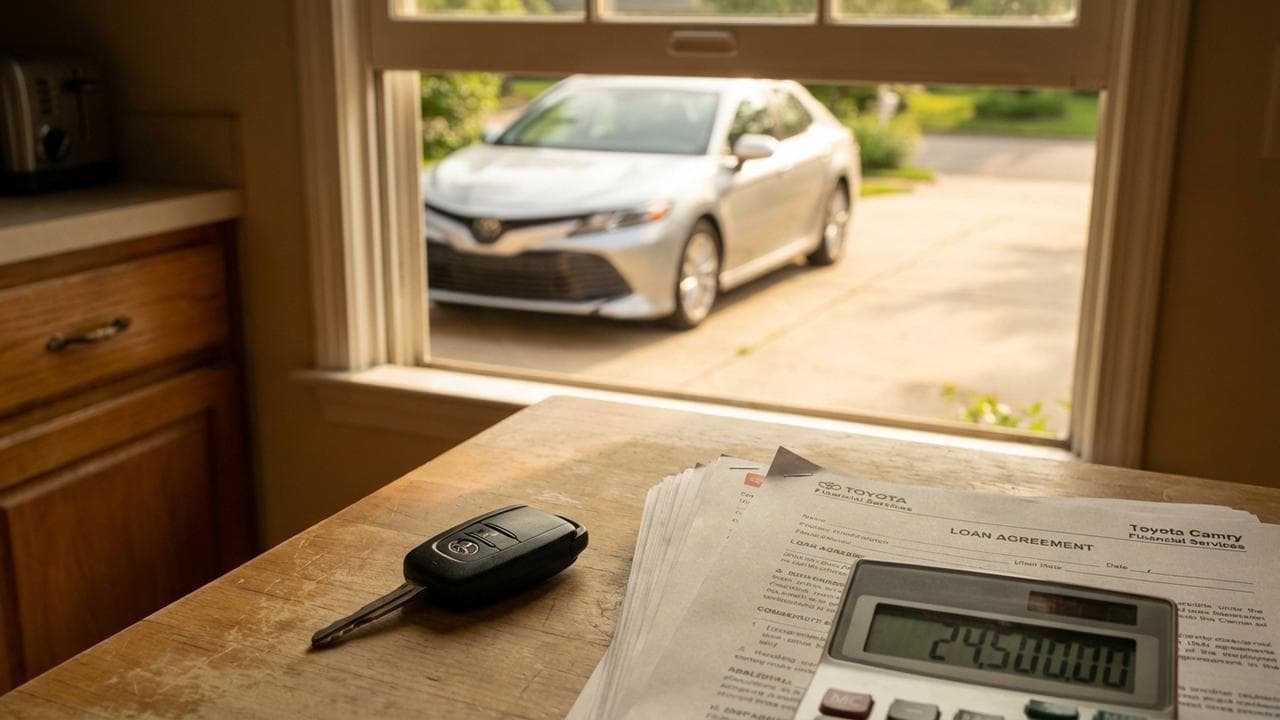
You owe $18,000 on your car loan. The car is worth $14,000. That is $4,000 in negative equity, and it means you cannot simply sell the car, pay off the bank, and walk away with cash in your pocket.
This is more common than most people think. About 27% of all trade-ins right now have negative equity. The average gap is around $6,000. If you are in this position, you are not alone and you are not stuck. But you do need to understand your options clearly, because some of them will make the problem worse.
I am a licensed dealer in California. I have bought over 50,000 vehicles, and a significant number of them had liens. Here is what I tell people who call me and say "I owe more than my car is worth."
Quick answer:
- Negative equity means you owe more on your car loan than the car is currently worth
- How to check: Compare your lender's payoff amount to KBB trade-in value. The gap is your negative equity.
- Options: Pay down the difference, sell to a dealer who handles the lien payoff directly, refinance to a shorter term, or keep making payments until you cross into positive equity
- Avoid: Rolling negative equity into a new car loan. It makes the problem worse almost every time.
What Negative Equity Actually Means
Negative equity is the gap between what you owe on your car loan and what the car is currently worth. The terms "upside down" and "underwater" mean the same thing.
Here is a simple example. You bought a car two years ago for $28,000 and financed $26,000 after a small down payment. Your current payoff balance is $22,000. But the car has depreciated to a market value of $17,000. You have $5,000 in negative equity.
That $5,000 gap matters because your lender holds the title. They will not release it until the full payoff amount is satisfied. If you sell the car for $17,000, someone still needs to come up with the other $5,000 before the title transfers.
How You End Up Upside Down on a Car Loan
Negative equity does not happen by accident. It is almost always the result of one or more of these factors:
- Low or zero down payment. New cars lose roughly 20% of their value in the first year. If you put nothing down, you are underwater the moment you drive off the lot.
- Long loan terms. A 72 or 84-month loan means your balance drops slowly while the car depreciates quickly. On an 84-month loan, you may not reach positive equity until year four.
- High interest rates. With a high APR, more of each monthly payment goes to interest rather than principal. Your balance barely moves for the first two years.
- Rolling previous negative equity into a new loan. This is the most dangerous one, and we will cover it in detail below.
- Rapid depreciation. Some vehicles lose value faster than others. Luxury brands and certain sedans depreciate more aggressively than trucks and SUVs, which tend to hold value better.
Most people in this situation did nothing wrong. They took the loan terms the dealership offered, made every payment on time, and then realized two years later that their car is worth less than what they owe.
Don't want to read the rest? Get a real number instead.
Tell Joe the basics. He calls or texts within 2 hours with what he'd actually pay for your car. Guaranteed to match or beat any CarMax offer.
Not ready to call? No problem.
Tell me about your car. I’ll text or call you back within 2 hours with a realistic range.
The Real Math: What Negative Equity Looks Like
Numbers make this clearer. Here are three scenarios I see regularly:
Scenario 1: Mild negative equity
You owe $15,000 on a 2022 Honda CR-V. The car is worth $13,500. Your negative equity is $1,500. This is manageable. You could cover the gap out of pocket, or a buyer offering close to market value gets you most of the way there.
Scenario 2: Moderate negative equity
You owe $22,000 on a 2021 Nissan Rogue. The car is worth $16,000. Your negative equity is $6,000. This is where most people feel stuck. Coming up with $6,000 cash to cover the gap is not realistic for many households.
Scenario 3: Deep negative equity
You owe $28,000 on a 2020 Dodge Charger. The car is worth $17,000. Your negative equity is $11,000. This usually involves a long loan term, a high interest rate, or previously rolled-in negative equity from an older car.
One forum post from r/personalfinance sums up the frustration: "I owe $22k on a 2018 Honda Accord worth $16k. Even if I find a buyer, I have to come up with $6k out of pocket. Nobody on Marketplace understands why I cannot just sell it."
The Trap: Rolling Negative Equity Into a New Car
This is the option dealerships will push hardest, and it is the one that makes the problem worse almost every time.
Here is how it works. You owe $22,000 on a car worth $16,000. The dealer offers you $16,000 on trade-in. That leaves a $6,000 gap. The dealer rolls that $6,000 into your new car loan. If the new car costs $30,000, your loan is now $36,000 on a vehicle worth $30,000.
You are immediately $6,000 upside down again. But it gets worse. New cars depreciate 20% in the first year. Twelve months later, your $30,000 car is worth about $24,000. You still owe roughly $33,000 on it. Your negative equity just grew from $6,000 to $9,000.
I have seen people do this two or three times in a row. Each cycle compounds the problem. By the third car, they owe $15,000 or more beyond what the vehicle is worth. At that point, there is no clean way out except time and continued payments.
When rolling in negative equity might be acceptable: If the gap is small (under $1,500), you are moving from a depreciating sedan to a vehicle that holds value better (like a Toyota Tacoma or 4Runner), and the new loan term is 48 or 60 months with a reasonable interest rate. Even then, you should go in knowing you will be underwater for the first 12 to 18 months.
Your Real Options for Getting Out of Negative Equity
Here is every option available, with an honest take on each one.
Option 1: Keep making payments and wait it out
If there is no urgency to sell, the simplest path is to keep paying. On a typical 60-month loan, most borrowers cross into positive equity around months 24 to 30. Making extra payments toward principal accelerates this. Even an extra $100 per month can cut months off the timeline.
This works best when: you can comfortably afford the payment, the car is reliable and does not need expensive repairs, and there is no life event forcing a sale.
When a life event does force the sale, like a divorce that requires splitting a co-signed loan, waiting is not an option. See how to sell a car during a divorce in California.
Option 2: Refinance the loan
If your credit has improved since you took the original loan, or if interest rates have dropped, refinancing can lower your monthly payment and put more of each payment toward principal. This does not eliminate negative equity, but it can speed up how quickly you build equity.
Be careful with term length. Refinancing a $20,000 balance from 60 to 72 months lowers your payment but extends the time you are underwater. Always refinance to a shorter or equal term when possible.
Option 3: Sell privately and cover the gap
A private sale typically gets you the highest price for the vehicle. If your negative equity is small, a private sale might close most of the gap. You would then pay the remaining difference to the lender out of pocket to get the title released.
The challenge with private sales on a liened vehicle is the process. The buyer wants a clean title. The lender will not release the title until the full payoff is received. This creates a trust issue. Most private buyers will not hand over $16,000 and then wait for you to clear the lien and mail them the title.
Some sellers handle this by meeting at the lender's office (if it is a local bank or credit union) and doing the payoff and title transfer together. This works but is time-consuming and only possible with local lenders.
For more on handling a private sale, see our guide to selling a car privately.
Option 4: Trade it in at a dealership
Dealerships handle negative equity trade-ins every day. They will pay off your lender directly and roll the remaining balance into your new loan. This is the path of least resistance, and it is also the most expensive one over time.
A dealership trade-in typically pays 10 to 20% less than private party value. On a $16,000 car, that could mean an offer of $12,800 to $14,400. Combined with the negative equity you are rolling over, your new loan starts significantly underwater.
If you are going to trade in, get your CarMax offer first. It gives you a real number to negotiate from. For a comparison of what CarMax pays versus what you can get privately, see our CarMax vs. private sale breakdown.
Option 5: Sell to a dealer who handles the lien payoff
This is what I do. When someone calls me with a liened vehicle, I handle the entire payoff process with the lender. The seller does not call the bank, does not coordinate title release, does not deal with any of the back and forth. I pay the full payoff amount directly to the lender. If the car is worth more than the payoff, the seller gets the difference as a check on the spot.
If there is negative equity, we talk through it. On vehicles where the gap is manageable, I can sometimes structure the deal so the seller covers a smaller portion. On vehicles with deep negative equity ($8,000 or more), the math is harder, and I will tell you that directly rather than waste your time.
The process takes about 20 minutes at your home. I inspect the vehicle, pull the valuation using professional tools backed by real auction and market data, and show you the number. I guarantee to match or beat any CarMax offer on vehicles I buy. If the number works, I write a check. If it does not, you have lost nothing but 20 minutes.
Option 6: Voluntary surrender (last resort)
If you genuinely cannot afford the payments and cannot sell the car for enough to cover the loan, voluntary surrender means you return the car to the lender. This is better than having it repossessed, but it still damages your credit significantly. The lender will sell the car at auction (usually for less than market value) and hold you responsible for the remaining balance plus fees.
A voluntary surrender should only be considered if you have exhausted every other option. Talk to the lender first. Many will work out a modified payment plan or a short payoff if they believe it will recover more than an auction sale.
How a Lien Payoff Works in California
Understanding the mechanics helps. Here is the step-by-step process. (This is the upside-down version; if your car is worth more than you owe, the general walkthrough is in how to sell a car you still owe money on in California.)
- Get your exact payoff amount. Call your lender or check their website for a 10-day payoff quote. This number is slightly higher than your current balance because it includes interest that will accrue before the payment arrives.
- The buyer (or dealer) sends payment to the lender. This is typically done by certified check or wire transfer. When a dealer buys your car, they send payment directly to the lender on your behalf.
- The lender processes the payoff. This takes 5 to 15 business days depending on the lender.
- The lien is released. In California, the lender either sends a lien-satisfied title to the new owner or electronically releases the lien through the DMV's electronic lien and title (ELT) system. Most major lenders use ELT, which is faster.
- Title transfer is completed. Once the lien is released, the new owner can register the vehicle in their name at the DMV.
When I buy a car with a lien, I handle steps 2 through 5 entirely. The seller signs the paperwork at their home, gets their check, and I take it from there. For more details on California title transfers and lien complications, see our guide to selling a car without a title in California.
How to Check If You Have Negative Equity
It takes about five minutes:
- Find your payoff balance. Log into your lender's app or website. Look for "payoff amount" or "payoff quote." This is different from your remaining balance because it includes accrued interest.
- Look up your car's market value. Use Kelley Blue Book or a similar tool. Check both the "trade-in" value (what a dealer would pay) and the "private party" value (what you could sell it for yourself). Use the trade-in value for a conservative estimate.
- Subtract. If the payoff is higher than the market value, the difference is your negative equity. If the market value is higher, you have positive equity, and selling is straightforward.
For a more specific number, our free listing tool generates professional listings for 5 platforms and gives you a range of what a dealer offer would look like. You can compare that range to your payoff balance to see where you stand.
Strategies to Reduce Negative Equity Faster
If you are not in a rush to sell, these steps can help you build equity faster:
- Make extra principal payments. Even $50 to $100 extra per month reduces your balance faster than the minimum payment schedule. Specify that the extra payment goes to principal, not future payments.
- Refinance to a shorter term. If your credit score has improved, refinancing from a 72-month to a 48-month loan at a lower rate can dramatically accelerate equity building.
- Avoid modifications that do not increase value. Aftermarket wheels, sound systems, and cosmetic mods rarely increase resale value. They often decrease it. Keep the car stock.
- Maintain the vehicle well. A car with full service records, clean interior, and no deferred maintenance sells for meaningfully more than a neglected one. The difference can be $1,000 to $3,000 on a $15,000 vehicle.
- Time your sale if you can. Used car values fluctuate seasonally. SUVs and trucks tend to be worth more in spring and early summer. Convertibles and sports cars peak in spring. Selling at the right time can close part of the gap.
What Not to Do
A few things that make negative equity worse:
- Do not stop making payments. A repossession destroys your credit and you still owe the remaining balance plus repo fees and auction losses. The lender will pursue you for it.
- Do not roll negative equity into a new car. Unless the gap is under $1,500 and you are moving to a vehicle that holds value well, this creates a cycle that compounds with every trade.
- Do not take out a personal loan to cover the gap without doing the math first. A personal loan at 12% APR to cover a $5,000 gap might make sense if you can sell the car for significantly more than the dealer trade-in. But if you are replacing it with another financed car, you are just moving debt around.
- Do not ignore it. Negative equity does not go away on its own if the car is depreciating faster than you are paying down the loan. The sooner you understand the numbers, the sooner you can make a plan.
Negative Equity and California Law
A few California-specific points that matter:
Lien release process. California uses an electronic lien and title (ELT) system. Most major lenders participate, which means the lien release happens electronically through the DMV rather than by mailing a paper title. This is faster and more secure, but it still takes 5 to 15 business days after the lender receives the payoff.
Deficiency balance after repossession. If you surrender the vehicle or it is repossessed, the lender can sell it at auction and pursue you for the difference between the auction price and your loan balance. In California, the lender must send you a written notice before pursuing the deficiency. You have the right to request a hearing.
Dealer disclosure rules. When you trade in a car with negative equity at a dealership, the dealer must clearly disclose how much negative equity is being rolled into the new loan. California law requires this to be itemized in the purchase contract. If it is not, that is a red flag.
For the full rundown of California paperwork and title requirements, see our complete guide to selling a car in California.
Frequently Asked Questions
What is negative equity on a car loan?
Negative equity means you owe more on your car loan than the vehicle is currently worth. If your payoff balance is $18,000 and the car is worth $14,000, you have $4,000 in negative equity. This is also called being "upside down" or "underwater" on your loan.
Can I sell a car with negative equity?
Yes, but you need to cover the gap between the sale price and the loan balance before the lender will release the title. You can pay the difference yourself, or work with a licensed dealer who pays the lender directly and handles the entire payoff process.
Is rolling negative equity into a new car a good idea?
In most cases, no. You start the new loan already underwater, and first-year depreciation on the new vehicle makes the gap worse. A $6,000 gap on your old car can become a $9,000 or $10,000 gap within a year on the new one. It is one of the most common financial traps in car buying.
How do I know if I have negative equity?
Check your loan payoff amount (on your lender's website or app) and compare it to your car's market value on Kelley Blue Book. If the payoff is higher, the difference is your negative equity.
What causes negative equity on a car?
The most common causes are low or zero down payments, long loan terms (72 to 84 months), high interest rates, and rolling previous negative equity into a new loan. New cars lose roughly 20% of their value in the first year, so buyers who finance with little money down are often upside down within months.
How does a dealer handle lien payoff when buying my car?
A licensed dealer pays the full payoff amount directly to your lender. The lender releases the lien, and the dealer handles the title transfer. If the car is worth more than the payoff, you receive the difference as your payment. The seller does not need to coordinate with the bank at all.
Can I trade in a car with negative equity in California?
Yes. Dealerships accept negative equity trade-ins routinely, but they roll the remaining balance into your new loan. California law requires the dealer to itemize the rolled-in amount in the purchase contract. Be aware that this increases your new monthly payment and puts you deeper underwater on the new vehicle.
How long does it take to get out of negative equity?
On a typical 60-month loan with a reasonable down payment, most borrowers reach positive equity around months 24 to 30. On longer loans with little down, it can take 36 to 48 months or more. Extra principal payments each month are the fastest way to close the gap.
The Bottom Line
Negative equity is a math problem, not a personal failure. Nearly a third of trade-ins right now are underwater. The key is understanding where you stand, what the numbers actually look like, and which options make the situation better instead of worse.
If you have a liened vehicle and want to know what it is worth, call or text me at (818) 325-7535. I can give you a range over the phone and come to your home for a firm offer. I handle the lien payoff directly with your lender, so you do not have to deal with the bank. No pressure, no cost, and you will know exactly where you stand in about 20 minutes.