
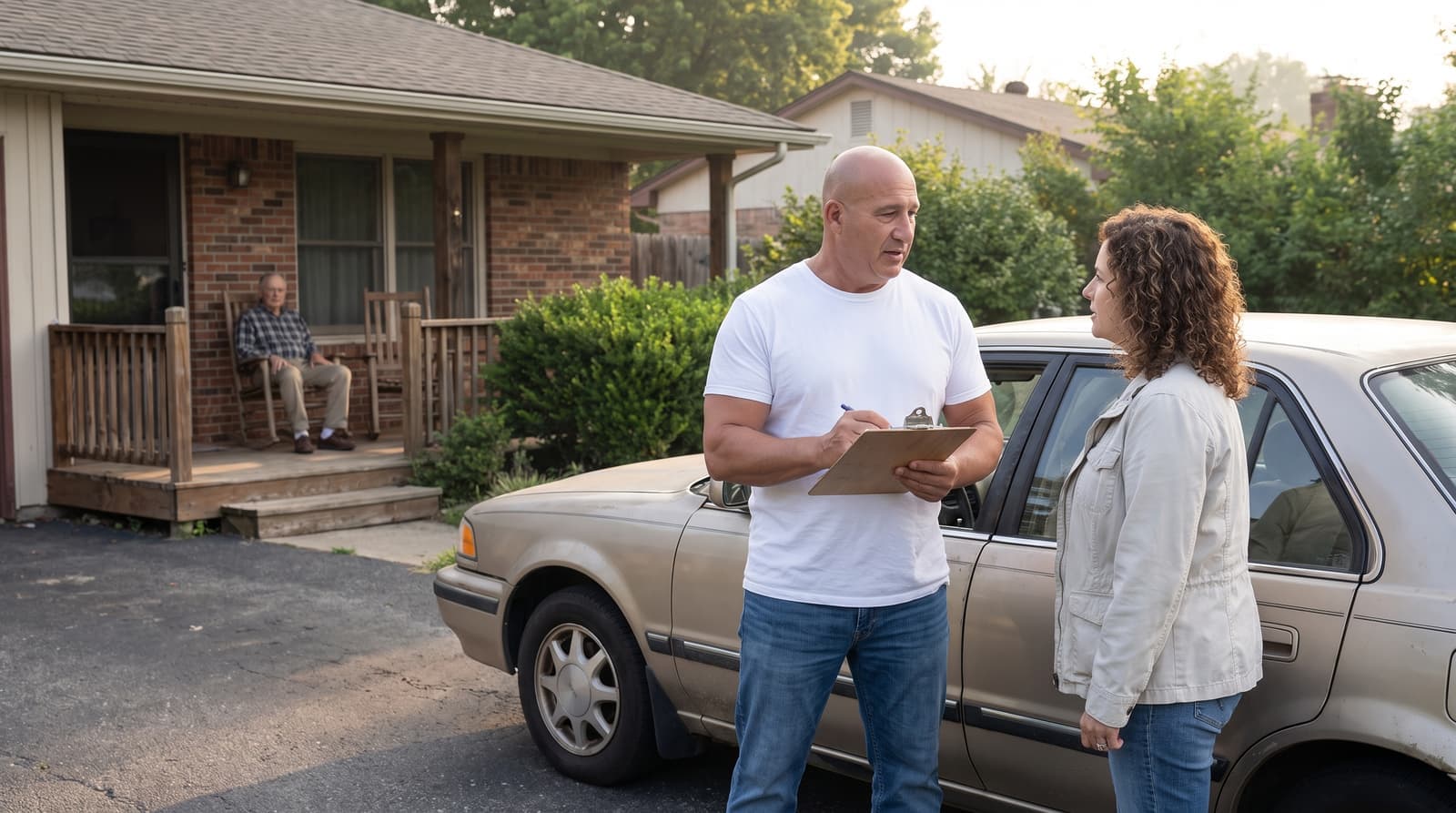
Yes. Using a power of attorney to sell a car is allowed in California while the owner is alive, so you can sell your parent's car for them. The DMV accepts its own one-page form, the REG 260, as well as a restricted or general power of attorney, and the person holding it can sign the release of ownership on the title (DMV VIRP §1.125).
There is one line you can't sign for them: the odometer disclosure. If the car is a 2011 model or newer, your parent (or a co-owner on the title) signs that line personally, in ink. If it's a 2010 or older, federal rules exempt it from odometer disclosure in 2026, and your power of attorney covers every signature on the deal.
Quick answer
- Can I sell it? Yes, while your parent is alive. A power of attorney can release ownership on a title or bill of sale (VIRP §1.125).
- Which form? The DMV's REG 260 (free, one page), a restricted POA, or a general POA. All three are accepted.
- Notary? Not for the REG 260. A general POA under the Probate Code needs a notary or two witnesses.
- VIN? The REG 260 must show the VIN. A general POA doesn't need one.
- Is a copy OK? Yes. A photocopy or fax of the REG 260 or a general POA is acceptable.
- Odometer: a POA can't sign it. Model year 2011 and newer needs your parent's own signature; 2010 and older needs no odometer disclosure at all.
- After your parent dies: the POA ends that day. The car goes through the estate instead.
- Dementia and no POA: a new POA usually isn't possible; the court route is a conservatorship.
Can you sell your parent's car with power of attorney in California?
Yes, and the rule is short. The DMV's registration manual says a power of attorney "may be used to release ownership on a title or bill of sale," and that the DMV accepts its own form, "a restricted POA (limited to a specific type of transaction, such as transfer of ownership) or a general POA" (VIRP §1.125).
A lot of the cars I buy are cars nobody in the house drives anymore, like a second car that sat or a car a daughter left behind when she went to college. A parent who has stopped driving is the same story, with one more layer of paperwork. Which paperwork fits depends on where your parent is right now:
| Your parent's situation | What lets you sell the car | Where to read more |
|---|---|---|
| Living, able to sign, just doesn't drive | Your parent signs the title, or signs a REG 260 naming you | This page |
| Living, signed a durable POA years ago | The durable POA (it survives incapacity, Probate Code §4125) | This page |
| Living, has lost capacity, holds only a REG 260 or other non-durable POA | That authority may have ended (PC §4155). Talk to an elder-law attorney. | The durability section below |
| Living, has lost capacity, never signed a POA | A court-appointed conservator of the estate | California Courts Self-Help |
| Has passed away | The POA ended at death; the car goes through the estate, usually with a REG 5 | Selling an inherited car in California |
| You want to keep the car yourself | A family transfer or gift. Talk to an attorney first; a gift needs express authority (PC §4264). | The "keeping the car" section below |
REG 260 vs. a durable power of attorney: which one does the DMV take?
Both. The REG 260 is the DMV's free, one-page, vehicle-only form, and it must list the car's VIN. A general or durable power of attorney is the document an estate-planning attorney drafts. It covers your parent's finances broadly, so it won't list a VIN, and the DMV accepts it without one (VIRP §1.125).
The difference that matters shows up if your parent's memory is slipping. California calls a power of attorney "durable" only when it contains language like "This power of attorney shall not be affected by subsequent incapacity of the principal" (Probate Code §4124). The REG 260, as printed, has no such sentence. And under Probate Code §4155, the authority under a nondurable power of attorney "is terminated by the incapacity of the principal to contract."
In plain terms, a REG 260 your mother signs today works while she can make her own decisions, and a durable power of attorney keeps working after she can't. If capacity is already in question, talk to an elder-law attorney.
I buy cars from your driveway.
I’m Joe Yavetz, a licensed California dealer. I come to your house, look at the car, write you a check the same day, and handle the DMV paperwork. The number I give you is the number you get. No fine print.
★ 5.0 · 48 Google reviewsSan Fernando Valley, Ventura County & West L.A.
How do you fill out the REG 260?
The form (REV. 3/2007) prints two identical copies on one sheet with a cut line. Your parent fills out and signs one; the other is for your records.
| Field on the REG 260 | What goes there | What to watch |
|---|---|---|
| Identification number | The full 17-character VIN | Copy it from the title, then check it against the plate on the dashboard. One wrong digit and the form doesn't match the car. |
| Year model / Make / License plate | As printed on the title | Match the title exactly. |
| "I, ___" (two lines) | Each owner's name, printed | Two lines exist for two owners, such as Mom and Dad. |
| "appoint: ___" | Your name, printed | This makes you the "attorney in fact." |
| Purpose (preprinted) | "to complete all necessary documents, as needed, to transfer ownership as required by law" | Nothing to write. This is the whole grant. |
| Signature, city, state, ZIP, date, DL/ID | Your parent signs and dates it and adds their driver license or ID number | The form states "ALL SIGNATURES MUST BE IN INK." |
| Certification (preprinted) | Your parent signs under penalty of perjury that the form is true | This is why the details have to be right. |
Your parent doesn't need to go anywhere to sign it, and you can work from a copy: "A photocopy or fax copy of a general POA, including the REG 260 is acceptable" (VIRP §1.125). Copies of the REG 262, a secure transfer form with its own power-of-attorney section, are not. That Section 5 is "provided for convenience and may be used whenever a power of attorney is required" (VIRP §5.075); a REG 260 does the same job (VIRP §1.125).
Does a REG 260 need to be notarized?
No. The REG 260 has no notary block, and the DMV's list of what a power of attorney must contain (a VIN, the agent's name, the principal's signature, and that it travel with the paperwork) doesn't include notarization (VIRP §1.125).
A general power of attorney is different. Under Probate Code §4121, it's legally sufficient only if it's dated, signed, and either acknowledged before a notary or signed by two qualified witnesses.
How do you sign the title as power of attorney?
You sign the owner's release line on the title for your parent. The DMV requires that the power of attorney "accompany applications signed by the attorney-in-fact" (VIRP §1.125), so a copy of the REG 260 or the general POA goes in the envelope with the title.
The DMV's manual shows the pattern with a business agent: "Jim Smith by Uome Loan Company by John Brown as POA." The manual prints only this business example. Following its pattern, a family version would read "Mary Jones by John Jones, POA." Confirm the exact wording with whoever files the transfer before you write on the title, because a mistake on a title means more forms to fix it.
If the title is lost, the replacement form is the REG 227, and a power of attorney can sign it, including the certification about what happened to the original title (VIRP §1.125 makes that one exception). Our REG 227 guide walks through it. For every other line on the title, see how to fill out a California title when selling a car.
Can a POA sign the odometer? The one line your parent still signs
No. "Odometer disclosure requires original signatures by the seller(s) and buyer(s); signatures by power of attorney are not acceptable" (VIRP §5.025).
Whether that line applies depends on the model year, under the federal rule (49 CFR §580.17):
- Model year 2010 and older: exempt from odometer disclosure. In 2026, your power of attorney can sign everything.
- Model year 2011 and newer: disclosure is required until the car is 20 years old (a 2011 stays in the rule through 2030). Your parent or a co-owner signs it in original ink.
The federal odometer power of attorney isn't a workaround, because it covers only lost or lender-held titles and the owner still signs (49 CFR §580.13).
If your parent lives in assisted living or a care facility, the law doesn't change: the REG 260 and, on a 2011 or newer car, the odometer line come from your parent's own hand, and you carry the rest. How and where your parent signs is one of the things I walk you through on the call.
What if both parents are on the title?
Look at the word between their names.
- "OR": either owner can sign alone. If Dad can still sign, you don't need a power of attorney.
- "AND": each owner signs. A power of attorney from the parent who can't sign covers that parent's release (the AND/OR rule is printed on the REG 227; VIRP §1.035).
The odometer rule helps couples: "The original signature of one seller and one buyer is sufficient when multiple owners are shown on the title" (VIRP §5.025). So on a 2011 or newer car titled to Mom AND Dad, the parent who can sign handles the odometer line. More on co-owners is in how to fill out the title.
What if Mom or Dad has dementia and never signed a power of attorney?
Every family's situation is different, so here is what exists, not what you should do. California lets "a natural person having the capacity to contract" sign a power of attorney (Probate Code §4120). A parent who has lost that capacity usually can't sign a new one.
The court-supervised route is a conservatorship of the estate, which a judge grants only when less restrictive options won't work. The California courts list those options: conservatorships and options to help someone with an impairment or disability. An elder-law attorney can tell you which route fits your parent.
What can't a power of attorney do for the car?
| Task | Can the POA holder do it? | Source |
|---|---|---|
| Sign the release of ownership on the title | Yes | VIRP §1.125 |
| Sign a bill of sale (REG 135) | Yes | VIRP §1.125 |
| Sign the REG 227 for a lost title, including the missing-title certification | Yes | VIRP §1.125 |
| Disclose odometer mileage | No (MY 2011+ needs the owner's original signature) | VIRP §1.125, §5.025 |
| Sign a Statement of Facts (REG 256) about what your parent knows | No | VIRP §1.125 |
| Hand the power to someone else | No | VIRP §1.125 |
| Keep using it after your parent dies | No | PC §4152(a)(4) |
What happens to the power of attorney when your parent dies?
It ends. Probate Code §4152(a)(4) terminates an agent's authority on the "death of the principal."
After that, the car goes through the estate, usually with the DMV's REG 5 affidavit. That process has its own page: selling an inherited car in California.
What if you're keeping the car yourself instead of selling it?
That's a different transaction. An agent has a duty to act solely in the principal's interest (PC §4232), so talk to an attorney first; a gift needs express authority (PC §4264). Then see transferring a car title to a family member and gifting a car in California.
How to sell a parent's car with power of attorney, step by step
Here is the order for selling a car on behalf of someone who can't handle it themselves:
- Read the title: names, AND or OR, any lender. Lost title? Start with the REG 227 ($28, VIRP Appendix 1F).
- Check the model year. 2010 or older, the POA signs everything. 2011 or newer, plan for your parent's odometer signature.
- Put the POA in place: the durable POA your parent already has, or a REG 260 naming you, VIN filled in, signed in ink.
- Arrange the odometer signature (2011 and newer). A co-owner on the title can sign instead.
- Sign the release and a bill of sale (REG 135) as agent, and send a copy of the POA with the title.
- Clear any loan. The lender has to be paid before it releases the title; anything owed above the car's value is the seller's to cover (lienholder titles, selling a car you still owe money on).
- File the REG 138 release of liability within 5 days (Vehicle Code §5900). See what to do after selling a car.
What goes in the envelope:
| Document | Who signs | Original or copy? |
|---|---|---|
| Certificate of Title (or REG 227 if lost) | You, as POA, on the release line | Original |
| REG 260 or general POA | Your parent | Copy or fax is fine (VIRP §1.125) |
| Odometer disclosure (MY 2011+ only) | Your parent or a co-owner, plus the buyer | Original ink |
| REG 262, only if one is used: Section 5, signed by your parent | Your parent | Original; copies not accepted |
| Bill of sale (REG 135) | You, as POA | Keep a copy each |
| Lender payoff letter (if there's a loan) | The lender | As the lender issues it |
| REG 138 release of liability | Filed online by the seller's side | Keep the confirmation |
Will a dealer buy the car from you if you hold the power of attorney?
Often, yes. Every one starts with a quick phone call so I can look at the POA and the title before anyone signs. If the deal can be done, I handle the DMV side. If something needs fixing first, I'll tell you on the call, and who the payment is made out to is part of that conversation.
Whoever you sell to, check the license first. It takes two minutes: how to verify a car dealer's license in California.
Frequently asked questions
Can I sell my parent's car if I have power of attorney?
Yes, while your parent is alive. The DMV accepts a REG 260, restricted, or general power of attorney to release ownership (VIRP section 1.125). The exception is the odometer: on a 2011 or newer car, your parent or a co-owner signs that line in ink.
Does a California DMV power of attorney need to be notarized?
The REG 260 does not. It has no notary block, and VIRP section 1.125 does not require one. A general power of attorney under the Probate Code must be notarized or signed by two qualified witnesses (Probate Code section 4121).
Can a POA sign a car title in California?
Yes for the release of ownership, no for the odometer. The agent signs the release line, and the power of attorney goes to the DMV with the title. The odometer needs the owner's original signature (VIRP section 5.025), though model year 2010 and older cars are exempt in 2026.
Does the DMV accept a copy of a power of attorney?
Yes. The DMV accepts a photocopy or fax copy of a general power of attorney, including the REG 260 (VIRP section 1.125). It does not accept copies of the REG 262, which is a secure document. The odometer disclosure must carry an original ink signature.
Does the REG 260 need the VIN?
Yes. A vehicle power of attorney such as the REG 260 must contain the VIN. A general power of attorney is the exception and will not list one (VIRP section 1.125). Copy the full 17-character VIN from the title.
Is a REG 260 a durable power of attorney?
Not as printed. The REG 260 has none of the durability language in Probate Code section 4124, and a nondurable power of attorney ends when the principal loses capacity (section 4155). If memory is declining, ask an elder-law attorney.
My parents are both on the title. Do both have to sign?
Joined by OR, either owner signs alone. Joined by AND, each owner signs, and a power of attorney can cover the parent who can't. For the odometer, one seller's original signature is enough when multiple owners are on the title (VIRP section 5.025).
My parent has dementia and never signed a power of attorney. Can I still sell the car?
Not with a new power of attorney signed now, in most cases. California lets a person with the capacity to contract sign a power of attorney (Probate Code section 4120). The court-supervised route for managing someone's finances is a conservatorship of the estate, which a judge grants only when less restrictive options won't work. The California Courts Self-Help Guide explains the options. This is general information, not legal advice.
Handling a parent's car is usually one item on a long list, and the paperwork is the part I can take off it. CurbSold is me, a licensed dealer who comes to your driveway in West L.A., the San Fernando Valley and Ventura County. Call me first, and we'll go over the power of attorney and the title together before anyone signs. Call or text (818) 325-7535, or read how selling your car from home works.
This article is general information, not legal advice.
Sources
- California DMV, Vehicle Industry Registration Procedures Manual, §1.125 Signature by Power of Attorney (POA) (VC §1652)
- California DMV, Power of Attorney, REG 260 (REV. 3/2007)
- California DMV, Vehicle Industry Registration Procedures Manual, §5.025 Disclosure Requirements; §5.075 Vehicle/Vessel Transfer and Reassignment Form (REG 262); Appendix 1F Fees
- California DMV, Vehicle Industry Registration Procedures Manual, §1.035; Application for Replacement or Transfer of Title, REG 227 (REV. 9/2024)
- Code of Federal Regulations, Title 49, §580.13 and §580.17
- California Probate Code §§4120, 4121, 4124, 4125, 4152, 4155, 4232, 4264
- Judicial Branch of California, Self-Help Guide: "Conservatorships" and "Options to help someone with an impairment or disability"
- California Vehicle Code §5900