
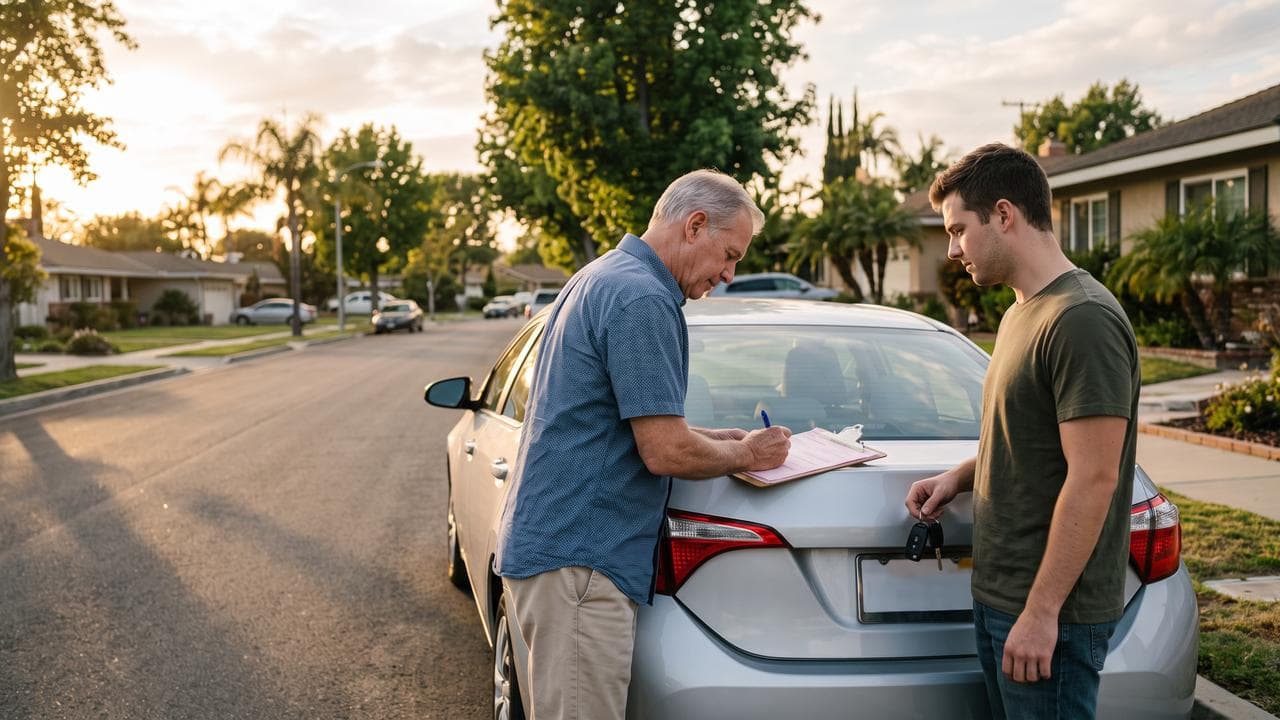
To fill out a California title when selling a car, you sign and date Line 1a on the front of the pink slip, the line marked "Signature of Registered Owner," exactly as your name is printed. If the car is model year 2011 or newer, you also write in the mileage and sign as "Transferor/Seller" in the odometer box, which is on the front too. All of it in blue or black ink. The buyer fills in the back (their name, address, driver license number, purchase date and price) at the same time, in front of you. No notary is required. The mistakes that sink people are small ones: white-out, a signature that doesn't match the printed name on the front, or a blank odometer line, and any one of them can cost you $28 and a few weeks for a duplicate title.
I'm Joe Yavetz, a licensed California dealer for over 30 years, and I've handled the title on more than 50,000 cars. The paperwork is the part of a private sale people fear most, and it's honestly the easiest part once someone walks you through the actual document. So let's walk through the actual document, field by field, plus the handful of extra forms that show up in real sales and the one filing after the sale that protects you from the buyer's parking tickets.
This guide assumes the title is in front of you. If you cannot find it, stop here and file a REG 227 first: the REG 227 guide walks through the $28 replacement and the box that lets you sell before it arrives.
Quick answer:
- Where to sign: Line 1a, "Signature of Registered Owner," on the front of the current title (a co-owner signs 1b). On older title versions, go by the line number: the owner still releases on Line 1.
- What to fill in: your signature (exactly as your name is printed) and the date on Line 1a, then the odometer reading, your signature and your printed name in the odometer box, also on the front. Blue or black ink only.
- The back is the buyer's: their name, address, driver license number, purchase date and price.
- Both parties sign the odometer disclosure. Pencil, white-out, or corrections void it.
- Notary: not required for a standard California title transfer.
- After the sale: file the free Release of Liability (REG 138) at dmv.ca.gov within 5 days.
- Messed-up or lost title: duplicate costs $28 (REG 227); the DMV says titles usually arrive by mail within 15 to 30 days.
Where do you sign a California title when selling?
The California Certificate of Title, the "pink slip," has two sides with two different jobs. The front belongs to you, the current owner: it identifies you, the vehicle, and any lienholder, and it holds the lines where you release the car. The back belongs to the new owner.
Your signature goes on Line 1a, "Signature of Registered Owner," on the front of the current title, right under the statement that your signature releases your interest in the vehicle. Sign it and date it. A second owner signs Line 1b: if the names are joined by "AND," both of you must sign; if they're joined by "OR," either one can. Don't sign anything on the back. That side is the buyer's application for transfer.
Older California titles (the multicolored "rainbow" title or a small pink "Certificate of Ownership") are still valid, and on those the owner also releases on the line numbered 1. Go by the line number, not by which side you're on. If you want the plain-English tour of the document itself before the line-by-line, start with what the California pink slip actually is.
What goes in each field of the seller's section?
Here's a simplified map of both sides of the current California title, based on the DMV's own sample. The numbered fields are yours, and the numbers match the walkthrough below.
Vehicle and registered owner(s)
VIN, year, make, plate, and the owner names, printed by the DMV. Nothing to fill in here.
Lines 1a / 1b: release by registered owner(s)
Odometer disclosure
The buyer signs and prints their name beside yours, as Transferee/Buyer.
Lienholder release
Only if a lender is listed. The lender signs and dates here to release its interest.
Application for Transfer by New Owner (lines 3a–9b)
The buyer's full legal name, address, signature, driver license number, purchase date, and purchase price (or "gift"). Completed at the sale, in front of you, never left blank.
New lienholder (lines 11–13)
Only if the buyer is financing the car.
Title reassignments by licensed California dealers
Dealers only. Leave it blank.
1. Signature of registered owner (Line 1a)
Sign exactly as your name is printed in the registered owner box on the front of the title. If it reads "MICHAEL A. RIVERA," sign Michael A. Rivera, not Mike Rivera. The DMV compares the signature against the printed owner name, and a mismatch triggers a request for a REG 256 Statement of Facts explaining the difference. A co-owner signs Line 1b the same way.
2. Date
The actual day the car changes hands, in MM/DD/YYYY format. Don't leave it blank and don't backdate it; this date drives the buyer's 10-day window to register the transfer and your own 5-day window to file the release of liability.
3. Odometer reading
The odometer box sits on the front, just below Line 1b. Enter the exact mileage at the time of sale, in whole miles. For any vehicle model year 2011 or newer, federal rules require this disclosure until the car is 20 model years old (a 2021 rule change that expanded the old 10-year window). Vehicles from 2010 and earlier are past their window and exempt, though I'd fill it in anyway to head off questions.
Three things void an odometer disclosure instantly: pencil, white-out, and any visible alteration. If the mileage isn't accurate because the odometer was broken or replaced, check the "Not Actual Mileage" box and be ready to explain on a REG 262. And if you botch the entry, do not try to fix it on the title; the DMV requires a fresh disclosure on a REG 262 plus a REG 256 explaining what happened.
4. Your odometer signature and printed name
Sign as "Transferor/Seller," date it, and print your name in clear block letters, again matching the title. The buyer signs and prints their name in the "Transferee/Buyer" space next to yours. Both signatures, every time.
Ink rules for every field: blue or black pen. No pencil, no red ink, no correction fluid anywhere on the document. An altered title is an invalid title.
I buy cars from your driveway.
I’m Joe Yavetz, a licensed California dealer. I come to your house, look at the car, write you a check the same day, and handle the DMV paperwork. The number I give you is the number you get. No fine print. I bring the title paperwork and fill it out with you.
★ 5.0 · 61 Google reviewsSan Fernando Valley, Ventura County & West L.A.
What does the buyer fill out?
The back of the title is the buyer's "Application for Transfer by New Owner": their full legal name (as it appears on their driver's license), address, signature, driver license number, purchase date, and purchase price. They also sign their half of the odometer disclosure on the front. This happens at the sale, in front of you.
The price should be what the buyer actually paid. The DMV uses it to calculate the buyer's use tax, and it cross-checks against the buyer's paperwork, so writing $2,000 on a $9,000 sale is fraud, not a favor. If the car is a genuine gift, the price box says to state that instead, and the transfer runs with a REG 256 declaring the gift; qualifying family transfers skip use tax entirely, and I covered when gifting beats a $1 sale in gifting a car in California vs. selling for $1.
Never hand over a title with the buyer's section blank. That's called an open title, it's illegal in California, and it leaves the car registered to you while a stranger drives it. If a buyer says they'll "fill it in later," that's a no from you, politely.
What if there are two names on the title?
Look at how the names are joined on the front:
- "AND" means every listed owner must sign, one on Line 1a and one on Line 1b. No exceptions; an absent co-owner needs a power of attorney (REG 260).
- "OR" means any one owner's signature is enough to sell the car.
Divorce and inherited-car situations add their own layer here; I've written separate guides on selling a car during a California divorce and transferring a title after the owner has died, because signing for a deceased owner is its own DMV process (REG 5, not a forged signature).
What if there's a lienholder on the title?
If a bank or credit union appears as the legal owner on the front, the car can't transfer until that lien is released: either the lienholder signs the release on the front of the title itself, or provides a separate lien release (REG 166). On a car two model years old or newer, only the lienholder's signature on the title itself is accepted. A title with an open lien gets rejected, period.
If you still owe money on the car, the practical path is usually different from chasing your lender for paperwork: a licensed dealer can pay the lender directly at purchase and hand you the difference. That's a service I run every week; the details are on selling a car with a lien.
Which extra DMV forms might you need?
| Form | What it is | When you need it |
|---|---|---|
| REG 138 | Notice of Transfer and Release of Liability | Every sale. Free, online, within 5 days. See the next section. |
| REG 262 | Vehicle/Vessel Transfer and Reassignment Form | Odometer redo, "Not Actual Mileage" cases, or titles with no odometer space. Original ink only; the DMV rejects photocopies. |
| REG 256 | Statement of Facts | Gifts, family transfers, signature mismatches, and any "here's what happened" explanation. |
| REG 135 | Bill of Sale | Recommended for every sale. Any document identifying the vehicle and terms works, even if it isn't the DMV form. |
| REG 101 | Statement of Error or Erasure | A crossed-out or wrong-section signature on the title, signed by whoever made the error. |
| REG 227 | Application for Replacement or Transfer of Title | Lost, stolen, or ruined title. $28 fee. |
What do you do after the title is signed?
The title going to the buyer isn't the finish line. California gives you 5 days to file the Notice of Transfer and Release of Liability (REG 138) at dmv.ca.gov. It's free and takes about five minutes. Until it's filed, the car is still registered to you, which means the buyer's parking tickets, toll violations, and worse can arrive with your name on them.
When I buy a car, this is the one piece of paperwork the seller still owns, so I don't leave it to chance: I show the seller how to file the release of liability on the spot, on their phone, before I drive away. Ninety seconds, done, protected. If you're selling privately, do it the same day, and the full post-sale checklist (plates, insurance, smog paperwork) is in what to do after selling a car in California.
What if the title is lost or ruined?
You apply for a duplicate with the REG 227: $28, online at dmv.ca.gov if there's no lien on record, and the DMV says titles usually arrive by mail within 15 to 30 days. An address mismatch forces the application in person at a field office, and a second replacement within 90 days of the first requires a CHP vehicle verification, so get the address right the first time.
You can also sell without waiting for the duplicate: the REG 227 doubles as a transfer document when a dealer prepares it correctly at purchase. I do that regularly; call before the appointment so I can have the paperwork ready when I show up. The full picture is in can you sell a car without a title in California.
Can you do any of this electronically in 2026?
Not the title itself. California's Electronic Lien and Title (ELT) program is a back-office system between lenders and the DMV; once a loan is paid off, the owner still gets a paper title in the mail. Unlike Arizona or Florida, California has no owner-facing digital title transfer, so a 2026 private sale still means two people signing a physical pink slip at a kitchen table. The things you can do online: file the REG 138 release of liability and request a duplicate title when there's no lien.
The version where I handle the paperwork instead
Everything above is the do-it-yourself route, and it works fine when the title is clean and both parties are careful. But if reading about REG 262 ink rules is not how you want to spend a Saturday, there's a simpler version: I come to your driveway anywhere in the San Fernando Valley, Ventura County, or West L.A., verify the car, and make a firm offer on the spot. With a normal title, the whole transfer is genuinely easy: you sign off, we exchange the title for funds, and the deal is done. I bring every form the sale needs, walk you through the release of liability filing before I leave, and if you're holding a CarMax number, I'm guaranteed to match or beat it.
Call or text me at (818) 325-7535. Ten minutes at your curb usually beats an afternoon at the DMV. And if you want the bigger picture of every selling option in the state, start with the pillar guide: how to sell a car in California.
Frequently Asked Questions
Where do you sign a California title when selling a car?
On Line 1a, "Signature of Registered Owner," which is on the front of the current California title (a co-owner signs 1b). For a 2011 or newer car, also sign the odometer disclosure, which is on the front too. The buyer fills in the back. Older title versions also use Line 1 for the owner's release, so go by the line number.
Does a California car title need to be notarized?
No. California does not require notarization for a standard private-party title transfer; buyer and seller signatures in ink are enough. The one common exception is a lienholder's release on a REG 227 replacement-title application, where Section 5 must be notarized whenever a legal owner is on record.
Do both the buyer and seller sign the odometer disclosure?
Yes. Federal and California rules require the odometer disclosure to show the exact mileage at the time of sale and to be signed by both the seller and the buyer. An altered, whited-out, or pencil entry voids the disclosure, and the DMV will require a fresh one on a REG 262 form plus a REG 256 Statement of Facts explaining the discrepancy.
What happens if you make a mistake on a car title in California?
Do not use white-out or scribble it out; any alteration can void the title. For a crossed-out or wrong-section signature, the DMV accepts a Statement of Error or Erasure (REG 101) signed by the person who made the error. If the odometer section is the problem, redo the disclosure on a REG 262 with a REG 256. If the title itself is ruined, apply for a $28 duplicate with a REG 227.
What price do you write on the title if the car is a gift?
The buyer writes the actual purchase price in the price box on the back of the title. For a genuine gift, write "Gift" there instead and declare the gift on a REG 256 Statement of Facts; a genuine gift owes no use tax, whoever receives it. Writing a fake low price on a sale to dodge tax is illegal; the DMV cross-checks with the buyer's paperwork.
Is a bill of sale required to sell a car in California?
The DMV expects a bill of sale or an equivalent document identifying the vehicle and the sale terms. The official form is the REG 135, but any bill of sale that identifies the vehicle is acceptable even if it is not the DMV's form. It protects both sides if the purchase price or sale date is ever questioned. The form, line by line, is in the California bill of sale (REG 135).
What do you do after the title is signed over in California?
File the Notice of Transfer and Release of Liability (REG 138) with the DMV within 5 days of the sale. It is free and takes about five minutes online at dmv.ca.gov. Until it is filed, parking tickets, tolls, and even accident liability from the buyer's driving can land on you, because the car is still registered in your name.
Can you fill out a California title transfer online?
Not the title itself. As of 2026, California is still a paper-title state for private sales: the buyer and seller sign a physical pink slip. The DMV's electronic title program (ELT) only covers lenders holding liens, not owners. What you can do online is file the seller's release of liability (REG 138) and, if there is no lien, request a duplicate title.
En español: Cómo Llenar el Título de un Carro en California para Venderlo.