
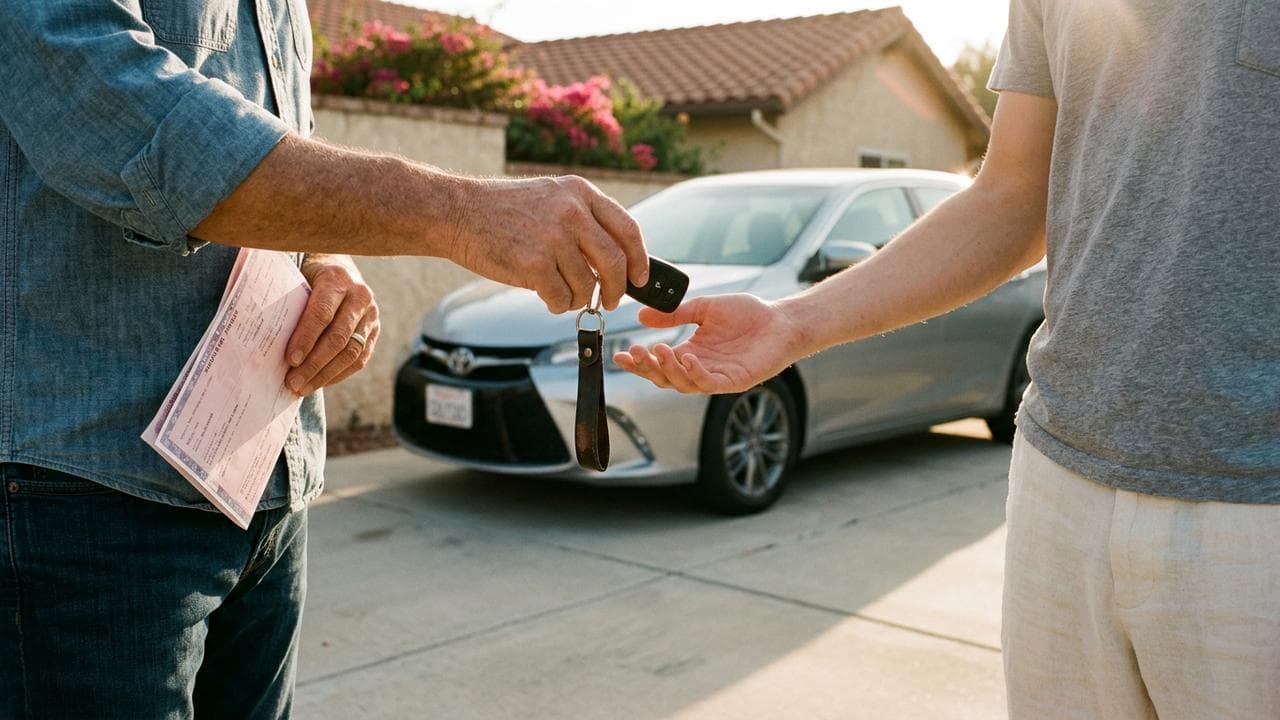
Transferring a car title to a family member in California requires three things: the signed pink slip, a REG 256 form declaring the family relationship, and a DMV filing, in person or by mail. If you do it as a gift, you pay $15 and skip both the smog check and the use tax. A sale to a parent, child, spouse, grandparent or grandchild is use-tax exempt too. Sell to anyone else, adult siblings included, and the buyer owes 7.25% to 11.75% of the purchase price in tax, depending on where the car is registered.
I handle title transfers constantly as a licensed dealer. The process itself is simple. What trips people up is the paperwork details: a missing signature, forgetting to write "GIFT" on the title, or not filing the liability release. Those mistakes turn a 20-minute DMV visit into weeks of follow-up calls.
Here is the complete walkthrough, including the actual costs, the forms you need, and the mistakes I see people make over and over.
Quick answer:
- Forms needed: Signed title (pink slip) + REG 256 (Statement of Facts) + REG 138 (Notice of Transfer and Release of Liability)
- Cost for a gift: $15 title transfer fee. No use tax. No smog (usually).
- Cost for a sale: $15 fee. No use tax to a qualifying family member; to anyone else, adult siblings included, use tax at 7.25%–11.75% of the purchase price
- Who qualifies as family: Spouse, domestic partner, parent, child, grandparent, grandchild. Siblings only when both are minors — adult siblings use the gift exemption instead
- Deadline: Submit paperwork within 10 days. Pay fees within 30 days.
- Timeline: New title arrives by mail in 15–60 days
DMV Family Transfer Forms: What You Need in California
Three forms handle 95% of a DMV family transfer in California: the signed pink slip, REG 256, and REG 138. Here is what each one does and where you get it.
1. California Certificate of Title (pink slip)
This is the actual title document. The current owner signs Line 1 on the front to release ownership. The new owner fills in their name, address, and signature on the back. Write "GIFT" or "$0" in the purchase price field if no money is changing hands. This is critical for the tax exemption. For exactly where each signature and field goes on the pink slip, and the ink mistakes that get titles rejected, see our field-by-field California title guide.
If the title is lost, you need a REG 227 (Application for Replacement or Transfer of Title) to get a duplicate before you can transfer. That adds time. If the car is older and the title has no odometer space, you will also need a REG 262 for the odometer disclosure.
2. REG 256 (Statement of Facts)
This is the form most people either skip or fill out wrong. It has two sections that matter:
- Section A declares the family relationship and claims the use tax exemption. You must state the specific relationship (e.g., "parent to child") and the vehicle's current market value.
- Section B claims the smog certification exemption for family transfers.
You need both sections completed. Missing Section A means you pay use tax. Missing Section B means you need a smog check. Download it from dmv.ca.gov or pick one up at the DMV office.
3. REG 138 (Notice of Transfer and Release of Liability)
The seller files this within 5 days of the transfer. It releases you from liability for anything that happens with the vehicle after you hand it over. Parking tickets, accidents, toll violations. If you skip this and your nephew gets a red light camera ticket three weeks later, that is coming to you.
You can file this online at dmv.ca.gov. It takes two minutes. Do it the same day you sign the title over.
Forms you might also need
| Form | When you need it |
|---|---|
| REG 227 | Title is lost, stolen, or damaged |
| REG 262 | Title has no odometer space, or title is noncomplying |
| REG 166 | Vehicle has a lien that has been paid off (lienholder signs this) |
How Much Does It Cost to Transfer a Car Title to a Family Member?
This is where the gift vs. sale distinction matters. The difference is real money.
Gift transfer (no money changes hands)
| Fee | Amount |
|---|---|
| Title transfer fee | $15 |
| Use tax | $0 (exempt with REG 256) |
| Smog inspection | $0 (exempt with REG 256, usually) |
| Total | $15 |
Sale to a relative who doesn't qualify (adult sibling, cousin, in-law)
| Fee | Amount (example: $20,000 car) |
|---|---|
| Title transfer fee | $15 |
| Use tax (most of Ventura County, 7.25%; up to 9.25% in Oxnard and Santa Paula) | $1,450 ($1,850 in Oxnard or Santa Paula) |
| Use tax (City of Los Angeles, 10.25%) | $2,050 |
| Smog inspection | $0 for an adult sibling (smog-exempt); a cousin or in-law needs a smog certificate (~$50) |
| Total | $1,465–$2,065 (+ smog if needed) |
The math is straightforward. Gift or sale, a transfer to your kid who is heading to college is use-tax exempt with a REG 256. If your adult brother is buying it from you at a family discount, use tax applies on whatever amount you write down.
The "Should I Gift or Sell?" Question
People ask me this all the time. Here is how I think about it:
Gift it if: The car is going to your child, parent, or spouse and no money is changing hands. Write GIFT, file REG 256, pay $15, done.
Sell it privately if: You need the money and want to keep it in the family. To a parent, child, spouse, grandparent or grandchild, a sale is still use-tax exempt; to an adult sibling or other relative, use tax applies (7.25%–11.75%). On a $15,000 car in the City of Los Angeles, that is $1,538 your family member pays to the state.
Sell it to a dealer if: You would rather have cash and let your family member buy what they actually want. I can give you a firm offer and a check the same day. Sometimes the math works better: sell the car for $18,000, give your kid $15,000, and everyone comes out ahead of a discounted family sale where the state takes a cut.
I buy cars from your driveway.
I’m Joe Yavetz, a licensed California dealer. I come to your house, look at the car, write you a check the same day, and handle the DMV paperwork. The number I give you is the number you get. No fine print. If selling makes more sense than transferring it, I’ll tell you what I’d pay.
★ 5.0 · 48 Google reviewsSan Fernando Valley, Ventura County & West L.A.
Do I Need a Smog Check for a Family Title Transfer?
Usually no. Family transfers between qualifying members are exempt from smog certification when you file REG 256 Section B. But there are two exceptions that catch people:
Exception 1: Biennial smog is already due. If the vehicle's registration renewal requires a smog check, the family exemption does not override it. The vehicle still needs to pass smog for the renewal, regardless of who owns it.
Exception 2: The "bought for you" rule. If a family member purchased the vehicle specifically for you, without first titling it in their own name, smog IS required even for a family transfer. This comes up when a parent buys a car at auction or from a private seller intending to immediately give it to their child.
Vehicles exempt from smog regardless of transfer type:
- Electric vehicles (all years)
- Gasoline vehicles 1975 or older
- Diesel vehicles 1997 or older (or over 14,000 lbs)
- Motorcycles
- Trailers
Who Counts as "Family" for the California Title Transfer Exemption?
Here is the part almost every guide gets wrong: the use tax exemption and the smog exemption use two different family lists, written into two different laws. They overlap almost entirely, and they part ways on exactly one relationship: siblings.
Use tax exemption (Revenue & Taxation Code §6285, the one on REG 256 Section A):
- Spouse
- Registered domestic partner
- Parent (natural or legally adopted)
- Child (natural or legally adopted)
- Grandparent
- Grandchild
- Sibling — only when both siblings are minors related by blood or adoption
Smog exemption (Vehicle Code §4000.1(d), REG 256 Section B) — same list, except:
- Siblings qualify at any age. There is no minor requirement in the smog statute.
So an adult transferring a car to an adult sibling does skip the smog certificate, but does not get the family use tax exemption. If money changes hands, the buyer owes use tax — and if it is a genuine gift, the separate gift exemption covers the tax instead. Two boxes on the same form, two different answers, and it catches people constantly.
Who does NOT qualify: Cousins, aunts, uncles, nieces, nephews, in-laws, stepchildren (unless legally adopted), and ex-spouses once the divorce is final (the marriage has to be current at the time of transfer). If you are transferring to someone outside these lists, the buyer pays use tax on a sale (a genuine gift is still use-tax exempt with a REG 256) and you need a smog check. If the transfer is part of a divorce, whether you are retitling a co-owned car or selling it to split the proceeds, see how to sell a car during a divorce in California.
Two more fine-print rules worth knowing. The exemption comes from California Revenue & Taxation Code §6285, and it only applies when the selling family member is not in the business of selling vehicles. If your dad happens to be a licensed car dealer, the family exemption disappears. And plan on documentation: the DMV can ask the new owner to prove the relationship (birth certificate, marriage license) when registering.
The sibling question, answered straight: adult siblings do not qualify for the family transfer exemption. Under R&TC §6285 and the DMV's own registration manual, siblings are covered only when both the person giving the car and the person receiving it are minors related by blood or adoption. That is a narrow rule, and it catches most people by surprise, because brothers and sisters feel like immediate family in every other context.
If you are an adult transferring a car to an adult sibling, use the gift exemption instead. It works regardless of relationship, and it is the path that actually holds up: write GIFT on the title, take no money, no trade, and no services in return, and file REG 256. If your sibling pays you anything at all, it is a sale, and the buyer owes use tax of 7.25% to 11.75% of the price.
One relationship that doesn't fit this form at all: a parent who has died. There's no family transfer to claim, because the person releasing the title can't sign it. That transfer runs on a REG 5 instead, and my guide to transferring a car title when the owner is deceased covers the 40-day rule and the estate threshold that actually applies.
CA DMV family transfer vs. gift: which one applies?
These are two different exemption boxes on the same REG 256 form, and they answer two different questions.
The family transfer exemption is about the relationship. If the recipient is on the qualifying list above, the transfer is exempt from use tax even when money changes hands, and it usually skips smog under Section B. A parent can sell a car to their daughter for $5,000 and she pays no use tax. Adult siblings are not on the use tax list, so this route is closed to them — though they do still get the smog exemption, which runs on a separate statute.
The gift exemption is about the money. If nothing of value changes hands (no payment, no trade, no services), the transfer is exempt from use tax no matter who the recipient is, family or not. The smog exemption still depends on the family list, so a gift to a friend usually needs a smog certificate.
So the quick decision:
- On the family list, money involved: family transfer exemption. Fill in the real price, complete REG 256, no use tax.
- Adult sibling, money involved: a taxable sale. Adult siblings are not on the use tax list, so the buyer owes use tax on the price — but they are on the smog list, so no smog certificate is needed either way. If no money is changing hands, gift it instead.
- On the family list, no money: either box works. Write GIFT on the title and complete REG 256 accurately.
- Not on the list, no money: gift exemption. See the full guide to gifting a car in California, including why a $1 sale is the wrong move.
- Not on the list, money involved: a standard sale. The buyer pays use tax on the price.
What Are the Deadlines I Need to Know?
| Deadline | What happens |
|---|---|
| 5 days | Seller must file Notice of Transfer and Release of Liability (REG 138) |
| 10 days | Both parties must submit transfer paperwork to DMV |
| 30 days | Transfer fee must be paid to avoid late penalty |
| 90 days | Smog certificate must be dated within 90 days of transfer (if required) |
| 15–60 days | New title arrives by mail |
The 5-day REG 138 deadline is the one people forget. Everything else has some buffer. The release of liability protects you from the moment you hand over the keys. File it online the same day. If you want the statute behind it and the exact list of citations it cancels, that is in our California release of liability guide.
What If the Car Has a Lien on It?
You cannot transfer a title with an active lien. The loan must be paid off first.
Here is the process:
- Pay off the remaining balance with your lender
- Get a lien release (REG 166, signed by the lienholder)
- Wait for the title if the lender held it electronically (ELT program). They will either mail the title to you or release it to the DMV.
- Then proceed with the normal family transfer process
For vehicles 2 model years old or newer with a lien, the lienholder must request a replacement title directly. A lien release on REG 166 alone is not sufficient for newer vehicles.
If you owe more than the car is worth, you are upside down on the loan and cannot transfer the title until the balance is cleared. I wrote a separate guide on what to do when you have negative equity.
The 7 Mistakes That Cost People Time and Money
I see these constantly. Every single one is avoidable.
- Not writing "GIFT" on the title. If the purchase price field is blank or has a dollar amount, the DMV assesses use tax. Write GIFT clearly in the price field.
- Skipping the REG 256. Without it, you lose both the tax exemption and the smog exemption. It is one page. Fill it out.
- Forgetting the Notice of Transfer (REG 138). The seller remains legally liable for the vehicle until this is filed. Tickets, towing fees, even accident liability can follow you. File it online the same day you sign the title.
- Missing the 10-day paperwork deadline. Late fees add up. The DMV is not flexible on this.
- Incomplete or mismatched signatures. Both parties must sign. The name on the title must match exactly. If the title says "Michael" and the seller signs "Mike," the DMV will reject it.
- Using pencil or making corrections on the title. The DMV rejects altered documents. If you make a mistake, you may need a REG 101 (Correction Form) or a new duplicate title. Use black ink, take your time.
- Not checking for liens first. Before you start any of this, verify the title is clear. If there is a lien, the entire process stops until the loan is paid off and the lienholder releases the title.
What Happens After the Transfer?
The paperwork is done. Here is what needs to happen next:
Insurance: The new owner must have California minimum liability insurance (30/60/15) before driving the vehicle. Get a policy in place before the DMV visit, or at minimum before the keys change hands.
Registration: The vehicle's existing registration stays valid until its next renewal date. The new owner will receive a registration renewal notice at their address once the DMV processes the transfer.
Keep copies: Make copies of everything before you hand it to the DMV. The signed title, the REG 256, the REG 138 confirmation. If something gets lost in processing, you will need proof of what was submitted.
Thinking About Selling Instead?
Not every family transfer makes sense. Sometimes the car is worth more sold than gifted, especially if you need the cash and your family member would rather pick their own vehicle. If the car is a parent's and they have stopped driving, selling a parent's car with power of attorney covers what you can sign for them.
I buy cars across the San Fernando Valley and Ventura County. I come to your driveway, show you a firm offer backed by real market data, and write you a check the same day. No trip to the DMV, no paperwork on your end.
If you are weighing your options, call or text me at (818) 325-7535. I will tell you what the car is worth and you can decide whether selling, gifting, or trading in makes the most sense for your situation. For the full California selling process, see my complete guide to selling a car in California. If the title is already lost, read my guide on selling a car without a title in California. If you inherited the vehicle, my guide on the REG 5 process for a deceased owner covers probate and REG 5. And if the car has mechanical issues you would rather not pass along, see my guide on selling a car as-is in California.
Frequently Asked Questions
How much does it cost to transfer a car title to a family member in California?
The base title transfer fee is $15. Transfers between qualifying family members (parent, child, grandparent, grandchild, spouse, or domestic partner) are exempt from use tax even when money changes hands, once you file REG 256. Outside that list, and for sales between adult siblings, use tax is 7.25% to 11.75% of the purchase price depending on where the car is registered. On a $20,000 car in Thousand Oaks or Simi Valley (7.25%), that is $1,450 in tax; in Oxnard (9.25%), $1,850.
Do I need a smog check to transfer a car title to a family member?
Usually no. Transfers between qualifying family members are exempt from smog certification when you file REG 256 Section B. Two exceptions: if the vehicle's biennial smog is already due at registration renewal, or if a family member bought the vehicle for you without titling it in their name first.
What forms do I need for a family title transfer in California?
You need the signed California Certificate of Title (pink slip) with both parties' signatures, REG 256 (Statement of Facts) to claim tax and smog exemptions, and REG 138 (Notice of Transfer and Release of Liability) filed by the seller within 5 days. If the title is lost, you also need REG 227 for a duplicate.
Can I gift a car to my son or daughter without paying taxes in California?
Yes. Write GIFT or $0 in the purchase price field on the title, complete REG 256 Section A declaring the family relationship, and the transfer is exempt from California use tax. You still pay the $15 title transfer fee.
Can I transfer a car title to my brother or sister in California?
You can transfer the title, but adult siblings do not qualify for California's family transfer exemption. Under R&TC §6285 and the DMV's registration manual, siblings are covered only when both are minors related by blood or adoption. For adult siblings, the path that works is the gift exemption, which applies regardless of relationship: write GIFT on the title, accept no money, trade, or services, and file REG 256. If your sibling pays you anything, it is a sale, and the buyer owes use tax of 7.25% to 11.75% of the price. The smog exemption is separate and more generous: Vehicle Code §4000.1(d) covers siblings at any age, so you skip the smog certificate regardless.
How long does a family title transfer take in California?
You have 10 days to submit paperwork to the DMV after the transfer date. The seller must file the Notice of Transfer and Release of Liability within 5 days. Transfer fees are due within 30 days to avoid penalties. The new title typically arrives by mail in 15 to 30 days, sometimes up to 60.
Can I transfer a car title with a lien on it?
Not without the lienholder's approval. You must pay off the loan first and get a lien release (REG 166). For vehicles in the Electronic Lien and Title program, the lienholder holds the title electronically and releases it once the loan is satisfied.
Do I need insurance before transferring a title in California?
The new owner must have liability insurance before driving the vehicle. California requires minimum coverage of 30/60/15 ($30,000 per person and $60,000 per accident for bodily injury, $15,000 for property damage) — raised from the old 15/30/5 limits by SB 1107, effective January 1, 2025. Get insurance in place before the DMV visit.
What is the difference between gifting and selling a car to a family member in California?
For qualifying family (parent, child, grandparent, grandchild, spouse, or domestic partner), there is no tax difference: both a gift and a sale are exempt from California use tax once you file REG 256. The distinction matters outside that list and for adult siblings, where a gift is exempt but a sale triggers use tax of 7.25% to 11.75% of the price. On a $20,000 car, that is $1,450 to $2,350. If the recipient would rather have money than the vehicle, selling the car to a dealer and gifting the cash is often the simpler move.
Can I do a title transfer online in California?
Not the whole transfer. Submit the signed title, REG 256 and transfer fee at a DMV office or by mail to DMV, PO Box 942869, Sacramento, CA 94269. The seller's Notice of Transfer and Release of Liability (REG 138) can be filed online and is due within 5 days.
En español: Cómo transferir el título de un carro a un familiar en California.