
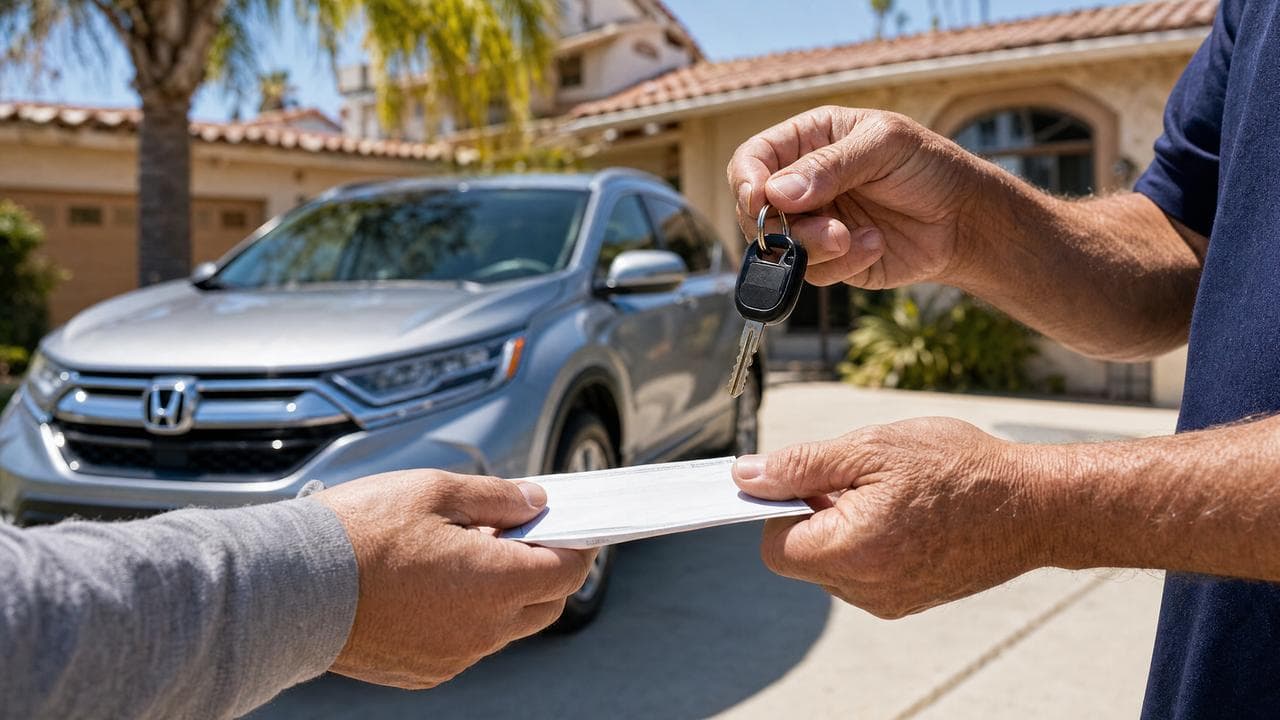
Yes. You can sell your car to a dealer without buying another car, leasing one, or signing up for anything else. I do it every day. The reason most people ask this question is that walking into a franchise dealership without trade-in intent feels like you wandered into the wrong place, because in their business model you did. Independent buyers like CurbSold exist for exactly this transaction. You sell, I write the check, and that's the end of it.
This is the supporting guide for our paid landing page on selling to a dealer. If you already know you want to do this and you're in the San Fernando Valley or Ventura County, that page has the call button and the form. This article is for everyone still figuring out whether a sale-only deal is even possible (it is) and what the appointment actually looks like (short).
Quick answer:
- Yes, you can sell without buying. Any licensed dealer can purchase your car outright. No purchase required, no strings.
- The dealers who like this work: Independent buyers and mobile dealers. CarMax. Carvana (sort of, if their offer holds). Most franchise dealerships will do it but make it feel inconvenient.
- What happens at the appointment: VIN scan, photos, valuation tool, offer on the screen, check written. About 20-30 minutes.
- What to bring: Title, registration, all keys, driver's license. Payoff info if you still owe money on the car.
- Typical timeline: Same day if you call before noon. Often same hour for local appointments.
Why does this question even need to be asked?
It needs to be asked because the entire dealership industry was built around the trade-in. The new-car sale is where the money is. The trade-in is the lever they use to make the new-car sale feel like a deal. Your old car gets folded into a single negotiation alongside the new car's price, the financing rate, the warranty, and the dealer add-ons. By the time the paperwork hits, almost nobody knows what they actually got for the trade.
So when you walk in and say "I just want to sell this car," you're asking the dealership to do the least profitable version of their job. Some will do it. Some will pretend they don't do it. Most will quote you a number that's a few thousand dollars below what they'd give as a trade-in, hoping you change your mind and look at the new inventory while you're there.
I'm not a franchise dealer. CurbSold is a licensed California dealer that only buys cars. There is no showroom. There's no F&I office. There's no salesperson with a quota. I drive to your house, I look at the car, I run the numbers, and if you say yes I write you a check. If you say no, I leave. That's the whole business.
How is a sale-only transaction different from a trade-in?
A trade-in is bundled. The dealer is solving for total deal profit, which means they can move the trade-in number up or down to make the new-car sale work. A sale-only transaction is naked. The price has to stand on its own. It can't be propped up by margin from somewhere else.
That sounds like it would mean a sale-only price is lower. In practice, with a dedicated buyer, it's usually higher than the trade-in number you'd get at the same dealership, and within a few percent of a private sale, for one specific reason: the buyer's margin is small and visible. There's no place to hide.
Here's how the four common ways to sell a car compare. I've owned and operated in this market for over 30 years and these numbers reflect what I actually see in the San Fernando Valley:
| Method | Time to close | Payment | Price vs. private sale | Hassle |
|---|---|---|---|---|
| Sell to CurbSold (dealer at your door) | 20-30 minutes | Same-day check | Under a patient private sale, but guaranteed to match or beat CarMax | None, I come to you |
| CarMax | 1-2 hours plus drive | Check, same visit | Under a patient private sale | Medium, must drive there |
| Carvana | 30 min online + 1-2 weeks to pickup | ACH after pickup | Under a patient private sale, and can be adjusted down at pickup | Low if offer holds |
| Trade-in at a franchise | 2-4 hours, attached to a purchase | Applied to new car | Under a patient private sale, and buried inside the new-car numbers | High; you're also buying a car |
| Private sale (Marketplace, Craigslist) | 2-4 weeks | Cash or cashier's check (risky) | Highest | Highest; strangers, no-shows, scammers |
The honest part nobody tells you: a dealer almost never pays the most. Private sale, done patiently with a clean car, does. The reason people sell to dealers anyway is that the time, the strangers, the lowball texts, and the test-drive logistics aren't worth the spread. A sale-only deal at the door splits the difference: better than CarMax, faster than private, no obligation.
I buy cars from your driveway.
I’m Joe Yavetz, a licensed California dealer. I come to your house, look at the car, write you a check the same day, and handle the DMV paperwork. The number I give you is the number you get. No fine print.
★ 5.0 · 48 Google reviewsSan Fernando Valley, Ventura County & West L.A.
What actually happens at the appointment?
I'll walk through a real one. A guy in Sherman Oaks called last week about a 2019 Toyota Highlander. He wasn't trading in. He'd already bought his new car (a Tesla) and the Highlander was sitting in the driveway taking up the second spot. He'd called CarMax, gotten a number on the phone, but didn't want to spend half a day driving to Duarte and waiting around.
I drove out the next morning. Here's what the appointment looked like:
- Walk-around and VIN scan (3 minutes). I looked at the car, opened the hood, checked tire wear, started the engine, scanned the VIN with my phone.
- Photos (4 minutes). Eight or nine angles, plus the odometer and the title.
- Valuation tool (5 minutes). I use the MaxOffer app and show you the price on the screen, the same price the big dealers pay. He watched while it loaded. The number came in at $26,800. CarMax had told him $26,400 on the phone the day before. I matched the higher of the two and added $150 because I had a buyer for that exact Highlander already lined up.
- Title and paperwork (8 minutes). Bill of sale, DMV release of liability, odometer disclosure. I had everything pre-filled on my tablet.
- Check and keys (1 minute). I wrote the check on the spot. He handed me both keys. I drove the Highlander away.
Total: about 22 minutes. He didn't drive anywhere. He didn't have to buy anything. He didn't have to negotiate. The price I quoted is the price he got.
When does selling to a dealer make sense (and when doesn't it)?
Selling to a dealer makes sense when:
- You want it done this week, not in a month
- You don't want strangers in your driveway negotiating with you
- Your car is in good shape but not perfect (dealers care less about cosmetics than private buyers do)
- You're juggling a life event (moving, divorce, estate, new baby) and the car is one thing on a long list
- You've already bought your next car and don't want to trade your old one against it for tax reasons (more on that below)
- You got a CarMax offer and don't feel like driving to a CarMax location to redeem it
It does NOT make sense when:
- You have 3-4 weeks, a clean car, photogenic listing photos, and patience for the private sale grind. You'll net more.
- Your car has a salvage title or major mechanical issues. Most dealers won't buy salvage, and the ones that will pay junk prices. (I don't buy salvage either. I'll point you to who does.)
- You're emotionally attached to a specific number and won't accept anything lower. The dealer price will be lower than the private price almost every time. That gap is the cost of speed.
Why most dealerships make this annoying
A franchise dealership has a fixed cost structure built around selling new cars. Every salesperson, every F&I manager, every floor-plan loan on the lot is a fixed cost. The only variable is how many new cars they push out the door this month. A sale-only deal doesn't help that number.
Worse, when you walk in to sell a car without buying one, you're occupying the sales floor without contributing to the metric the GM cares about. The salesperson assigned to you isn't going to make commission. So the appointment gets handed to the lowest-seniority person on the floor, the offer comes back low, and you leave feeling like nobody really wanted to help you.
I'm telling you this because it's not personal. It's structural. The dealership isn't being rude. It's being economically rational. You just happened to want the one transaction that doesn't fit their model.
What I do is the opposite. CurbSold has zero showroom, zero new-car inventory, zero salespeople, and zero F&I. The entire operation is one person (me) buying cars from people who want to sell them. That's why I can give you a real price on a sale-only deal and not flinch.
For a wider view of every option you have when selling a car in California, see our pillar guide on how to sell a car in California.
The CarMax question
A lot of the people who call me have already gotten a CarMax offer and are trying to decide whether to drive there or take a faster option. Here's how I think about it.
CarMax is fine. They pay a fair wholesale-ish price, the offer holds for seven days, and they hand you a check before you leave. The problem is the drive. The closest CarMax locations to the San Fernando Valley are Duarte, Oxnard, and Bakersfield, and the appointment itself is usually an hour to ninety minutes of waiting. So you're looking at three to five hours of your day, plus traffic.
I match or beat any CarMax offer. Guaranteed. You bring me the number, I verify it against the same professional market data, and I either match or beat it at your house. No driving, no waiting, no risk that the offer expires while you're stuck in traffic.
This isn't a trick. I use the MaxOffer app and show you the price on the screen, the same price the big dealers pay. If CarMax's number is genuinely fair, I match it and the difference for you is the three hours you didn't waste. If CarMax's number is low for the market (it happens, especially on hard-to-source vehicles), I beat it. There's no version of this where you do worse by calling me first.
For a deeper comparison, see CarMax vs. private sale and CarMax vs. Carvana.
What you actually need to bring to the appointment
Short list:
- Title (pink slip). If your name is on the title, you can sell. If two names are on it with "and" between them, both people need to sign. If "or" is between them, either one can sign alone. If you can't find the title, tell me on the phone. There's a $28 duplicate title process (REG 227) through the CA DMV and I can usually still buy the car the same day with a few extra forms.
- Current registration. Doesn't have to be the renewal sticker, just proof the car is registered to you.
- All the keys. Both fobs if there are two. Missing keys can cost $200-$400 to replace at the dealer, and that comes off the offer.
- Driver's license. Standard ID check.
- Payoff information if you still owe money. The bank's name and your most recent statement. I'll call your lender, get the exact payoff number, and either you write them a check from my check, or I send the payoff directly and write you a check for the equity above the loan.
That's it. I bring the bill of sale, the DMV release-of-liability, the odometer disclosure, and the check. The paperwork takes longer than the inspection.
The tax question (this matters in California)
People often ask whether they should trade in instead, because they have read that a trade-in saves them sales tax on the next car. In most of the country that is true. In California it is not.
Under CDTFA Regulation 1654(b)(1), a dealer who takes your trade-in still has to report the full selling price of the car you are buying, and cannot deduct the trade-in allowance from it. Buy a $40,000 car, hand over a $20,000 trade-in, and you are taxed on $40,000. About 40 states let you pay tax on the $20,000 difference. California is not one of them.
That is worth knowing before you walk in, because the tax argument is the one dealers lean on when their trade-in number is low, and here it does not hold.
It also makes your decision simpler than the internet suggests. There is no tax break to weigh against a cash offer, so it comes down to one question: who hands you more money? Get my number, get theirs, take the bigger one. I'll run it with you on the phone before you commit to an appointment. No pressure either way.
Ready to do this?
If you're in the San Fernando Valley, the Conejo Valley, or Ventura County, head over to our sell-to-a-dealer page for the call button and the appointment form. I answer my own phone. The price I quote is the price you get. No obligation to buy anything from me, ever, because I don't sell cars to consumers.
Call or text (818) 325-7535 and I'll come to you.
Frequently Asked Questions
Can I sell my car to a dealership without buying another one?
Yes. Any licensed dealer can buy your car outright. You are not legally or contractually required to purchase a vehicle in exchange. The reason most dealerships make this feel awkward is that their business model is built around the new-car sale, so a pure buy transaction isn't as profitable for them. Independent buyers like CurbSold are the opposite. We only buy. There is nothing to sell you.
Any dealer who buys cars carries a DMV occupational license you can look up. If the dealer is coming to your house rather than the other way around, check the license first; it takes two minutes and a legitimate dealer will hand you the number without being asked twice.
Will a dealer pay me less if I'm not trading in?
Not at a dedicated buyer. At a franchise dealership, sometimes yes, because back-end finance margin lets them stretch the number on a car they are also selling you. Note that in California this is not a tax story: the state grants no trade-in credit, so the stretch comes out of the deal, not out of your tax bill. CurbSold runs your VIN through the same professional valuation tool the big national buyers use and shows you the offer on the screen. The price doesn't change based on whether you buy something.
How long does it take to sell my car to a dealer?
About 20 to 30 minutes in person. I drive to your house, scan the VIN, take a few photos, run the numbers while you watch, write a check, and take the keys. The DMV paperwork I handle on my end.
What paperwork do I need to sell my car to a dealer?
California title (pink slip), current registration, all keys, and your driver's license. If you still owe money on the car, bring the lender's name and your most recent statement so I can verify the payoff. If you can't find the title, I can still buy the car most of the time. We just file a duplicate request.
Why don't dealerships advertise that they buy cars outright?
Because a sale-only transaction is the least profitable thing a franchise dealership can do. They want trade-ins. A trade-in lets them bake margin into the new-car deal and pocket the resale spread on your old car. Buying your car outright is just paying retail wholesale. Some dealerships will do it grudgingly. Most try to redirect you into a new car. Independent buyers like me skip all of that.
Do I have to drive to the dealership?
Not with CurbSold. I drive to you anywhere in the San Fernando Valley, Conejo Valley, or Ventura County. Your driveway, your office parking lot, wherever you want to do the appointment. Most franchise dealers require you to bring the car in.
What if CarMax already gave me an offer?
Bring me the number. I match or beat any CarMax offer. Guaranteed. You don't have to drive to a CarMax location to prove it. A photo of the appraisal sheet or the number from their app works. I verify it against the same professional market data the big buyers use, and if the number is real, I beat it or write you a check for the same amount today.
En español: Cómo Vender Tu Carro a un Dealer en California.