
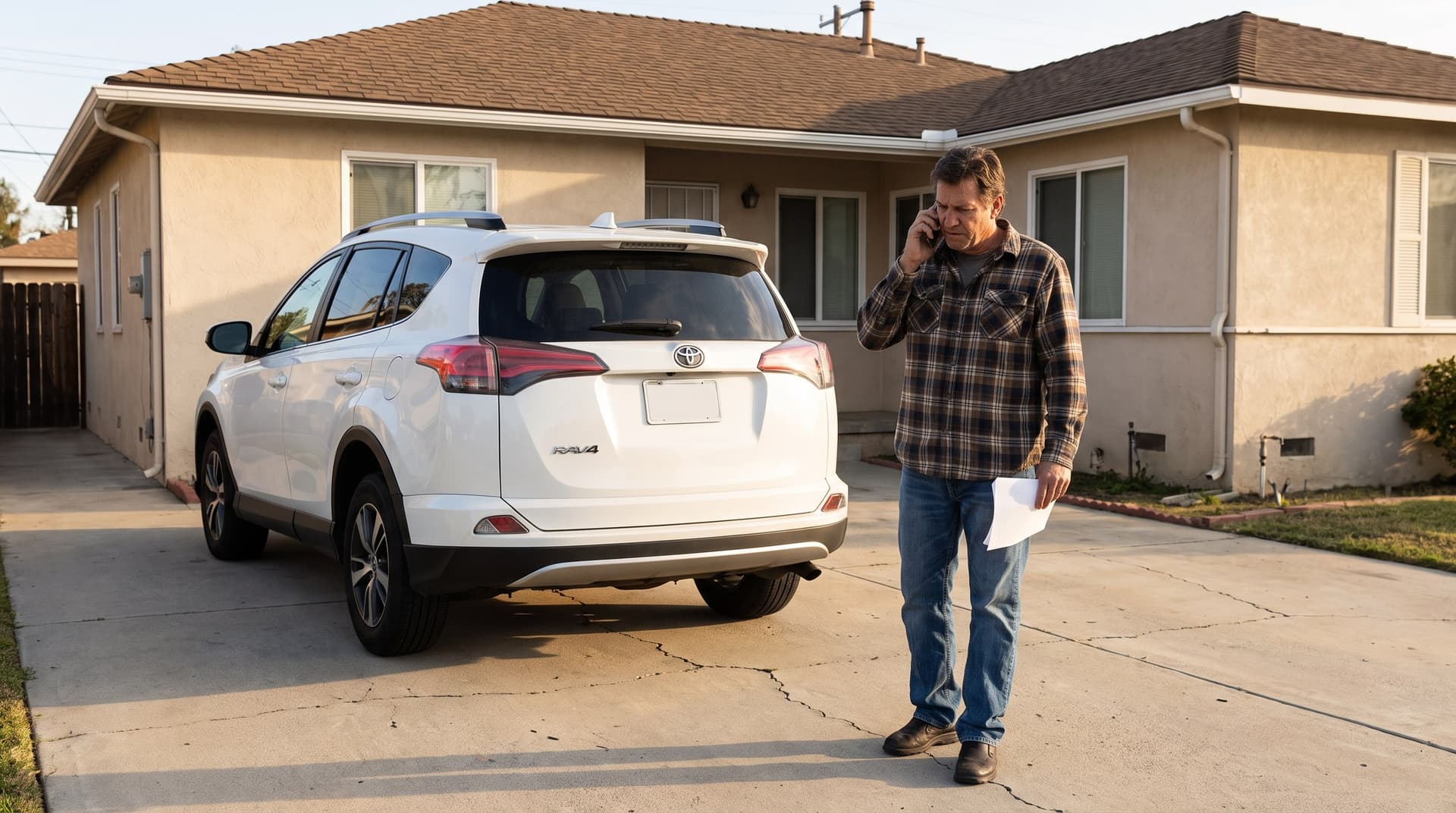
Yes, you can sell a car in California before the loan is paid off. It happens every day. The loan gets paid to the lender out of the sale, the lien comes off the title, and you keep whatever is left. The part almost nobody explains: who sends that payoff, what you sign, and how long the bank legally has to release your title. That part is written into California law, and I will show you exactly where.
I'm Joe. I'm a licensed California dealer, and plenty of the cars I buy at people's driveways still have a loan on them. Here is how it actually works, with the DMV rules and the real bank timelines, not guesses.
Quick answer:
- Can you sell it? Yes. The loan is paid from the sale proceeds; you get the difference.
- Who pays the bank: in a dealer sale, the dealer typically sends the payoff straight to your lender. In a private sale, the buyer's bank or the two of you handle it, which is where it gets messy.
- The magic number: ask your lender for a payoff quote first. It is NOT your loan balance; interest accrues daily until the day it's paid.
- Title timeline: once paid, California law gives your lender 15 business days to release the lien and send the title, with a $25-per-day penalty if they blow it.
- Owe more than it's worth? You can still sell; you cover the gap.
- Fastest path: a licensed dealer who handles the payoff and paperwork at your door and pays you the same day.
Can you sell a car that isn't paid off in California?
Yes. Having a loan on the car means your lender is the "legal owner" on the title and you are the "registered owner." You can't hand a buyer a clean title until the lender is paid, but nothing stops you from selling. The sale and the payoff happen together.
There are only three real paths:
- Sell to a licensed dealer. The dealer sends the payoff to your lender and pays you the difference. One appointment, and in my case it happens at your driveway.
- Sell to a private buyer. Doable, but now a stranger has to trust that your lender will release the title after their money pays your loan. Many buyers walk when they hear "there's still a loan on it." Buyers financing through a credit union will ask you for a 10-day payoff quote and a signed payoff authorization, because their bank sends the check to your bank.
- Pay the loan off yourself first. Clean, but it requires having the payoff amount in cash before you sell.
How does the loan payoff actually work?
Step one is always the payoff quote. Call your lender or pull it from their app and ask for the payoff amount, not the balance. The CFPB's guidance is blunt about this: the payoff amount "might be different from the outstanding balance listed on your statement" because interest is calculated daily until the loan is actually settled (CFPB).
Here's a detail I have never seen another car site get right: people talk about the "10-day payoff quote" like it's a California law. It isn't. There is no statute that sets a payoff-quote window for car loans. It's lender practice. Toyota Financial, for example, states its payoff quote is good for 10 days (Toyota Financial), and California credit unions like Golden 1 and SchoolsFirst require a 10-day payoff quote from the seller's lender before they'll fund a private-party purchase. Other banks just print a "good through" date. Check yours.
Step two: the payoff gets sent with your written authorization. When I buy a car with a loan on it, I send the payoff directly to your lender, and you sign an authorization directing them to release their interest. That seller-signed instruction is exactly what California law expects: the lender's clock starts once it has "payment in full... and a written instrument signed by the grantor of the security interest" (Veh. Code § 5753(c)).
Step three: you get the difference. If your car is worth more than the payoff, that gap is your money. Same appointment, same day.
One honest caveat from doing this for years: a small number of banks are picky about third-party payoffs, and every lien deal starts with a phone call so I can confirm how yours handles it. That call is also how the whole thing stays a same-day transaction instead of a surprise.
I buy cars from your driveway.
I’m Joe Yavetz, a licensed California dealer. I come to your house, look at the car, write you a check the same day, and handle the DMV paperwork. The number I give you is the number you get. No fine print.
★ 5.0 · 46 Google reviewsSan Fernando Valley, Ventura County & West L.A.
How long until the lender releases the title?
Worth separating two problems that feel identical: if your lender is holding the title, that is a payoff question and everything below applies. If the title is genuinely lost, that is a REG 227 question instead, covered in selling a car without the title in California.
This is the question that scares private buyers off, and it has a real legal answer. Once your lender receives payment in full plus your signed authorization, California Vehicle Code section 5753 gives them 15 business days to release the lien and send out the title. Miss the deadline and the law says they owe the buyer $25 per day, up to $2,500, and it can triple to $7,500 if they still don't pay after a written demand (Veh. Code § 5753(c), (e)).
In practice, most of it is electronic now. California runs an Electronic Lien and Title (ELT) system, which means many lenders don't hold a paper title at all; when the loan is satisfied, they notify the DMV electronically and the DMV issues the title (CA DMV). The DMV's own manual says the average time to receive a paper title from an electronic transaction is eight days. And when a dealer satisfies the lien, the DMV mails the new title directly to the dealer as the new legal owner, which is why my sellers never have to chase paperwork afterward.
What the banks themselves publish about their post-payoff timelines:
| Lender | What their official page says |
|---|---|
| Wells Fargo Auto | Begins title release within 3 calendar days for California-originated loans paid with certified funds (source) |
| Ally | Lien release mailed within 4 business days with certified funds, 10 otherwise; California handled electronically (source) |
| Golden 1 | Releases to the CA DMV within 10 business days; DMV issues the title in another 10 to 14 days (source) |
| Toyota Financial | Notifies the state within 10 business days; allow 6 to 8 weeks for the state to send the title (source) |
| Chase Auto | Allow up to 45 days to receive the title after final payment (source) |
That spread, 3 days to 45, is the whole argument for letting a dealer carry the wait instead of a private buyer. A stranger buying your car has to sweat that timeline. I don't.
What if you owe more than the car is worth?
You can still sell. You just have to bring the difference. If the payoff is $15,000 and the car is worth $12,000, the extra $3,000 has to come from you at the time of sale. That is not my rule; it is how every lender works, and it is exactly the scenario the CFPB and Chase describe in their own negative-equity guidance (Chase).
I still buy cars with negative equity. The deal works as long as the seller covers the gap, and I would rather tell you the real number over the phone than have you drive to a lot to hear it. Whatever you do, be careful with the other common option, rolling the shortfall into your next car loan. The CFPB warns that rolling negative equity into new financing makes the new loan more expensive, and it is how people end up upside down twice in a row. If you are in that spot, I wrote a separate guide on negative equity car loans that walks through the math.
What paperwork do you actually sign?
For a dealer sale with a loan on the car, the stack at your door is smaller than people expect:
- The title, if you're holding it, signed on line 1 as the registered owner. Many financed cars have no paper title to hand over at all because the lender holds it electronically; that's normal, and it's handled through the payoff and release process. (If you do have the title, here's exactly how to fill it out.)
- The payoff authorization, the written instruction to your lender that Vehicle Code 5753 is built around.
- The odometer disclosure, required for vehicles under 20 model years old, with real signatures; power of attorney is not accepted for the odometer line (CA DMV).
- The Notice of Transfer and Release of Liability (REG 138), which must reach the DMV within 5 calendar days of the sale and is what cuts off your liability for tickets and tolls after the car leaves (CA DMV). When I buy a car, filing this is part of the paperwork I handle; I also wrote up what to do after selling a car in California if you're selling privately.
With the title present, the paperwork at your driveway takes about 10 to 15 minutes.
Selling to a dealer vs. a private buyer when you have a loan
The honest comparison:
| Licensed dealer | Private buyer | |
|---|---|---|
| Who pays your lender | The dealer, directly | The buyer's bank, or you, with a stranger's money in flight |
| Paperwork | Handled at the appointment | You coordinate payoff, title, and DMV forms yourself |
| Title wait risk | The dealer carries it | The buyer carries it, and many walk away instead |
| Price | Wholesale-to-retail gap applies; get competing numbers | Highest on paper, if you find a buyer who'll tolerate the lien |
| Speed | Same day, including lien deals | Weeks, plus the payoff-and-title dance |
A private sale of a financed car is not impossible. It is just the hardest version of an already annoying process, and the scams get worse when a lien is involved because the money has to move before the title can.
How I handle loans at your driveway
The CurbSold version of all of the above: you call or text me, we talk through the loan on the phone, including which bank it's with, and I confirm the payoff mechanics before I drive out. At your driveway I check the car, make you a firm offer, and my offer is guaranteed to match or beat any CarMax offer. If you take it, I send the payoff to your lender, you sign the authorization and the DMV forms right there, and you get the difference the same day, cash or check. There is no balance limit on my end; whether the loan is $4,000 or $40,000, the process is the same. The full service is here: selling a car with a lien.
If you'd rather start by understanding what the car is worth against your payoff, get your lender's payoff quote first, then get a CarMax offer as your baseline and call me with both numbers: (818) 325-7535.
Frequently asked questions
Can I sell my car before it's paid off?
Yes. The loan gets paid to your lender out of the sale, the lien is released, and you keep the difference between the sale price and the payoff. If you owe more than the sale price, you can still sell by paying the gap at the time of sale.
Who pays my lender when I sell to a dealer?
The dealer typically sends the payoff directly to your lender, along with a payoff authorization you sign. Under California Vehicle Code section 5753, once the lender has payment in full and your signed authorization, it has 15 business days to release the lien and deliver the title.
What is a 10-day payoff quote?
It's a statement from your lender of the exact amount needed to close the loan, good for a set window, commonly 10 days, so daily interest doesn't make the number stale. It's lender practice rather than a California legal requirement, and some banks simply print a "good through" date instead.
Can I sell a financed car to a private buyer in California?
Yes, but the buyer or their bank has to get the payoff to your lender before a clean title can move, and the title can take days to weeks to arrive depending on the bank. Many private buyers won't take that risk, and buyers financing through a credit union will require a payoff quote and a signed authorization from you.
What happens if I owe more than the car is worth?
You pay the difference at the time of sale. Rolling the shortfall into a new car loan is the other common route, but the CFPB warns it makes the new loan more expensive. A dealer can still buy the car as long as the gap is covered.
How long does a lender have to release the title in California?
Fifteen business days after receiving payment in full and the seller's signed release authorization, under Vehicle Code section 5753. A lender that misses the deadline owes $25 per day, up to $2,500. Most California lenders release liens electronically through the DMV's ELT system, and the DMV says paper titles from electronic transactions average about eight days.
Will CarMax buy my car if I still owe money on it?
Yes, major buyers including CarMax handle loan payoffs. If you already have a CarMax offer in hand, CurbSold's offer is guaranteed to match or beat it, with the payoff and DMV paperwork handled at your door and same-day payment.
Do I need the paper title to sell a car with a loan on it?
Often you won't have one, because many California lenders hold the title electronically under the DMV's ELT program. That's normal. The lien release and title issuance happen through the payoff process; a dealer purchase doesn't require you to produce the paper title first.