
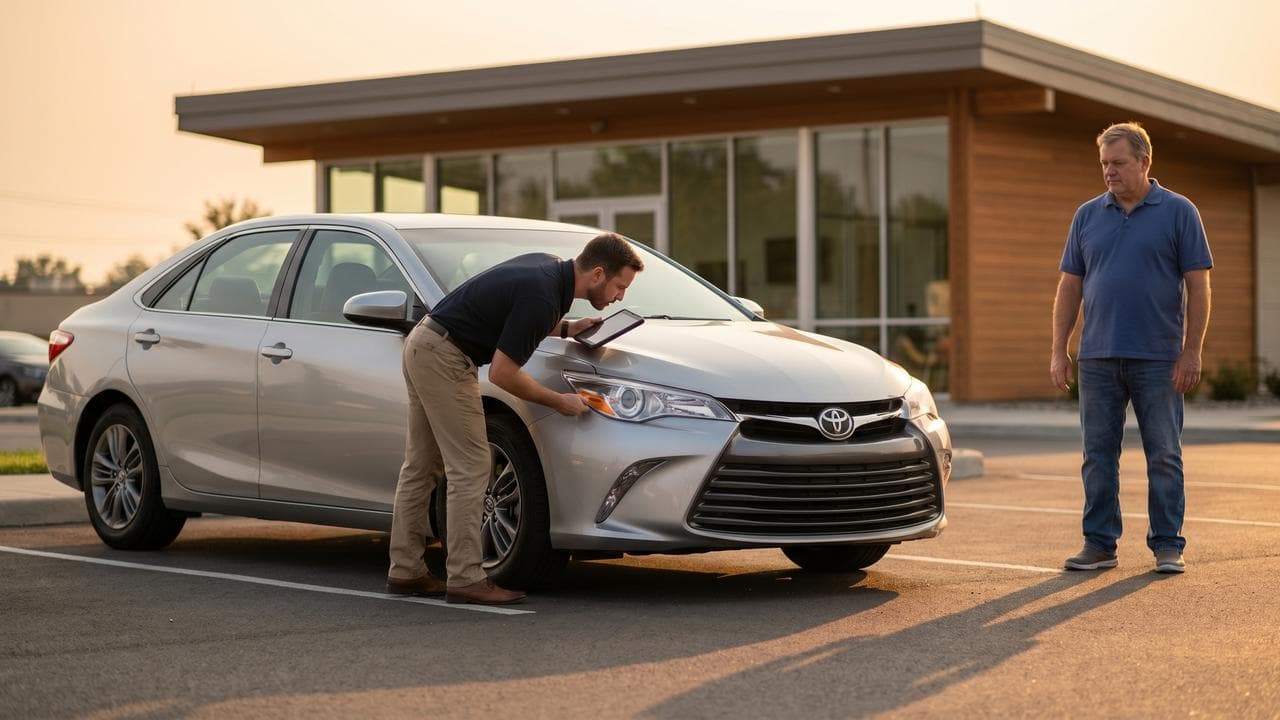
No. CarMax offers are firm. They don't negotiate.
What they will do is hold the number for 7 days, which is the actual leverage most sellers miss. The offer in your inbox is not a starting point in a back-and-forth. It's a take-it-or-leave-it figure generated by an algorithm, confirmed by an in-person inspection, and locked for one week. You cannot haggle it up. You cannot counter. You can only decide whether to use those 7 days to find a better number somewhere else.
I'm Joe. I've been a licensed dealer for over 30 years and I've bought more than 50,000 cars. I've watched hundreds of sellers walk into CarMax expecting to negotiate, leave frustrated, and call me a week later asking what their options are. This article is what I tell them.
Quick answer:
- CarMax does not negotiate. The offer is generated by an algorithm and the in-person appraiser confirms it. There is no person in the room with authority to move the number up.
- The 7-day window is the real lever. Your offer holds for 7 days. Use that time to get competing offers. You can still come back and accept on day 6.
- A competing dealer offer is the fastest path to more. A licensed dealer who inspects in person can often see what the algorithm overcorrected on. That's where the gap opens.
- CarMax keeps $2,253 in gross profit per used car retailed — an 8.5% margin, on an average retail price of $26,121, per their fiscal 2026 results (April 14, 2026), and that's what's left after they paid the seller and after they reconditioned the car. Their offer lands under a patient private sale.
- Three real alternatives: a mobile licensed dealer who comes to you, a Carvana quote (with caveats about post-inspection adjustments), or a short private listing test before you decide.
- I match or beat any CarMax offer. Guaranteed. Same-day check, paperwork handled, no driving across town.
Why You Can't Negotiate or Haggle With CarMax (and Why That's by Design)
CarMax built its whole brand on the no-haggle model. It applies in both directions: they don't haggle on the sticker price when you buy from them, and they don't haggle on the appraisal when you sell to them. That's not a sales tactic the local manager can override. It's the business model.
Here's how the process actually works on the selling side.
You enter your VIN and answer a short condition questionnaire online. CarMax's system runs that against their internal market data and pulls a number. That number is your "online offer." If you bring the car in, an appraiser physically inspects it, and one of two things happens: the appraiser confirms the algorithm and you walk out with the original number, or the appraiser finds something the questionnaire missed (a panel that's been repainted, an odometer discrepancy, a mechanical issue) and the offer adjusts down to reflect what was found. The appraiser does not have a button labeled "increase offer by $500 because the seller asked." That button doesn't exist. For a full walkthrough of what the appraiser checks in person and how often the offer holds, see what to expect at a CarMax appraisal appointment.
Read their own FAQ: "Can I negotiate my online offer with CarMax? No, all of our offers are firm and valid for 7 days." That's the official answer from CarMax, unchanged in 2026.
One thing that did change: as of November 2025, CarMax now offers nationwide at-home pickup for most sellers. You can complete the sale without driving to a store. The convenience is real. The pricing, however, is identical to what you'd get in-store, because it's the same algorithm-generated offer. So the at-home pickup launch removed a friction point, but it didn't change the math. The number is still firm, and it's still under what your car would bring in a patient private sale.
So when people ask "can you negotiate with CarMax," the literal answer is no. But the more useful question is: what does the 7-day window actually let you do?
What You Can Actually Negotiate (and What You Can't)
Some advice articles will tell you that you can negotiate trade-in appraisals, financing terms, or add-ons at CarMax. That advice is about buying a car from CarMax, not selling one to them. It's mixed-intent content and it muddies the water.
For sellers, here is the real list.
What you cannot negotiate:
- The appraisal number itself. The offer is what it is.
- The 7-day expiration. You can ask for an extension and they will usually decline politely.
- The condition flags the algorithm caught. If the system marked your car for an issue, that's how the offer was calculated.
What you actually can do during the 7-day window:
- Get competing offers from other buyers (this is the real play).
- Use the CarMax number as a floor when talking to other dealers.
- Bring the car to a different CarMax location if you suspect a regional pricing difference (this rarely changes anything, but it costs you nothing to ask).
- Walk away entirely and either keep driving the car or try a private sale.
The 7-day window is the actual product CarMax is selling you, even though they don't market it that way. It's a free, no-obligation price floor you can use however you want. Most sellers waste it sitting on the offer for 6 days, then accept on day 7. That's the opposite of what you should do.
I buy cars from your driveway.
I’m Joe Yavetz, a licensed California dealer. I come to your house, look at the car, write you a check the same day, and handle the DMV paperwork. The number I give you is the number you get. No fine print. Already have a CarMax offer? I’ll match it or beat it, guaranteed.
★ 5.0 · 48 Google reviewsSan Fernando Valley, Ventura County & West L.A.
Is CarMax Lowballing Me? How to Tell
People search "CarMax lowball offer" a lot, and the question hides two different situations.
Situation 1: CarMax is being fair, you just don't like the number. This is most clean, standard cars in good condition. The algorithm is reasonably accurate on a 2020 Toyota Corolla in good shape with average mileage. You won't get a thousand dollars more from any institutional buyer. The gap to a private sale exists, but the private sale also costs you 2-4 weeks and 10-30 hours of work.
Situation 2: CarMax is overcorrecting on a condition flag. This is where the real lowballs happen. The system catches a sensor code, a slight body imperfection, a higher-than-average mileage, or anything else it considers risk, and discounts heavily. Very heavily. Because the algorithm cannot physically see the car, it cannot tell whether that issue is a $40 fix or a $4,000 fix, so it assumes the expensive end and bakes in margin.
If you're in Situation 1, accept and move on. The convenience is worth it.
If you're in Situation 2, you have real money sitting on the table, and a licensed dealer who inspects the car in person is the cleanest way to recover it.
How do you tell which one you're in? Pull the Kelley Blue Book private-party value for your exact year, trim, mileage, and condition. Compare it to the CarMax offer. If the gap is under 15%, you got a relatively clean number. The algorithm didn't flag anything major. If the gap is 20% or more, something in the system overcorrected on a condition flag and the discount is heavier than it should be. That's the lowball signal, and it's the situation where a competing licensed dealer can usually find money.
For the full math and a complete walkthrough of when CarMax's number is actually fair, the should I accept my CarMax offer piece breaks it down in detail.
CarMax Firm Offer vs. Competing Dealer vs. Private Sale
Here is what the three real paths look like on the same car. Assume a clean 2020 Honda CR-V EX, 55,000 miles, good condition, no issues.
| Option | What you get | Time | Effort | Risk |
|---|---|---|---|---|
| CarMax firm offer (in-store or at-home pickup) | ~$18,800–$20,000 | Same day (in-store) or ~24 hours (at-home pickup) | Photos + scheduling, or trip to store | Low. Number is firm for 7 days |
| Carvana online quote | ~$19,800–$20,500 (initial) | 3–7 days | Online photos + scheduling | Medium. Quote valid 7 days and 1,000 miles, can adjust at pickup |
| Competing mobile licensed dealer | Match or beat CarMax (guaranteed) | Same day | Phone call, dealer comes to you | Low. Firm offer, in-person inspection |
| Private sale (Facebook/Craigslist) | ~$23,000–$24,000 | 2–4 weeks (60–85% abandon) | 10–30 hours, listings, photos, calls | High. No-shows, lowballers, scams |
The chart shows the real trade-off. CarMax is fast and certain but pays the least. A private sale pays the most but costs you weeks. A competing licensed dealer with a match-or-beat guarantee threads the needle: same-day, in-person inspection, paperwork handled, and a number that meets or exceeds what CarMax gave you.
The math on a $20,000 CR-V: walking from CarMax to a mobile licensed dealer who beats their number by $500 is $500 of recovered money for a 20-minute appointment in your driveway. That's a $1,500-per-hour return. Most sellers don't think of it that way because they don't realize the option exists.
3 Real Alternatives That Pay More Than CarMax
In order of how quickly they can put more money in your hand.
1. Call a local licensed dealer who comes to you.
This is what I do. I bring a firm offer to your driveway in the San Fernando Valley and Ventura County, inspect the car in person, and write you a check the same day. Because I see the car physically, I can correctly price issues the CarMax algorithm overcorrected on. I match or beat any CarMax offer. Guaranteed. The whole appointment is about 20 minutes. Call or text (818) 325-7535. If you want to see exactly how that works first, here is how I beat your CarMax offer.
2. Get a Carvana quote, with one caveat.
Carvana's initial online offer is often higher than CarMax. The catch: their offer is valid for 7 days and 1,000 miles, and the number is not firm until pickup. At the inspection, they can and do adjust the price down if the car's condition differs from your self-report. Minor cosmetic discrepancies typically run $200–$500. Larger issues like undisclosed mechanical problems or frame damage can drop the offer by thousands. Use Carvana's quote as a comparison data point. Just don't make plans around the number until the check actually clears.
3. Run a short, structured private listing test.
If you have 3–5 days to spare and the patience for messages, list the car on Facebook Marketplace at the KBB private-party number. You'll know within 72 hours whether you have real buyers at that price. If you do, the math may justify staying with the private sale. If you don't (lots of lowballers, no serious buyers, no-shows), you've validated that the institutional offers in your hand are the right path. The 7-day CarMax window covers this entire experiment.
For the full counter-play list with five specific moves to make before you accept, see Should I accept my CarMax offer. And for the deeper comparison of where CarMax fits in the market, the pillar guide on selling your car to CarMax has the full picture.
Has Anyone Ever Successfully Negotiated With CarMax?
Short answer: no. Longer answer: every Reddit thread, Quora post, and forum question on this topic ends the same way. The people who claim they "negotiated" with CarMax mostly mean one of three things:
- They went back with a competing offer (KBB Instant Cash Offer, Carvana, a dealer) and CarMax matched it. That's not negotiation; that's a price-match policy applied informally on some appraisals.
- They got a different CarMax store to give them a slightly different number. This happens occasionally because the in-person inspection is judgment-based on certain condition items.
- They re-ran the appraisal a few weeks later after market conditions shifted, and got a higher number the second time.
None of those are actual negotiation in the haggle-the-price-up sense. If your goal is to walk into CarMax, ask for $500 more, and have them write it down, that doesn't happen. If your goal is to recover money that CarMax's algorithm discounted aggressively, a competing licensed dealer in person is the move.
What Is the Downside of Selling to CarMax?
The downside is the price. That's it. CarMax built a clean, predictable, low-friction process and keeps a margin for the privilege — $2,253 per used car retailed in fiscal 2026, after reconditioning costs. For some sellers, that gap is meaningful money. For others, the convenience is worth it and they should sign and move on. With nationwide at-home pickup now live, even the trip-to-the-store complaint is gone, which makes the price gap the only real factor left in the decision.
The other "downsides" people cite (slow appraisal lines, the trip to the store, the wait) are real but minor. The actual cost is the price gap. The question is whether that gap is worth acting on for your specific car and your specific timeline.
The CarMax vs. private sale comparison walks through the full trade-off math, and the CarMax vs. Carvana piece shows where the two big online buyers actually differ on selling price.
Frequently Asked Questions
Are CarMax offers really firm, or is there room to ask for more?
CarMax offers are genuinely firm. The appraiser does not have authority to raise the number. What you can do is bring a competing offer from a licensed dealer or another instant-cash service and ask CarMax to match. They sometimes will. That's the closest thing to negotiation that exists in this process.
How long is a CarMax offer good for?
7 days from the date of the appraisal. Use the full window. There is no benefit to accepting on day 1 unless you're certain. Get competing offers, sleep on it, then come back and accept if nothing better turned up.
Will CarMax beat another dealer's offer?
Sometimes. There is no official policy, but in practice CarMax will occasionally match a higher written offer from a competing dealer if you bring it to them. Whether they do depends on the appraiser and the situation. It costs nothing to ask.
Can I get a higher CarMax offer at a different location?
Rarely. The algorithm is consistent across stores. The in-person appraisal can vary slightly because different appraisers grade condition differently, but the swing is usually small. Driving to a second location is not generally worth the time.
What if I think CarMax's offer is way too low?
That's the signal that the algorithm flagged something on your car and discounted heavily. The fastest way to recover the money is a licensed dealer who inspects the car in person and can correctly price the issue. Call or text (818) 325-7535 and I'll bring a firm offer to your driveway. I match or beat any CarMax offer. Guaranteed.
Has anyone ever successfully negotiated with CarMax?
Not in the haggle-the-price-up sense. People who say they negotiated usually mean CarMax matched a competing dealer offer they brought in, or they got a slightly different number at a second store. Actual back-and-forth negotiation on the appraisal does not happen at CarMax.
Can you negotiate with CarMax when selling a car?
No. When you sell a car to CarMax, the offer is generated by an algorithm and confirmed by an in-person appraiser who has no authority to raise it. There is no back-and-forth. The one thing you can do is bring a higher written offer from a competing licensed dealer and ask CarMax to match it, which they sometimes will.
Are CarMax prices negotiable?
No. CarMax built its brand on the no-haggle model, and it runs in both directions: the sticker price when you buy is firm, and the appraisal number when you sell is firm. The selling offer holds for 7 days, and that window, not haggling, is where sellers actually gain leverage by collecting competing offers.
Can you haggle with CarMax?
No, haggling is not part of the CarMax process. The appraiser does not have a button to increase the offer because you asked. What works instead is using the 7-day offer window to get a competing offer from a licensed dealer who inspects the car in person and can price what the algorithm overcorrected on.