
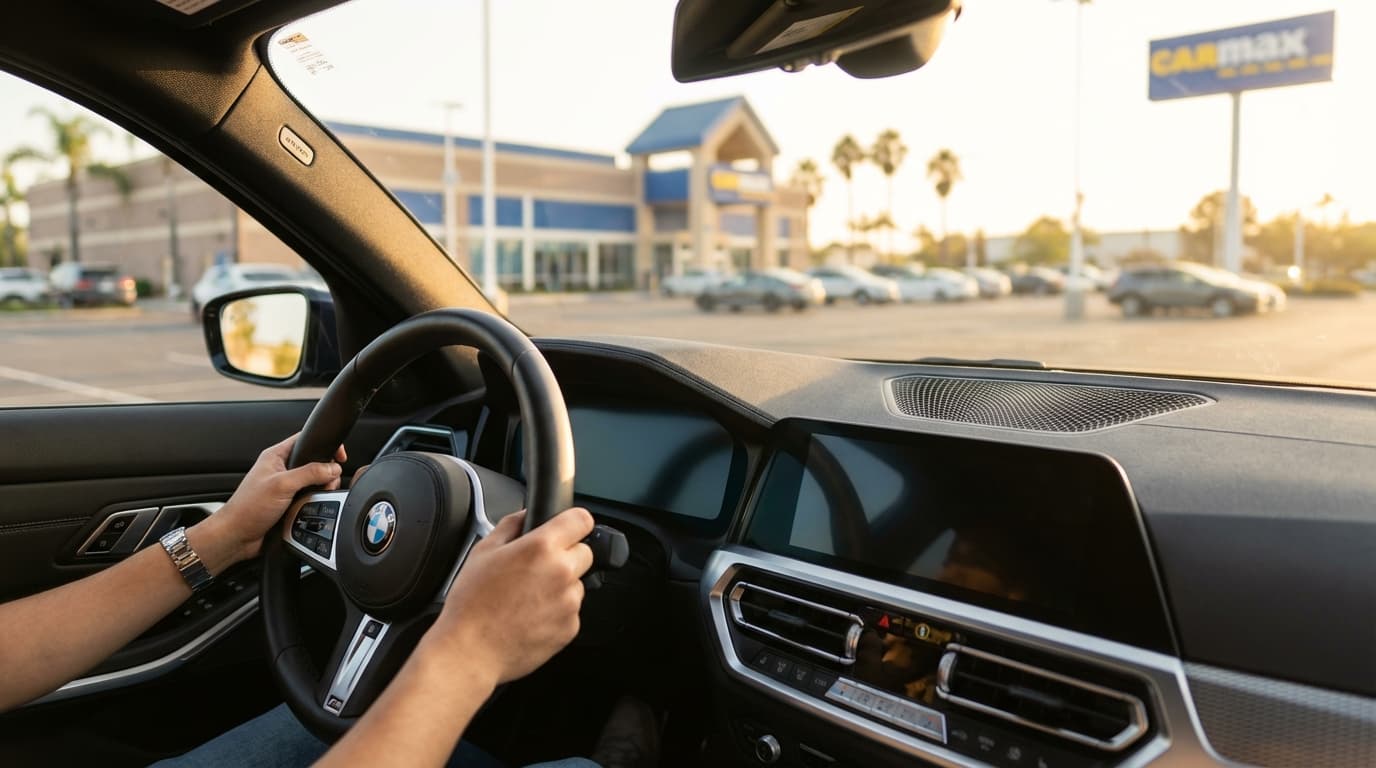
If you're thinking about selling your car to CarMax, here's the short version: CarMax will make you a firm offer in about two minutes online, pay you less than your car would bring in a patient private sale, and not negotiate a cent. For most people selling a standard car with a clean title, that's actually a fair trade. For some people, it's a bad deal they don't have to take.
I'm Joe. I've been a licensed dealer for more than 30 years and I've bought over 50,000 cars. I use the same professional valuation tools licensed dealers use, backed by real auction and market data. I've watched hundreds of people sell to CarMax and I've watched hundreds choose something else. There's no one right answer. There's only the right answer for your specific car and your specific situation.
This guide walks through the whole process as it actually works in April 2026, what you can realistically expect, and how to figure out if CarMax is your best move.
Quick answer:
- Price: CarMax's own fiscal 2026 results (reported April 14, 2026) show $2,253 of gross profit per used car retailed, an 8.5% margin, on an average retail price of $26,121 — what's left after they paid the seller and after they reconditioned the car. Expect their offer to land under a patient private sale.
- Process: Online instant offer in about 2 minutes, valid for 7 days. In-store appraisal takes 30 to 45 minutes. Payment is same-day in-store, 1 to 3 days with at-home pickup.
- Negotiation: None. CarMax's offer is their offer. It does not go up.
- At-home pickup: Available nationwide as of November 2025. They come to you, look at the car, and take it with them.
- What they won't buy: Salvage titles, major unrepaired damage, cars with liens exceeding their value, unfinished recalls in some cases.
- Best for: Clean title, standard make and model, you value speed over squeezing the last dollar.
In this guide
- How does CarMax's selling process actually work in 2026?
- How much does CarMax typically pay for a car?
- Comparison: CarMax vs other ways to sell
- Does CarMax ever negotiate on their offer?
- What's the difference between at-home pickup and going in-store?
- When does selling to CarMax make the most sense?
- When does selling elsewhere make more sense?
- What do you need to bring to sell your car to CarMax?
- What cars will CarMax not buy?
How does CarMax's selling process actually work in 2026?
The short answer: four steps, and the first three can be done without leaving your couch.
Step 1: Get an instant offer. You go to carmax.com (or, as of February 2026, through CarMax's ChatGPT app integration), plug in your VIN and mileage, answer a handful of condition questions, and CarMax returns a firm offer in about two minutes. The offer is good for seven days. You haven't committed to anything yet.
Step 2: Schedule the transaction. You have two choices now. The classic route is to book a time at a CarMax store and bring the car in. The newer option, launched nationwide in November 2025, is at-home pickup. CarMax sends someone to your driveway, looks over the car, confirms the number, and takes it with them.
Step 3: The appraisal. Whether you go in-store or they come to you, an actual person inspects the car. They're checking for things the online form couldn't tell them: undisclosed damage, weird smells, signs of a flood, aftermarket modifications, tires that look rougher than you said. If everything matches, the number from step 1 holds. If they find something, the number goes down. This is the part everyone worries about. In practice, if you were honest on the online form, the number almost always holds. For a step-by-step of what the appraiser checks and how often the offer actually holds, see what to expect at a CarMax appraisal appointment.
Step 4: Payment. If you're in-store, you sign paperwork, get a check, and they'll even call you a Lyft ride home within 60 miles if you don't have one. If you did at-home pickup, the car leaves with them and payment comes through a few business days later. Same-day payment is one of CarMax's selling points, and it only applies to the in-store route.
The whole in-store process, start to finish, usually takes under an hour once you're there. That's a big part of why people use it. Compare that to the weeks you'd spend selling privately. For a full breakdown of how long every selling method actually takes, see our guide on how long it takes to sell a car.
I buy cars from your driveway.
I’m Joe Yavetz, a licensed California dealer. I come to your house, look at the car, write you a check the same day, and handle the DMV paperwork. The number I give you is the number you get. No fine print. Headed to CarMax? I’ll match or beat their offer without you leaving the house.
★ 5.0 · 48 Google reviewsSan Fernando Valley, Ventura County & West L.A.
How much does CarMax typically pay for a car?
Less than a private buyer would pay. CarMax publishes how much less, which is more than most buyers will ever tell you.
Here's the number straight from their filings. In CarMax's fourth quarter and fiscal year 2026 results, reported April 14, 2026, gross profit was $2,253 on every used vehicle they retailed — an 8.5% margin, on an average retail price of $26,121. Read that one carefully, because almost everybody online has it backwards. CarMax's 10-K says cost of sales “includes the cost to acquire vehicles and the reconditioning and transportation costs associated with preparing the vehicles for resale.” So the $2,253 is what's left after they paid you and after they fixed the car up.
Which means the distance between the check in your hand and the sticker in their window is wider than $2,253, not narrower. Tires, brakes, paint, detail — that money is spent inside the same distance, before the $2,253 is counted. That's not a trick. That's the cost of a business that gives you a firm number in two minutes and hands you a check the same day.
What it means for you in practice: their offer usually lands a couple thousand dollars under what a patient private-party sale would bring on a clean, late-model car, and further under on an older or higher-mileage one, because that's where the reconditioning bill grows. And if anyone quotes you a single national percentage for that gap, they're guessing. Nobody measures it. It moves with the car, the mileage, and what their lot needs that week. I'd rather hand you the number CarMax actually publishes than a percentage that would make my own pitch sound bigger.
Why such a gap? CarMax isn't trying to rob you. They're a business, and their business model is buying cars from consumers, reconditioning them, and reselling them at a profit. The $2,253 they disclose isn't lowballing. It's the margin they need to make the whole operation work: warranty risk, floor space, the chance of a car that won't sell, the sales staff, the buildings — sitting on top of the reconditioning money already spent to get the car sellable. Every big car buyer (CarMax, Carvana, CarGurus, the local Toyota dealer) works off the same kind of spread for the same reason.
Where it gets weird. CarMax's offers are driven by their internal auction data and their resale projections. If your car is the exact model CarMax needs on their lots right now, your number comes in strong. If they already have 12 of them on their Phoenix lot and interest rates are up and nobody's buying, it comes in soft. That's why you sometimes see wild discrepancies between big-buyer offers. There's a well-known Threads post from a seller whose parents got a $2,500 CarMax quote on a car and then got an $8,300 Carvana quote the same day. That happens. Neither one is wrong. They're different buyers with different inventory needs.
Don't take the first number personally. Shop it. Shop it fast, since the offer is only good for a week. For the exact 5 counter-plays worth running before you accept (and the 3 cases where the CarMax number IS the right one), see should I accept my CarMax offer. For a deeper look at how CarMax stacks up against doing a private sale yourself, see CarMax vs. private sale.
Comparison: CarMax vs other ways to sell
Here's how the main selling options stack up at a glance:
| Method | Time to payment | Price vs private party | Hassle | Paperwork | Best for |
|---|---|---|---|---|---|
| CarMax in-store | Same day | -15 to -20% | Low | They handle | Clean title, standard car |
| CarMax at-home pickup | 1 to 3 days after pickup | Same as in-store | Very low | They handle | Metro addresses, no rush on the check |
| Carvana online | 1 to 3 days | -15 to -20% (variable) | Very low | They handle | Similar to CarMax, sometimes better, sometimes worse |
| Private sale | 2 to 4 weeks | Baseline (the top number) | High | You handle | Patient sellers with time and a clean car |
| Mobile dealer (like me) | Same day at your door | Matches or beats CarMax | Very low | I handle | SFV + Ventura County sellers who want speed AND a competitive number |
No single option is best for everyone. The question is which tradeoffs you're willing to make.
Does CarMax ever negotiate on their offer?
No. This is the most-asked question about CarMax and the answer is the same every time. No, they will not come up, not even a little, not even if you brought a friend.
CarMax operates on a strict no-haggle model. The offer the system generates is the offer. The appraiser can adjust it downward if they find something the online form didn't capture, but they cannot adjust it upward. They're not allowed to. That's not a tough negotiation tactic. It's a policy.
Why this is actually good for most sellers. Negotiation is stressful. Most people hate it. If you walk into a regular used-car dealer with a trade-in, you're going to spend an hour going back and forth, wondering if you're being cheated, kicking yourself for every number you accepted. CarMax takes all of that away. The price is the price. You take it or you don't. A lot of people find that liberating. The number might not be the maximum you could have gotten, but you don't have to fight for it, and the fight is worth something.
Why this is sometimes a problem. If you know your car is worth more than the CarMax number, and you have evidence for why (recent comparable private sales, rare trim, exceptional condition, low miles), CarMax is not the right buyer. They're not going to meet you in the middle. Your options are: sell privately (more money, more time, more risk), try a competing big buyer, or find a dealer who will actually look at your specific car and make you a case-by-case offer. For the full reality of what you can and cannot push on, see are CarMax offers negotiable.
If you're in the San Fernando Valley or Ventura County and you've got a CarMax offer in hand that feels too low, I'll come to your driveway and look at the car myself. I match or beat any CarMax offer. Guaranteed.
What's the difference between at-home pickup and going in-store?
CarMax's at-home pickup is the newest thing in their selling flow. It launched nationwide in November 2025 and it changes the equation for people who don't want to drive across town to a store.
Here's how the two options actually compare.
In-store drop-off. You take the car to a CarMax location. They do the appraisal while you wait (usually 30 to 45 minutes). If everything checks out, you sign the paperwork, they hand you a check, and you're done. Same day. If you don't have a ride home, they'll order you a Lyft anywhere within 60 miles on their dime. The in-store route is the fastest path from "I want to sell" to "I have money."
At-home pickup. You book a pickup window. A CarMax employee shows up at your driveway at the scheduled time, looks over the car, confirms the number, and drives it away. Payment comes a few business days later through their transfer process, not on the spot. This is easier if you don't want to deal with driving to a store, or you only have one car and don't want the logistics problem of how to get home after selling it. But you give up the same-day payment.
Which is better? Depends on whether you need the money today and whether you can spare an hour to drive over. If you're working from home and just want the car gone, pickup wins. If you need the check in your hand to close on another car this afternoon, go in-store.
One thing to keep in mind: at-home pickup is genuinely convenient, but it's also what a lot of smaller mobile dealers (including me) have been doing for years. The difference is in how the appraisal works. CarMax's pickup person is confirming a number that was already generated by their system. I come out, actually look at your car, explain what I'm seeing, and write you a check before I leave.
When does selling to CarMax make the most sense?
CarMax is genuinely a good option for a lot of sellers. Here's when it's probably your best move:
- You have a clean title and no liens, or a lien that's well under the car's value.
- Your car is a standard make and model in the kind of condition people actually buy. Honda, Toyota, Subaru, Ford, Chevy. Mid-mileage. No big dents, no salvage history, no mechanical problems that will show up the second someone drives it.
- You value speed and simplicity over squeezing every dollar. If the difference between $16,500 from CarMax and $19,000 from a private buyer is two weeks of your life dealing with strangers, CarMax's deal looks pretty good.
- You don't want to deal with private buyers. Tire-kickers, no-shows, people who want to "test drive" the car for an hour, scammers asking you to meet at a gas station. Private selling is a real job. CarMax isn't.
- Your private-party ceiling is close to the CarMax number anyway. On a standard commuter car with high miles, the gap between what CarMax pays and what you could get privately might only be a few hundred dollars. That's not worth the hassle for most people.
If any of those describe you, CarMax is a reasonable choice. Take the offer, book the appointment, get the check, move on with your life.
When does selling elsewhere make more sense?
CarMax is not always the best option. Here's when you should probably look elsewhere:
- You have a rare, premium, or enthusiast car. Miata NA, 996 Turbo, low-mile BRZ, clean E39 M5. CarMax's algorithm doesn't care about fanatic buyer demand. A rare car sold to CarMax is cash left on the table.
- Your car has a problem CarMax won't deal with. No title, salvage title, major mechanical issue, flood history, incomplete recall. CarMax either won't buy or will take so much off the price you'd be better off selling it somewhere that actually handles problem cars.
- Your CarMax offer came in noticeably below expectation. Sometimes CarMax's number is just wrong for your specific car. Their model is built on averages, and if your car is an outlier, you'll feel it. Shop the offer.
- You're dealing with a life-event sale. Inherited car in probate, divorce forcing a sale, a move out of state, an elderly parent who can't drive anymore. These are situations where what you need isn't the absolute highest number. What you need is someone who will come to you, handle the paperwork carefully, and not make it harder than it already is.
- You're in a specific geographic area where a local buyer can do better. Mobile dealers who come to your driveway have lower overhead than CarMax. They have the room to match or exceed CarMax's number on specific cars.
If you're in the San Fernando Valley or Ventura County and you fall into any of these categories, that's my business. I'm a licensed dealer, I come to your driveway, and I match or beat any CarMax offer. I handle the paperwork. You get a check on the spot. It takes about twenty minutes.
If you want the local rundown of every place to sell a car around here, from the dealer lots to the instant-offer buyers, I compared them all in where to sell your car in the San Fernando Valley.
If you're comparing CarMax to Carvana specifically, I wrote a full breakdown of how both companies work and where they differ: CarMax vs Carvana for selling.
What do you need to bring to sell your car to CarMax?
Less than you'd think. Here's the actual list:
- The title, or the lienholder's information if you still owe money. CarMax handles the lien payoff for you. You just need to tell them who to pay.
- A valid government-issued ID. Driver's license is fine.
- All sets of keys you have. If you only have one, bring one. CarMax won't reduce the offer for missing a spare key (some dealers will).
- The car's registration, though this isn't strictly required in most states.
That's it. You don't need your service records. You don't need to prove maintenance. You don't need to bring a Carfax. CarMax runs their own history check.
Do you need to clean the car? No. A clean car will not increase the offer. I say this every time someone asks. CarMax pays based on fundamentals (year, make, model, mileage, condition), not whether the interior smells like vanilla. If you want to vacuum it out of pride, fine. If you want to pay for a detail hoping to get $500 more, don't.
What cars will CarMax not buy?
CarMax buys most cars, but there's a short list of things they won't touch:
- Salvage title or branded title vehicles. Anything marked "salvage," "rebuilt," "flood," "lemon law buyback," or similar. Some states have more categories than others.
- Vehicles with major unrepaired damage. Deployed airbags, frame damage, engine that doesn't start, significant collision damage that hasn't been repaired. They'll sometimes take a car with cosmetic damage. They won't take one that isn't drivable.
- Cars with liens that exceed the value. If you owe $18,000 on a car they're valuing at $14,000, you'd need to bring a check for the $4,000 difference to the transaction. Some sellers do this to get out from under a bad loan. Some can't afford to.
- Unfinished recalls, in some cases. Minor recalls usually don't block the sale. Severe safety recalls (Takata airbag type situations) sometimes do, depending on the current federal guidance at the time.
- Very old or very high-mileage cars outside their resale criteria. CarMax sells cars off their lots. If yours is too far outside the profile they can actually sell, they may pass or give you an offer so low it doesn't make sense to accept.
If you're in any of these situations, don't give up. A lot of mobile dealers (myself included) specifically handle cars that bigger buyers won't touch. We work with title problems, we buy cars with mechanical issues, we deal with negative equity. Bigger chains can't afford to take those cars. Smaller operators like me can.
Frequently Asked Questions
How does the CarMax instant offer process work?
Four steps. (1) Get an instant offer online at carmax.com using your VIN, mileage, and condition info. CarMax returns a firm number in about 2 minutes. (2) The offer is valid for 7 days. You can shop it, sleep on it, or accept. (3) Redeem the offer by visiting a CarMax store (30-45 minute appraisal) or scheduling at-home pickup, available nationwide as of November 2025. An appraiser physically verifies the car matches what you reported. If it does, the number holds. If not, the offer adjusts down. (4) Payment: same-day check in-store, or 1-3 business days after at-home pickup. The number itself is non-negotiable. The algorithm sets it, the appraiser confirms it, and no manager has authority to move it up.
Can I sell my car to CarMax without buying a car from CarMax?
Yes. CarMax will buy your car even if you're not buying anything from them. There's no obligation attached to getting the offer or completing the sale. A lot of people assume it works like a trade-in at a regular dealer. It doesn't. You can walk in, sell the car, and walk out with a check.
Do I need an appointment to sell my car to CarMax?
No, but making one is a good idea. Most CarMax stores accept walk-ins for appraisals. On weekends especially, walking in without an appointment can mean a long wait. If you already have an online offer, scheduling an express drop-off time online is the fastest route. You're typically in and out in under 30 minutes.
How does the CarMax appraisal appointment work?
You book a time slot online after getting your instant offer, bring the car in, and an appraiser checks it against what you reported: mileage, condition, damage, modifications. If the car matches, the online number holds and you can leave with a check the same day. Plan on 30 to 45 minutes for a standard appraisal, or under 30 with express drop-off if you already have an online offer. Walk-ins work too, but weekend waits get long. If driving to a store is the part you want to skip, a mobile dealer brings the appraisal to your driveway with no appointment at all.
What is CarMax express drop-off and how does it work?
Express drop-off is CarMax's fast lane for sellers who already have an online offer. You get the offer at carmax.com, schedule a drop-off time at a store, and an associate verifies the car against what you entered online. If everything matches, you sign, hand over the keys, and leave with payment in under 30 minutes. The regular walk-in appraisal takes 30 to 45 minutes because they're generating your number from scratch.
Can I extend my CarMax offer after it expires?
No. CarMax offers expire after 7 days and they don't extend them. Once it lapses, you request a new offer, and the new number can come back higher or lower depending on mileage, season, and what their lots need. Sellers have watched offers drop thousands of dollars between one week and the next. CarMax's Offer Watch tool tracks your car's value over time so you can generate a fresh offer when you're ready, but that's a new offer, not an extension of the old one. If your offer is about to expire and you're still deciding, that's exactly the moment to shop it. Call or text me before it lapses and I'll match or beat it while it's still your floor.
Can CarMax pick up my car from my home?
Yes, in most areas. CarMax rolled out at-home pickup nationwide in November 2025. You accept the online offer, choose home pickup instead of a store visit, and an associate comes out to verify the car and drive it away. Two catches: distance restrictions and fees can apply depending on your location, and payment arrives 1 to 3 business days after pickup instead of same-day like the in-store route. If you're in the San Fernando Valley or Ventura County and want the driveway visit with a check in your hand before the car leaves, that's what I do.
Does CarMax lowball you?
I wouldn't use the word lowball. CarMax publishes exactly what it makes. Per CarMax Reports Fourth Quarter and Fiscal Year 2026 Results (April 14, 2026), gross profit was $2,253 on every used vehicle it retailed, an 8.5% margin, on an average retail price of $26,121. That $2,253 is what is left after they paid the seller and after they reconditioned the car, so the gap between your check and their resale price is wider than $2,253, not narrower. That spread is what every large-scale buyer takes to cover reselling and overhead on top of the reconditioning money already spent. It is a real cost, not a con. Whether the number feels low depends on whether you were expecting private-party money from a dealer. If you were, you'll be disappointed. If you knew the math going in, the number is usually fair.
How long is a CarMax offer valid?
Seven days from the day they generate it. You can use those seven days to shop the offer. Take it to a mobile dealer, take it to Carvana, try a private listing. If nothing else comes through within a week, the CarMax number is still there waiting for you. Treat the CarMax offer as your floor, not your ceiling.
Will CarMax buy my car if I still owe money on it?
Yes, as long as what you owe is less than what they're paying. CarMax handles the lien payoff directly with your lender. If you owe more than the car is worth (negative equity), you can still sell to CarMax, but you'll need to cover the difference at closing, usually by check. Some people do this to escape a car loan they can't afford anymore. Some people can't.
Will CarMax buy my car if I don't have the title?
Not directly. You need either the original title or a duplicate (which you can request from your state DMV), plus any lien release if applicable. If you've lost the title and don't want to deal with the DMV paperwork, that's a situation where a smaller dealer who specializes in problem titles can help. CarMax isn't built for that.
Do I need to clean my car before selling to CarMax?
No. Don't bother paying for a detail. A clean car will not get you a higher offer. CarMax prices on condition fundamentals, not cosmetics. Vacuum it out if you want. Don't spend $200 on a full detail hoping it'll move the needle. It won't.
What should I do if my CarMax offer feels too low?
Shop it. That's what the 7-day validity window is for. Get a quote from Carvana. Get a quote from KBB Instant Cash. If you're in the San Fernando Valley or Ventura County, call or text me and I'll come to your driveway and take a look. I match or beat any CarMax offer. Guaranteed. Your CarMax number becomes my floor, and sometimes I can go above it depending on the car. Either way, you shouldn't leave money on the table because you were in a hurry.
If you want to dig deeper into what it actually means to beat a CarMax offer and the specifics of how that works, read Beat Your CarMax Offer.