
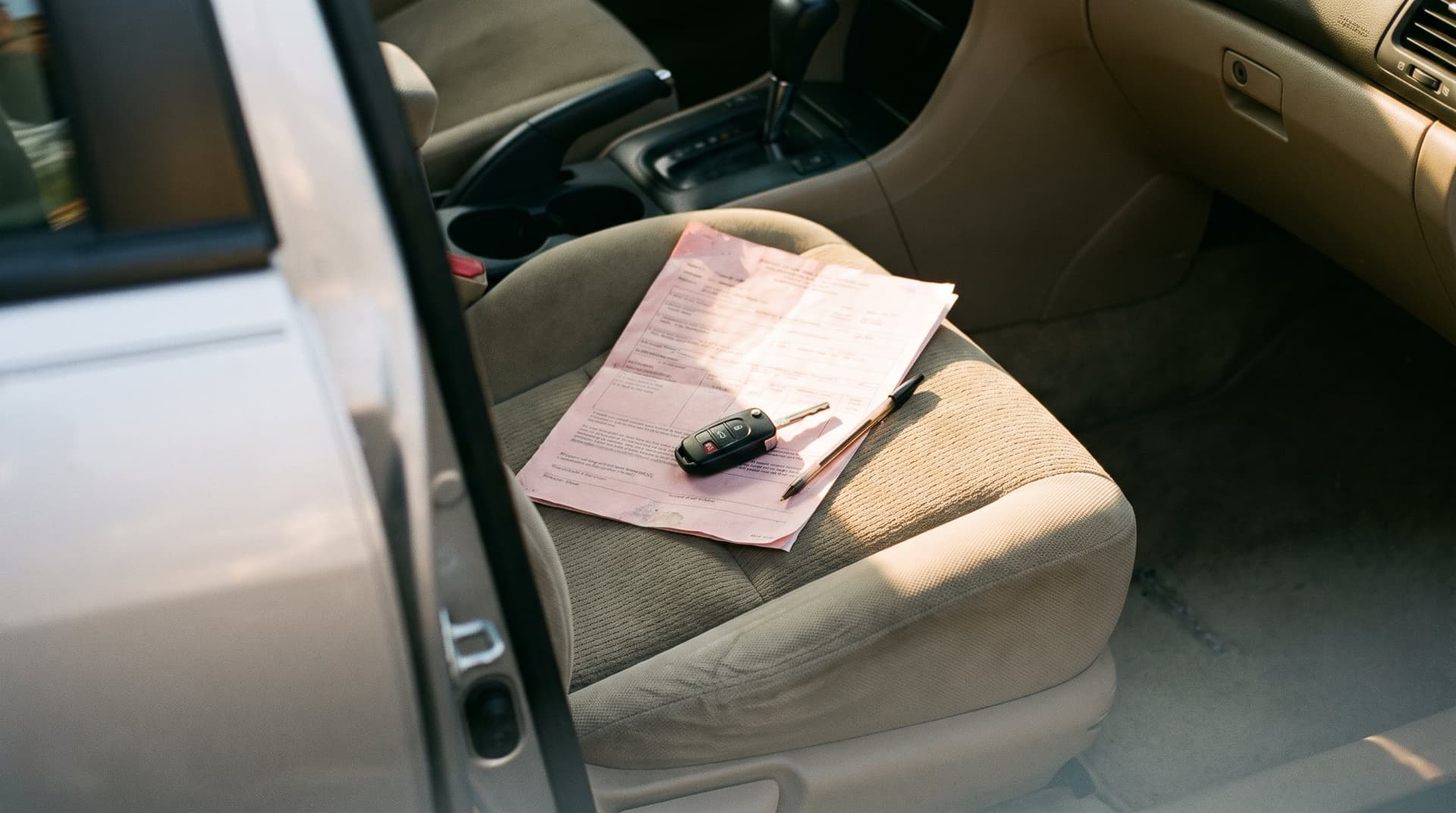
A pink slip is the California Certificate of Title, the DMV document that names the legal owner of a vehicle. The nickname comes from the paper: California titles were printed pink, and the DMV's own registration handbooks still refer to the document as the "Certificate of Ownership (aka 'pink slip')" today (dmv.ca.gov).
I'm Joe, a licensed California dealer. I have taken the pink slip out of a glove box, a kitchen drawer, and a shoebox of a late father's papers, all in the same week, and I have watched more than a few sellers sign the wrong line while I stood two feet away. So here is what the document is, where your signature goes, and what to do when the thing is missing.
Quick answer:
- What it is: the California Certificate of Title. It identifies the legal owner and carries the VIN, make, model, year, odometer mileage, registration date, lienholder, and any title brands.
- Where the seller signs: Line 1, the registered owner's release of interest. Sign as your name is printed, no white-out.
- If you lost it: form REG 227, Application for Replacement or Transfer of Title. The DMV's replacement title fee is $28.
- If you still owe money: your lender holds the title as legal owner, and the car cannot transfer until that lien is released.
- Notary: not for your signature. Only for a lienholder releasing interest on REG 227 (Vehicle Code 5752).
- After the sale: you have 5 calendar days to file the Notice of Transfer and Release of Liability (REG 138). The buyer has 10 days to transfer the title.
Why is a California car title called a pink slip?
Because it used to be pink, and Californians never let go of it. The DMV's dismantler handbook still describes the face of one title version as pink with a blue border and a white opaque state seal, and it lists four different title versions in circulation, including the older Certificate of Ownership that the handbook itself labels the pink slip.
That matters more than trivia. Because four versions exist, the physical layout of the document in your hand is not identical to the one in the photo you found on a forum. The field names hold steady even when the layout moves, which is why the DMV writes instructions in terms of Line 1 and section names instead of "top right corner."
The phrase crossed languages too. Spanish-speaking sellers in the Valley search "cómo llenar el pink slip en California" using the same English nickname, and the DMV publishes Spanish versions of its title and release-of-liability pages.
What is actually printed on a California pink slip?
The DMV describes the Certificate of Title as an official document that identifies the legal owner of a vehicle. On it you get the VIN, the make, model and year, the odometer mileage on record, the registration date, lienholder information, and title brands (dmv.ca.gov).
Two of those deserve a translation, because they are the source of most confusion I hear on the phone.
Registered owner is you, the person who drives the car and gets the renewal notices. Legal owner is whoever holds a financial interest in it. If you paid cash, those are the same person. If you financed it, the legal owner is your bank or credit union, and they are the ones holding the paper.
Title brands are the DMV's permanent notes about the vehicle's history. Salvage is the one people know. A brand does not stop a sale, but it changes the number, and any buyer who tells you otherwise is not looking at the same document you are.
Who has your pink slip right now?
If the car is paid off, the DMV mailed it to you. It is in a file, a safe, or the glove box, and roughly a third of the sellers I meet cannot find it on the first pass.
If you have a loan, your lender has it, and in most cases they do not have paper at all. They hold an Electronic Lien and Title record with the DMV. Once you pay the loan off, the lender releases the lien electronically and the title comes to you. The REG 227 form states this limit plainly on its own first line: it cannot be used to release a lien on a vehicle with an Electronic Lien Title (REG 227 PDF).
My honest opinion on this one: if you have an open loan and no title, deal with the payoff before you shop the car anywhere. Chasing offers while the lien is unresolved wastes two weeks and puts you in front of buyers who will use the mess as a reason to move the number. The payoff mechanics are their own subject, and I wrote them up separately, title loans included, in the guide to selling a car you still owe money on.
Where do you sign the pink slip when selling a car?
Line 1, the registered owner's release of interest. The DMV states it directly on its private-party registration page: the title must be signed by the seller on Line 1 (dmv.ca.gov).
Which physical side of the document that lands on depends on which of the four title versions you are holding, so match the field name, not a location you saw in someone's photo. The full field-by-field walkthrough, including the buyer's section and the odometer disclosure, is in how to fill out a California title when selling a car.
Four rules travel with that signature regardless of version:
- Every owner joined by "AND" has to sign. The REG 227 instructions spell out the same convention that governs the title: co-owners joined by AND require the signature of each owner, while co-owners joined by OR require only one.
- The odometer disclosure is required for vehicles under 10 years old. If the title has no space left for the mileage, the DMV routes you to a REG 262, which is printed on security paper and is not downloadable. You have to get one from a DMV office.
- No white-out, no scratch-outs. A corrected title is a rejected title, and the fix costs you $28 and a wait.
- Your signature does not need a notary. More on that below, because it is the single most common piece of bad advice on this topic.
I buy cars from your driveway.
I’m Joe Yavetz, a licensed California dealer. I come to your house, look at the car, write you a check the same day, and handle the DMV paperwork. The number I give you is the number you get. No fine print.
★ 5.0 · 48 Google reviewsSan Fernando Valley, Ventura County & West L.A.
Situation to form: the whole map on one table
| Your situation | What you need | Which DMV form | Cost |
|---|---|---|---|
| You hold the title, no loan | Signature on Line 1 plus odometer disclosure | The title itself (REG 262 if no space for mileage) | $0 to sign |
| Title lost, stolen, or unreadable | Replacement, or transfer with replacement | REG 227 | $28 replacement title |
| Loan still open | Lienholder release before anything else | Lender releases the ELT record | Varies by lender |
| Selling or gifting to a qualified relative | Title plus use tax exemption | REG 256 Statement of Facts | $15 transfer |
| Registered owner has died | Title path outside probate | REG 5 affidavit | $15 transfer |
| The sale just happened | Release of liability inside 5 calendar days | REG 138 | Free |
| You are the buyer | Transfer inside 10 days of purchase | Signed title plus transfer fee | $15 transfer |
The fee column comes straight off the DMV's published schedule, where Replacement Title is listed at $28 and Transfer at $15 (dmv.ca.gov registration fees). Family transfers have their own use-tax wrinkle that saves real money when it applies, and I covered it in transferring a car title to a family member. Inherited vehicles run on the REG 5 path, which is walked through in transferring a car title after death in California.
What if you lost your pink slip?
You file a REG 227. Its full name is the Application for Replacement or Transfer of Title, and it does two different jobs depending on which box you check at the top.
Check Replacement Title and you complete Sections 1 through 3, and the DMV issues you a new title. Check Transfer of Title with Replacement and the seller completes Sections 1 through 4 while the new owner completes Sections 6 and 7, which lets the sale and the replacement happen in one filing instead of two.
The details on that form that trip people up:
- Issuing a replacement cancels the original. The warning is printed right on Section 3. If the old title turns up in a drawer next month, it is dead paper.
- If your address has changed, you cannot mail it. The form requires you to file in person with proof of ownership and your driver license or ID card.
- If the title was replaced in the last 90 days, a CHP vehicle verification is required before the DMV will issue another one.
- If the DMV mailed you a title you never received, allow 30 days from the issue date before filing.
- The fee is $28. You will see $21 quoted all over the Q&A sites. That number is stale. The DMV's published fee page lists Replacement Title at $28, alongside the $15 transfer fee and the $76 registration fee.
Where I stop being useful: if you bought the car from someone who was not the registered owner of record, or there is no paper trail at all, a REG 227 will not fix it. That is bonded title territory, and the right move is a DMV field office and a real conversation, not a blog post. I tell people that on the phone and I will tell you the same here.
The deeper version of every one of these paths, including bonded titles and probate, is in can you sell a car without a title in California.
Can you sell a car without a pink slip in California?
Yes, if you are the registered owner of record. The DMV's own handbook says the REG 227 is used to transfer ownership when the California title is lost, stolen, mutilated, or illegible, which is the whole reason the "Transfer of Title with Replacement" box exists on the form (dmv.ca.gov handbook 4.020).
What you cannot do is sell a car whose title you have no claim to, or move a car with a live lien on it without the lender's release. Those are not paperwork problems. They are ownership problems, and no form solves them.
Buyers who insist on cash and a handshake with no title are a separate warning. If someone does not care whether the paperwork is clean, ask yourself what they plan to do with the car, and then decline.
Does a California pink slip have to be notarized?
Your signature, no. A lienholder's release, yes.
The DMV is specific about this. When a legal owner or lienholder releases interest, the signature must be notarized under Vehicle Code 5752, and REG 227 prints "Must be notarized" directly in the heading of Section 5. Nothing on that form asks a private seller to find a notary for their own release of interest.
I mention it because the notary-shop pages that rank for these searches have a commercial reason to blur the line, and I have watched sellers pay for a service they did not need.
What happens after you sign the pink slip over?
The clock starts. You have 5 calendar days to notify the DMV that the car is no longer yours, using the Notice of Transfer and Release of Liability, form REG 138. The requirement sits in Vehicle Code 5900 and the DMV states it as a legal obligation, not a suggestion (dmv.ca.gov).
What the filing buys you is written into Vehicle Code 5602: once the DMV has your notice, any liability for parking violations, traffic violations, or civil litigation after the date of sale becomes the responsibility of the buyer. File it electronically and the vehicle record updates within one business day.
Two things the release of liability does not do. It does not transfer ownership, and it does not excuse the buyer from anything. The buyer still has to complete the transfer and pay the fees, which the DMV gives them 10 days to do. If they drag their feet, your notice is the reason the tickets are their problem instead of yours.
The rest of the after-the-sale list, plates, insurance timing, and what to do when the buyer never registers, is in what to do after selling a car in California. If you are still upstream of the sale, the smog certificate is the other document that stalls private sales, and the rules and exemptions are in the smog check guide for sellers.
The version where the pink slip is not your problem
Here is what happens when you sell to me instead. I come to your driveway anywhere in the San Fernando Valley, Ventura County, or West L.A., inspect the car, and give you a firm offer. The price I quote is the price you get. If the number works, I write you a check on the spot, I fill out the title with you sitting right there so nothing gets signed on the wrong line, and I file the release of liability for you. I am a licensed dealer, so the buyer-side transfer is my paperwork, not yours.
If the title is lost, that does not end the conversation. I handle REG 227 transfers regularly, and the sale can be structured around the replacement instead of waiting on it.
Call or text me at (818) 325-7535. If your situation is one I cannot buy into, I will tell you what I would do instead, which happens often enough that I have a short list of referrals ready. New to the whole process? Start with how to sell a car in California.
Frequently asked questions
What is a pink slip in California?
A pink slip is the California Certificate of Title, the DMV document that identifies the legal owner of a vehicle. It carries the VIN, make, model, year, odometer mileage, registration date, lienholder information, and any title brands. The nickname comes from the pink paper California titles were once printed on, and the DMV's own handbooks still use the phrase.
Is a pink slip the same as a car title?
Yes. Pink slip is California slang for the Certificate of Title. It is a different document from your registration card, which is a permit to operate the car on public roads and expires, while the title proves ownership and does not.
Where do you sign a pink slip when selling a car in California?
On Line 1, the registered owner's release of interest. Sign it the way your name is printed on the title, since mismatched signatures are one of the things DMV clerks bounce, and never use white-out. If two owners are joined by "AND," both have to sign. If they are joined by "OR," one signature is enough.
Can you sell a car without a pink slip in California?
Yes, if you are the registered owner of record. You use form REG 227, the Application for Replacement or Transfer of Title, which the DMV accepts to transfer ownership when the title is lost, stolen, mutilated, or illegible. You cannot sell a car with an unreleased lien on it, and you cannot sell one you never held title to.
How much does it cost to replace a lost pink slip in California?
$28. That is the DMV's published Replacement Title fee. The $21 figure repeated on Q&A sites is out of date. Budget the $15 transfer fee separately if the replacement is part of a sale.
Does a California pink slip have to be notarized?
Not for the seller. A private seller's signature releasing interest needs no notary. A lienholder releasing interest does need one: Vehicle Code 5752 requires it, and REG 227 prints "Must be notarized" in the heading of Section 5.
Who keeps the pink slip when you still have a car loan?
Your lender. They are the legal owner of record until the loan is paid, and most lenders hold an Electronic Lien and Title record instead of paper. REG 227 cannot be used to release a lien on a vehicle with an Electronic Lien Title, so the lender has to release it before the car can transfer.
What do you do after you sign the pink slip over to the buyer?
File the Notice of Transfer and Release of Liability, form REG 138, within 5 calendar days. Vehicle Code 5900 requires it, and once the DMV has it, liability for tickets and civil claims after the sale date shifts to the buyer under Vehicle Code 5602. Filing online updates the record within one business day. The buyer separately has 10 days to complete the transfer.