
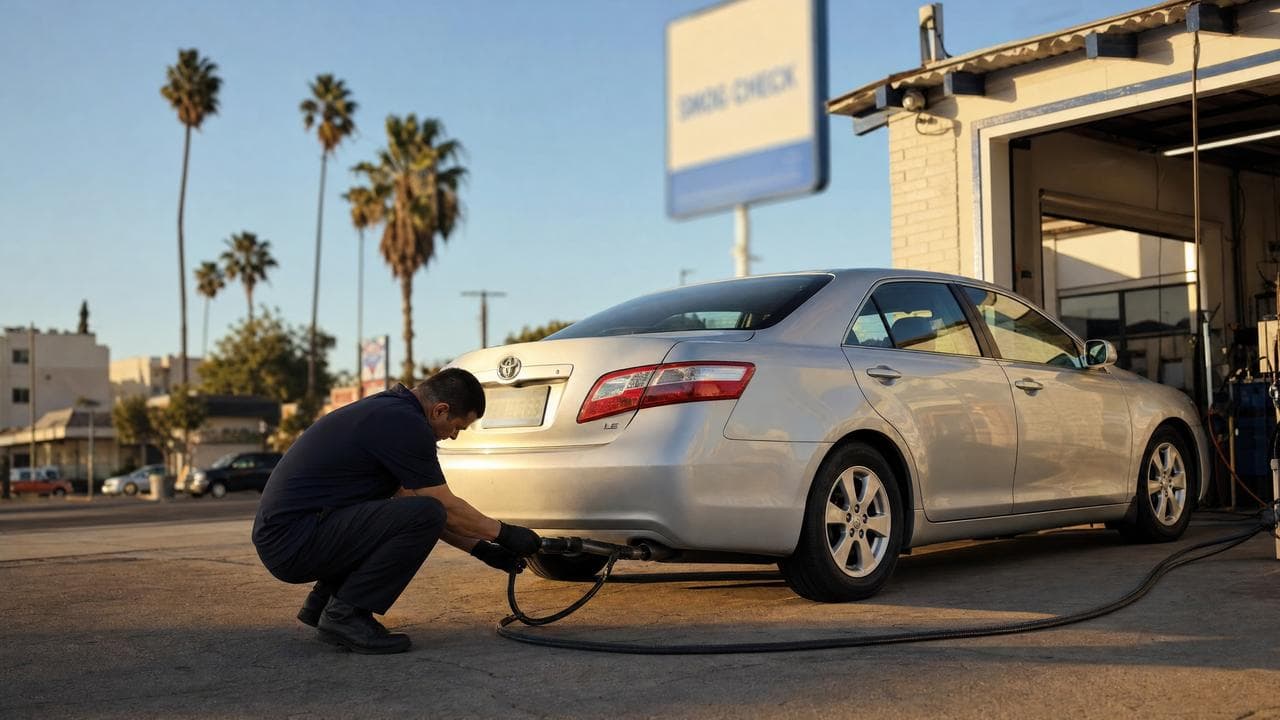
In California, the seller must provide the buyer a smog certificate issued within 90 days of the sale, unless the car qualifies for one of seven exemptions. Family transfers, sales to licensed dealers, gas vehicles four model years old or newer, hybrids over a certain age, electric vehicles, motorcycles, and PNO (Planned Non-Operation) cars all skip the requirement.
If your car will probably pass, you smog it, sell it, and move on. If it might fail or is sitting on Planned Non-Operation, the path looks different and the wrong move costs you money. Part of the How to Sell a Car in California series.
Quick answer:
- Who pays: The seller, in a private sale. Cost: roughly $40 to $80 at a STAR station.
- How long it's valid: 90 days from the date the certificate is issued.
- Newer cars skip it: Gas vehicles four model years old or newer are exempt from the seller smog requirement. The buyer pays a smog transfer fee instead.
- Family transfers skip it: Spouse, domestic partner, sibling, child, parent, grandparent, or grandchild only. Cousins, aunts, uncles, and in-laws are not exempt.
- Licensed dealers skip it: When you sell to a licensed California dealer, the smog responsibility shifts to the dealer's resale paperwork. You do not have to provide a passing cert.
- If it fails: You can repair it, retire it through the BAR Consumer Assistance Program ($1,350 to $2,000), sell it to a junk buyer, or sell it to a licensed dealer.
Do I have to smog my car before selling in California?
If your car is more than four model years old and runs on gasoline, yes. The seller is on the hook. The Department of Motor Vehicles will not finalize the title transfer without a valid smog certificate attached to the application, and the buyer will, fairly, push the cost back on you.
The rule comes from California Vehicle Code §24007 and §44011. In practice it works like this: you take the car to a STAR-certified smog station, the station runs the test, and if the car passes, the certificate is sent electronically to the DMV. It is valid for 90 days.
Note one quiet trap. If you got a biennial smog certificate for your registration renewal within 90 days of the sale, you do not need a new one. Bring the DMV inspection record. A lot of sellers pay for a second smog they did not need because no one told them this.
Which cars are exempt from the seller smog requirement?
Seven categories of vehicles skip the seller smog requirement in California. If your car fits any of them, you do not have to provide a smog certificate at the time of sale.
- Gasoline cars four model years old or newer. For a sale in 2026, that means model years 2023 and newer. The new owner pays an $8 smog transfer fee at the DMV instead.
- Gasoline cars 1975 or older. Smog-exempt for life.
- Diesel vehicles model year 1997 or older.
- Diesel vehicles with a gross vehicle weight rating over 14,000 pounds.
- Electric vehicles. No emissions, no test.
- Motorcycles.
- Transfers between immediate family members. Spouse, domestic partner, sibling, child, parent, grandparent, or grandchild only. The DMV publishes this list and it is narrower than people think. A cousin transfer is not exempt. A father-in-law transfer is not exempt.
There is also a dealer exemption, under Vehicle Code §24007(b)(1). I cover that in a section below because it is the one most private sellers do not know about.
When the transfer is to family and no money changes hands, the smog exemption usually pairs with the use-tax exemption. The rules for that are in the guide on gifting a car in California.
I buy cars from your driveway.
I’m Joe Yavetz, a licensed California dealer. I come to your house, look at the car, write you a check the same day, and handle the DMV paperwork. The number I give you is the number you get. No fine print.
★ 5.0 · 48 Google reviewsSan Fernando Valley, Ventura County & West L.A.
How does the 90-day smog certificate window actually work?
The certificate is valid for 90 days from the day the STAR station issues it. After day 91 it expires and you need a new one. This matters more than it sounds.
Here is the scenario I see all the time. Seller smogs the car early because they want to be ready. The car sits in the driveway for four months while they list, take photos, deal with no-shows, lower the price, and finally find a buyer. By the time the buyer is ready, the smog certificate has expired and the seller pays for a second one. Forty bucks plus another trip to the station.
The fix: smog your car within a week or two of when you actually expect to close. If you are listing privately, wait until you have a serious buyer with a deposit or a confirmed appointment.
What happens if my car fails smog?
A smog failure is not the disaster most sellers think it is. You have four real options, and only one of them ends with you driving to the junk yard.
| Option | What you get | Best for |
|---|---|---|
| Repair the car and re-test | Passing cert, then sell at market value | Cars where the repair is under $800 and the car is worth $5,000+ |
| BAR Consumer Assistance Program retirement | $1,350 (any income) to $2,000 (income-eligible) check from the state | Older cars, income-qualified households, cars worth less than $2,000 retail |
| Sell to a licensed dealer | Market price for the car, no smog responsibility | Cars that still have resale value despite the failure |
| Junk yard / Pick-n-Pull / LKQ | $200 to $800 in scrap value, depending on weight and parts | Cars with major mechanical failure beyond emissions |
The repair math is the first call. California requires emissions repairs to be done at a STAR station, and the diagnostic-plus-repair window is usually $300 to $1,200 for common failures (catalytic converter, oxygen sensor, EVAP system). If the repair is under $800 and the car will sell for $5,000 or more passing, repair it. The car appreciates by the gap.
If the repair is over $1,000 and the car is worth less than $4,000, the math gets ugly. That is where the next two options matter. If your car has already failed, I walk through the registration lock, the 60-day permit, the waiver and every retirement gate in what to do when your car fails smog.
The BAR Consumer Assistance Program ($1,350 to $2,000 retirement check)
The Bureau of Automotive Repair's Consumer Assistance Program is the one option most private sellers have never heard of. The state will pay you a flat check to retire your vehicle if it qualifies. There are three tiers.
- $1,350. No income requirement. Your car must have failed its most recent smog check.
- $1,500. Income at or below 225% of the federal poverty level (around $35,910 for one person, $74,250 for a family of four as of 2025). Car must have a completed smog inspection (pass or fail) within 180 days.
- $2,000. Same income limit as the $1,500 tier. Car must have failed its most recent smog inspection.
To qualify, you must be the registered owner, the car must be currently registered (or expired less than 120 days), continuously registered in California for the last two years (with some flexibility), and not a zero-emissions vehicle. You also cannot have retired another car as sole owner in the past 12 months.
The application lives at bar.ca.gov/cap. Processing takes a few weeks. When approved, you drive the car to a state-contracted dismantler (BAR requires it to arrive under its own power) and they hand you the check.
For a 1998 Toyota Camry with a bad catalytic converter, the math is straightforward. Retail value passing: maybe $1,800. Repair cost: $900 to $1,400. Retire it for $1,350 (no income test) and the state has effectively bought your car for full passing value. The $2,000 income-eligible tier beats most private sale outcomes for a car of that age.
Selling to a licensed dealer skips the seller smog requirement
This is the structural exemption. When you sell your car to a licensed California dealer, the smog certificate responsibility transfers to the dealer's resale paperwork, not yours. You do not have to provide a passing cert.
The dealer handles the smog when they resell the car to the next retail buyer. The state's reasoning is that the dealer is a regulated entity with reporting obligations, so the chain of custody is clean. Your responsibility ends at the dealer's lot.
For sellers whose cars probably won't pass, or who do not want to spend $400 on a catalytic converter to sell a $4,000 car, this is the cleanest path. The dealer takes the car, writes you a check, and the smog problem becomes theirs.
This is one of the reasons I can make an offer on a car with a check engine light or a known emissions issue when a private buyer would walk away. The light costs the private buyer their weekend; it costs me a line item on the resale prep sheet. Different math.
If you want a firm offer on a car that may or may not pass smog, I run the numbers using the same valuation tools the top dealers use and bring the offer to your door. Call or text (818) 325-7535.
What about selling a PNO (Planned Non-Operation) or non-op car?
A PNO car is one you have officially told the DMV is not being driven. You pay a $28 PNO filing fee instead of full registration, and you do not need a smog certificate to keep the status active.
But the moment you sell it, the rules shift.
If the buyer plans to drive it, the car has to be brought back to operational status. That means a current smog certificate (if it is not exempt by age), back registration fees, and a passing inspection. The seller is responsible for the smog under §4000.4. In practice, most PNO sales end one of three ways:
- Buyer is a hobbyist or restorer. They keep it on PNO (a $28 filing). No smog needed. The transfer documents note PNO status.
- Buyer wants to drive it. Seller smogs the car (or the buyer does, with a price reduction). If the car has been sitting two-plus years, expect a fail on the first test. Cars need to run for at least a week of regular driving cycles before they pass a modern OBD-II smog test.
- Buyer is a licensed dealer. Same structural exemption as any other dealer sale. No smog cert needed from the seller.
The mistake I see most often on PNO sales is a seller agreeing to deliver a "smogged" car without realizing the car has been sitting for 18 months and will throw monitor-not-ready codes for two weeks. If you are selling a PNO car to a private buyer who wants to drive it, build a one-week "drive it around" window into the deal before the smog appointment.
What paperwork do I need at the time of sale?
For a standard private sale of a car more than four model years old:
- Signed title (pink slip), with the seller signature and date on the back
- Bill of sale (the California REG 135 form, or any written bill with vehicle info and both signatures)
- Smog certificate (the STAR station sends this electronically; the seller hands the buyer the printed vehicle inspection report as proof)
- Notice of Transfer and Release of Liability (REG 138) filed by the seller within 5 days of the sale, online at dmv.ca.gov
- Odometer disclosure on the title (for cars fewer than 20 model years old, 2011 or newer)
For a dealer sale, the dealer prepares the bill of sale and handles the title work. You sign the title, the dealer takes it from there, and the REG 138 is filed as part of the dealer's standard process.
What do I do after selling the car in California?
File the Notice of Transfer and Release of Liability (REG 138) with the DMV within five days. This is the single most important post-sale step in California and the one private sellers skip most often.
Without the REG 138 on file, you are still the registered owner of record for tickets, toll violations, and impound charges run up by the buyer. I have seen sellers get hit with parking tickets six months after the sale because the buyer never registered the car and ran up violations under the old plate. The REG 138 is free, takes about three minutes online, and ends your liability the day you file it.
For the full post-sale checklist, see what to do after selling your car in California.
When does selling to a dealer make more sense than smogging and selling private?
The short version: when the smog risk and the repair cost together exceed the spread between private-party value and dealer offer.
For a car that will probably pass smog, has resale value over $8,000, and you have three or four weeks to spend on listings and showings, private sale usually wins by $1,500 to $3,000 net. Smog it, list it, take the gain.
For a car that might fail, is worth under $5,000, or you do not have weeks to spend on the process, a licensed dealer who comes to your house usually wins on a per-hour basis. No smog responsibility, no parade of strangers, no relisting. One appointment, one check.
The break-even depends on the car. A 2015 Honda CR-V with 110,000 miles and a clean smog history? Probably worth the private sale effort. A 2008 Nissan Altima with 220,000 miles and a current check engine light? Almost never worth it.
If you want to know which side of the line your car falls on, I can give you a range over the phone with the VIN and a couple of photos, and a firm offer at your door if the range works for you. Call or text (818) 325-7535.
Frequently Asked Questions
Who pays for the smog check when selling a car in California?
The seller, in a private sale of a gas vehicle more than four model years old. Cost is roughly $40 to $80 at a STAR-certified station. The certificate is valid for 90 days. If you sell to a licensed dealer, the smog responsibility transfers to the dealer's resale paperwork and you do not pay.
Can I sell my car if it failed smog in California?
Yes. You have four options. Repair and re-test if the repair is under $800 and the car is worth $5,000 or more. Apply for the BAR Consumer Assistance Program retirement check ($1,350 to $2,000). Sell to a licensed California dealer, who handles the smog on resale. Or sell for scrap to a junk yard. A failed smog does not mean the car is unsellable.
How long is a California smog certificate good for?
90 days from the date the STAR station issues it. If the sale takes longer than 90 days, you need a new smog test. The fix is to wait until you have a serious buyer or confirmed appointment before getting the smog.
Do I need a smog check to transfer a car to a family member in California?
Only for transfers outside the immediate family. The exempt list is spouse, domestic partner, sibling, child, parent, grandparent, or grandchild. Cousins, aunts, uncles, nieces, nephews, and in-laws are not exempt and need a smog certificate.
Can I sell a PNO or non-op car in California without smog?
Yes, if the buyer keeps it on PNO status. The $28 PNO filing fee applies and no smog is required while the car stays non-operational. If the buyer plans to drive it, the seller is responsible for the smog certificate before the registration is reactivated, unless the buyer is a licensed dealer.
What is the California vehicle retirement program?
The Bureau of Automotive Repair's Consumer Assistance Program pays a flat retirement check for qualifying vehicles. Three tiers: $1,350 (any income, failed smog), $1,500 (income-eligible, pass or fail smog within 180 days), $2,000 (income-eligible, failed smog). The registration must be current or expired no more than 120 days, and the car must have been continuously registered in California for the last two years. Apply at bar.ca.gov/cap.
Will California give you $1,200 if your car doesn't pass smog?
Close, but the real numbers are higher. California's Consumer Assistance Program (CAP) pays a flat retirement check for qualifying cars: $1,350 with no income requirement if the car failed its last smog check, $1,500 income-eligible (pass or fail, applied within 180 days), or $2,000 income-eligible with a failed smog. The registration must be current or expired no more than 120 days, and the car must have been continuously registered in California for the last two years. Apply at bar.ca.gov/cap.
Is a dealership exempt from the smog certificate when buying my car?
Yes. When a licensed California dealer buys your car, the smog certificate responsibility transfers to the dealer's resale paperwork. You do not have to provide a passing smog at the time of the sale. The dealer handles the smog when they resell the car to the next retail buyer.
What do I do after selling my car in California?
File the Notice of Transfer and Release of Liability (REG 138) with the DMV within 5 days online at dmv.ca.gov. This ends your liability for tickets, toll violations, and impound charges. Cancel your insurance on the sold vehicle, keep your copy of the bill of sale and smog certificate for at least three years, and confirm the buyer registers the car under their name within 10 days.
Related: How to Sell a Car in California (pillar), How to Sell a Car As-Is in California, Transfer a Car Title to a Family Member in California, Sell Your Car to a Licensed Dealer.