
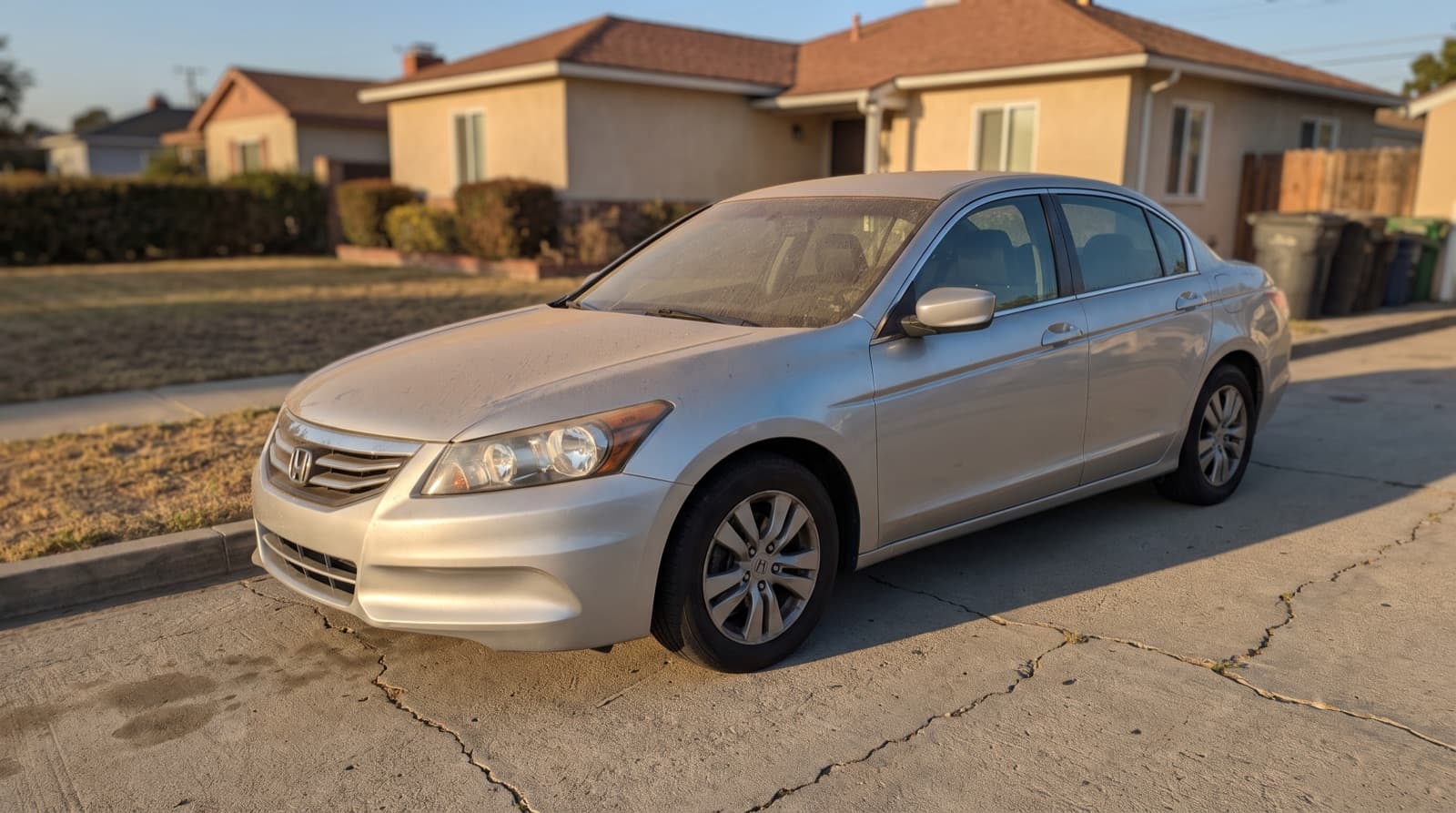
Yes, you can legally sell a car with expired registration in California. The law people are thinking of, Vehicle Code § 4000(a)(1), makes it illegal to drive, move, or leave standing upon a highway a vehicle without current registration. It says nothing about transferring ownership. A car sitting in your driveway on two-year-old tags is a car you are allowed to sell today.
The fear I hear on the phone is always the same one. Someone in Reseda or Simi Valley has a car that stopped being driven, the renewal notice went into a drawer, and now they believe they have to clear an $800 DMV bill before anyone is allowed to buy it. That is not how the transfer works, and paying the DMV first is usually the most expensive order to do things in.
Here is what actually applies: what the penalties cost, what the smog rule says when the buyer is a dealer, and who really owes the back fees when the car changes hands.
Quick answer:
- Selling is legal. Veh. Code § 4000 covers operating the car on a highway, not selling it. Expired tags do not block a title transfer.
- No grace period. Penalties begin the day after the expiration date. They start at 10% of the vehicle license fee and reach 160% past two years.
- No smog certificate when you sell to a licensed dealer. Veh. Code § 24007(b)(1) carves out vehicles "sold to a dealer." On a car that has been parked for years, this is often the whole decision.
- Back fees are the seller's personal debt under Veh. Code § 9562(d). They do not vanish in a dealer sale. What changes is that you never front the cash or stand in a DMV line.
- PNO has a 90-day cliff. File Planned Non-Operation within 90 days of expiration and you owe the PNO fee plus a penalty. On day 91 you owe a full year of registration.
- File REG 138 within 5 days of handing over the keys. Veh. Code § 5900. Expired tags change nothing about that deadline.
Is it legal to sell a car with expired registration in California?
Yes, and the confusion comes from reading a driving law as a selling law.
Vehicle Code § 4000(a)(1) prohibits a person from driving, moving, or leaving a vehicle standing upon a highway unless it is registered and the fees have been paid. That is an operation rule. It attaches to the highway, not to the pink slip. The DMV will complete a title transfer on a car with dead tags, and buyers do it every day.
Two practical limits do apply. The car cannot be legally driven to the buyer on public roads, which is why a driveway purchase and a flatbed matter more than people expect. And the DMV will want the registration account brought current at some point in the transfer, which is a money question and not a legality question. I cover that below, because the honest answer is more useful than the one most sites give.
The other thing worth saying plainly: a long lapse does not damage the title. The car is not "salvage," it is not flagged, and nothing about it is permanent. It is a bill with a clock on it.
How much do expired tags cost in California?
There is no grace period. The DMV says so on its own penalties page: it does not offer a grace period for paying annual registration fees. Penalties start the day after the date printed on the card, and they are set by Vehicle Code § 9554.
Three charges stack on top of the registration you already owe: a percentage penalty on the vehicle license fee and weight fee, a registration late fee, and a CHP late fee.
| How late | VLF and weight fee penalty | Registration late fee | CHP late fee |
|---|---|---|---|
| 1 to 10 days | 10% | $10 | $10 |
| 11 to 30 days | 20% | $15 | $15 |
| 31 days to 1 year | 60% | $30 | $30 |
| 1 to 2 years | 80% | $50 | $50 |
| More than 2 years | 160% | $100 | $100 |
A vehicle that was never registered in California before runs on a shorter schedule. The DMV publishes it on the same page under the heading "Penalties for New Vehicles or Vehicles Never Registered in California": 40% of the vehicle license fee and weight fee at one year or less, 80% from one to two years, and 160% past two years.
The number that surprises people is the jump between the third and fifth rows. Say your car carries a $180 annual vehicle license fee, which is ordinary for a mid-2010s sedan. At six months late you are looking at $108 in VLF penalty plus $60 in flat late fees. Cross two years and the same car carries $288 in VLF penalty plus $200 in flat late fees, and you owe two full years of registration underneath all of it. Roughly $488 of the bill is penalty alone, and none of it buys you anything.
That is the moment to stop and do the arithmetic, because before you pay the DMV a dime on a car you are about to sell, the money is going into an account that is about to belong to someone else. I buy cars across the San Fernando Valley, Ventura County, and West L.A., and I would sooner look at the car first and tell you whether paying that bill helps you or just moves your money. Call or text me at (818) 325-7535 and I will give you a straight read in about five minutes.
I buy cars from your driveway.
I’m Joe Yavetz, a licensed California dealer. I come to your house, look at the car, write you a check the same day, and handle the DMV paperwork. The number I give you is the number you get. No fine print. Dead tags do not change the number I write. I price the car and the arrears together, out loud.
★ 5.0 · 48 Google reviewsSan Fernando Valley, Ventura County & West L.A.
Do I need a smog certificate to sell a car with expired registration?
Not when the buyer is a licensed dealer. This is the sentence that changes most of these calls.
Vehicle Code § 24007(b)(1) bars selling or delivering a motor vehicle that is not in compliance with California's emissions rules "unless the vehicle is sold to a dealer or sold for the purpose of being legally wrecked or dismantled." Paragraph (b)(2) is where the seller's obligation lives, requiring the seller to hand the purchaser a valid certificate of compliance or noncompliance before delivery. When the buyer is a dealer, the carve-out in (b)(1) is doing the work, and the smog responsibility rides along with the dealer's resale paperwork instead of yours.
Now put that against a car that has been parked for three years. A vehicle that has sat that long will throw monitor-not-ready codes at the smog station, which means it needs a week or two of real driving before it can even take the test. But it cannot legally be driven on the highway, because the registration is expired. You would have to pay the full back registration and penalties, get the car legal, drive it for two weeks, then smog it, and only then list it. Four hundred dollars of catalytic converter later, you find out what it is worth.
Selling it to a licensed dealer skips that entire loop. No smog appointment, no monitor drive cycle, no repair bill on a car you are getting rid of. If the car has already failed its test, the four ways out, including the state's retirement check and who qualifies, are in what to do when your car fails smog in California. If your car is on the edge of failing rather than sitting dead, the smog check rules when selling a car in California guide breaks down all seven exemptions and what each path costs.
I will come to your driveway, look at the car where it sits, and give you a firm offer that does not change when I see the tags. (818) 325-7535, call or text.
Who actually pays the back registration fees?
This is where most articles get sloppy, and the sloppy version costs sellers money.
Under Vehicle Code § 9562(d), when a vehicle is transferred with registration fees and penalties unpaid and due, those fees and penalties are "the personal debt of the transferor of the vehicle who did not pay the fees and penalties when they became due or accrued." The transferor is you, the seller. A sale does not erase the arrears, and no dealer can make them disappear. Anyone who tells you otherwise is selling you something.
What a dealer purchase does change is the mechanics, and the mechanics are worth real money:
- You never front the cash. In a private sale, the buyer walks into the DMV, pays the arrears to complete the transfer, and takes that number straight out of your price. Same money, worse sequence, because you also had to negotiate against a stranger holding a printout.
- You never stand in the line. The DMV work belongs to the dealer's title department. You sign the title and you are done.
- The arrears are already inside the number. When I write an offer on a car with dead tags, the back registration is part of my math before I say the figure out loud. You get one number, and it is the number on the check.
That last part is the honest tradeoff. The fees are real, they are yours, and they show up in the offer one way or another. The difference is that you find out the whole number in twenty minutes in your driveway instead of discovering it at a service window after three private buyers ghost you. If you are weighing the private-sale route anyway, selling a car as-is in California covers what you owe a private buyer in disclosures.
What about PNO, and the 90-day cliff nobody publishes
Planned Non-Operation is the DMV's way of saying "this car is parked and I am not paying full registration on it." You file a REG 102, pay the $28 PNO fee, and the car stays legal to own but illegal to drive.
The timing rule is where people get hurt, and it comes from Vehicle Code section 4604.5(b), which the DMV applies through section 3.055 of its registration procedures manual:
- File by midnight on the expiration date. You pay the PNO fee and no penalty. Clean.
- File within 90 days after expiration. Still allowed if the vehicle was not operated in any manner, but the PNO fee and a PNO penalty are both due.
- Day 91 and beyond. PNO is gone. The vehicle must be registered, and full-year fees and penalties are owed.
That third line is the cliff. A car that went off the road in March and gets attention in August has already crossed it, and the owner usually finds out at the counter. If the car has been sitting for a season and you are deciding whether to file PNO or sell, check the expiration date first, because the answer changes on a specific day.
Whether to file PNO at all, or sell the car instead, is its own decision; I walk through both, including what it takes to bring a car back off PNO, in PNO in California: file it or sell.
Selling a car that is already on PNO status is its own situation with its own rules, and I wrote it up separately in the smog check guide rather than repeating it here.
Release of liability still applies
Expired registration changes nothing about the five-day deadline. Vehicle Code § 5900 requires the seller to notify the DMV of the transfer within five calendar days. That is the REG 138, Notice of Transfer and Release of Liability, filed free at dmv.ca.gov in about two minutes.
Skip it and you stay on the hook for what happens to the car after it leaves: parking citations, toll violations, red-light camera tickets, and civil liability in a collision. On a car with a lapsed registration this matters more than usual, because the next owner has a legal reason not to hurry to the DMV. File the REG 138 the same day you hand over the keys. The rest of the post-sale checklist is in what to do after selling a car in California.
What I would do with a car that has been sitting
My honest read, after buying a lot of these: for a car under roughly $6,000 in value with more than a year of lapse, paying the back registration to sell it privately is the wrong order of operations almost every time. You are spending certain money on an uncertain sale, and the smog test at the end of it is a coin flip on a car that has not run in a year.
For a car worth $15,000 or more with a short lapse, the math flips. Clear the registration, get it smogged, and sell it to a private buyer if you have the weeks to spend. The spread is worth the work.
The one thing I will not tell you is that a dealer purchase makes the DMV bill disappear. It does not. It gets accounted for, in the open, in a single number you can accept or turn down.
If you have a car in the San Fernando Valley, Ventura County, or West L.A. with tags that expired a while ago, call or text (818) 325-7535. I will come to you, look at the car in your driveway, and write you a check the same day if the number works. If it does not, I will still tell you the smartest way to move it.
This is part of the How to Sell a Car in California series.
Frequently Asked Questions
Is there a grace period for expired tags in California?
No. The DMV states plainly that it does not offer a grace period for paying annual vehicle registration fees. Penalties start the day after the expiration date printed on your registration card. The first tier is 10% of the vehicle license fee plus a $10 registration late fee and a $10 CHP late fee, and it applies from day one through day ten.
How much will 2 years of expired tags cost in California?
Two full years of registration fees, plus penalties. Once you pass the two-year mark the penalty is 160% of the vehicle license fee and weight fee, a $100 registration late fee, and a $100 CHP late fee. On a car with a $180 annual vehicle license fee, that is $288 in VLF penalty plus $200 in flat late fees, roughly $488 of pure penalty stacked on top of the actual registration owed. The exact number depends on your car's vehicle license fee, which is based on its depreciated value, so run it through the DMV's fee calculator before you assume.
Can you sell a car you never registered in California?
Yes, as long as the title is in your name and properly assigned to you. A vehicle that has never been registered in California uses a different DMV penalty schedule, published as "Penalties for New Vehicles or Vehicles Never Registered in California": 40% of the vehicle license fee and weight fee if it is one year or less overdue, 80% at one to two years, and 160% beyond two years. Selling to a licensed dealer works the same way it does for any other car.
Who pays registration when selling a car in California?
Under Vehicle Code § 9562(d), unpaid registration fees and penalties on a transferred vehicle are the personal debt of the transferor, meaning the seller who let them go unpaid. They do not disappear when the car changes hands. In a private sale the buyer usually pays them at the DMV counter and subtracts the amount from what they offer you. In a dealer sale the dealer handles the DMV work and the arrears are accounted for in the offer, so you never front the cash yourself.
Do I need a smog certificate to sell a car with expired registration?
Not when the buyer is a licensed dealer. Vehicle Code § 24007(b)(1) prohibits selling a non-compliant vehicle to a purchaser "unless the vehicle is sold to a dealer or sold for the purpose of being legally wrecked or dismantled," and the seller's duty in § 24007(b)(2) to hand over a valid certificate of compliance follows from that. A private buyer is a different situation: for most gas vehicles more than four model years old, the seller has to provide a smog certificate issued within 90 days of the sale.
Can I still file PNO on a car whose registration already expired?
Yes, within 90 days of the expiration date, as long as the car was not driven, towed, or parked on a public road. Vehicle Code section 4604.5(b) allows a Planned Non-Operation filing up to 90 days after expiration, with the PNO fee and a PNO penalty due. From day 91 onward PNO is off the table: the vehicle has to be registered and full-year fees and penalties are owed.
En español: Vender un carro con placas vencidas en California.