
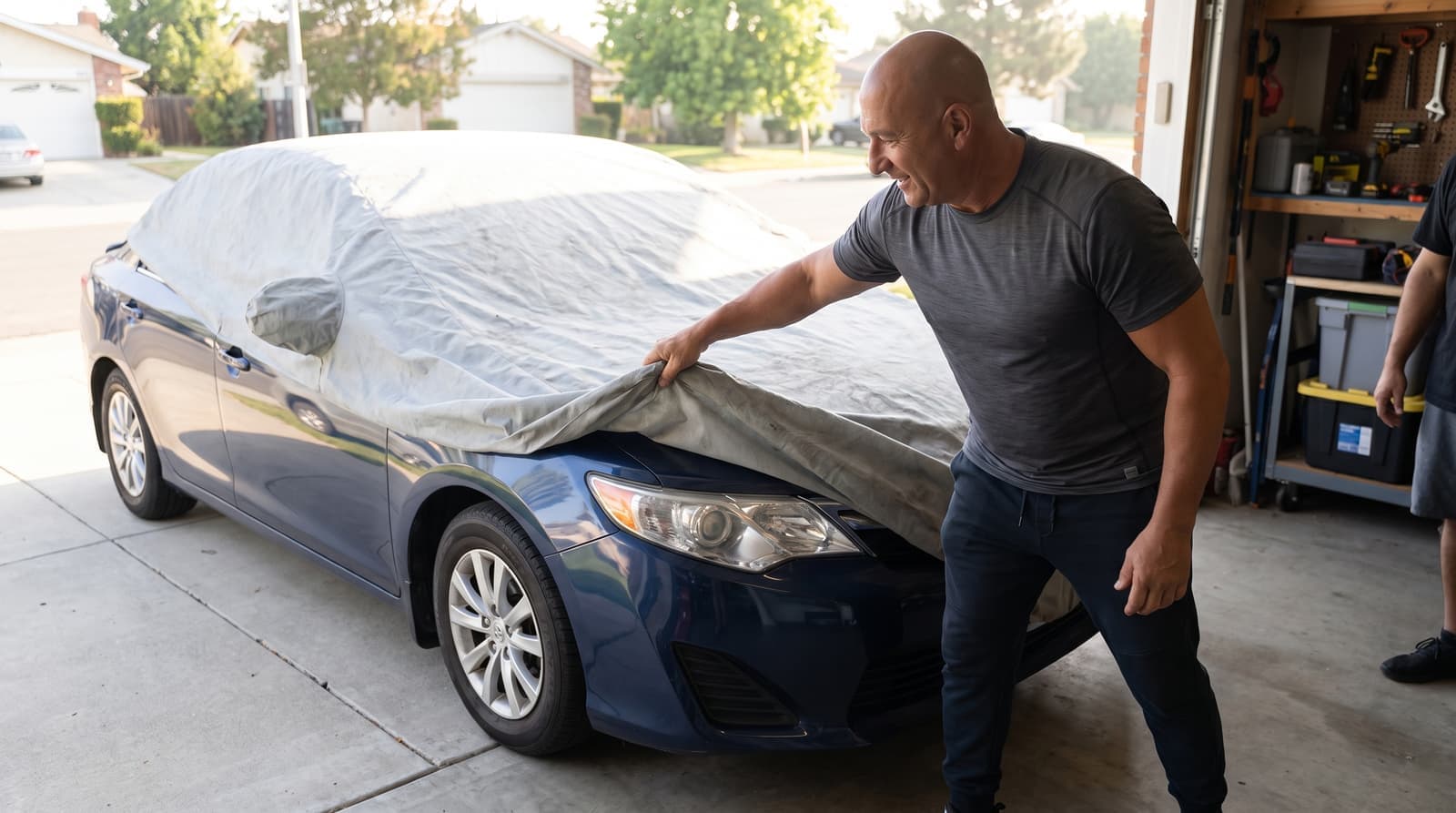
PNO, short for Planned Non-Operation, is a $28 filing that tells the California DMV your car will not be driven, towed, stored or parked on a public road for the entire registration year. It takes the place of the registration bill, it stays on your record until you register the car again, and it has a firm limit: more than 90 days after your registration expires, it's no longer available.
PNO is the right tool for a car someone is going to drive again. For a car nobody in the house will drive again, it's $28 to put the decision off, and the cost of coming back (a full year's registration, plus smog if it's due) is still waiting at the end.
Quick answer
- What it is: a DMV status for a car that stays completely off public roads, filed online or on form REG 102.
- Fee: $28 on the DMV's current fee schedule.
- Deadlines: file up to 60 days before your registration expires. By midnight on the expiration date there's no penalty. Up to 90 days after, there is one. From day 91, the car has to be registered (VC §4604.5(b)).
- How long it lasts: until you register the car again. You don't refile every year.
- Coming back: pay the full renewal before the first drive, then pass smog if it's due.
- Selling: legal at any point. A sale to a licensed dealer doesn't require a smog certificate from you (VC §24007(b)(1)).
What is PNO at the California DMV?
The DMV's definition is one sentence: "PNO means that the vehicle will not be driven, towed, stored, or parked on public roads or highways for the entire registration year." That's from the DMV's own Planned Nonoperation page, bold included.
"Non-op," "PNO" and "planned non-operation" all mean the same thing, and a car with PNO on file is often called a non-operational vehicle. The paper form is the REG 102, Certificate of Non-Operation, and the law behind it is Vehicle Code §4604.
In plain terms, you still own the car and the title is still good. You stop paying for the road, and the road is off limits: a garage, a driveway or a private lot is the whole list.
How much is the PNO fee in California?
The fee is $28. The DMV's registration fees page lists it as "Planned nonoperation (PNO) (all vehicles/OHV) (VC §4604)." Several filing-service sites that rank for this search still quote $23, so go by the DMV's page.
That $28 is the whole cost if you file on time. File late and Vehicle Code §4604.5(b) adds a penalty on top, based on how late you are:
| PNO filed after expiration | Penalty on the registration fee | Penalty on the vehicle license fee and weight fee |
|---|---|---|
| 10 days or less | $10 | 10% |
| 11 to 30 days | $15 | 20% |
| 31 to 90 days | $30 | 60% |
| 91 days or more | PNO is not available. The car must be registered under VC §4601. | Full registration applies |
Some search summaries, including AI answers, call the 90 days after expiration penalty-free, but the DMV's own penalties page says a late PNO can still be filed, "but applicable late penalties are due."
I buy cars from your driveway.
I’m Joe Yavetz, a licensed California dealer. I come to your house, look at the car, write you a check the same day, and handle the DMV paperwork. The number I give you is the number you get. No fine print. A car on PNO can't be driven to a buyer, so I come to where it's parked.
★ 5.0 · 48 Google reviewsSan Fernando Valley, Ventura County & West L.A.
When can you file PNO? The 90-day limit
Four dates decide it. All of them count from the expiration date on your registration card, not from the day you stopped driving.
- Up to 60 days before expiration. The earliest the DMV's PNO page lets you file.
- By midnight on the expiration date. On time. You pay $28 and no penalty (DMV VIRP §3.055).
- 1 to 90 days after expiration. Still allowed if the car "has not been operated in any manner," with the penalty from the table above.
- Day 91 onward. PNO is off the table. Under VC §4604.5(b), "the vehicle must be registered."
The deadline applies whether or not a renewal notice ever reached you. The DMV's manual says "the vehicle owner is responsible for either filing a PNO or renewing the registration, even if a billing notice is not received."
Once you're past day 90, the choice is register or sell. Here's the full late-penalty schedule for a lapsed car.
How do you put a car on non-op in California?
- Check the expiration date on your registration card.
- File and pay the $28 one of three ways: online through the DMV's File for Planned Nonoperation page, by mailing the REG 102 with payment, or at a DMV office.
- Park it off the street for the whole registration year: a garage, your driveway or a private lot.
- Keep the confirmation with the title.
How long does PNO last? Do you have to pay it every year?
You file it once. The DMV's manual says PNO "is not required to be filed annually," and the DMV's PNO page says the status stays on the record until you register the car. Your registration expiration date doesn't change while the car sits.
That's convenient, and it's also how a one-year pause turns into four, because no yearly PNO bill arrives to make you think about the car again.
Do you need insurance on a PNO car?
The DMV doesn't answer this in one sentence, but its rules line up like this. For a car that's still registered but not being driven, the DMV's tool is the Affidavit of Non-Use, REG 5090. After it's filed, the DMV's insurance requirements page says "the vehicle's insurance may be cancelled." When renewal comes due and the car still isn't being used, the same page says "you must pay renewal fees or request" PNO. You can't file an ANU once the registration has already expired.
Before cancelling the policy outright, ask your insurer about comprehensive-only coverage for the months the car is parked. A parked car can still be stolen, and liability coverage doesn't pay for that.
What happens if you drive or street-park a PNO car?
You lose the PNO for that year. The DMV's registration renewal page says: "if you decide to operate your vehicle or park it somewhere where it could get a parking ticket, then you need to pay full vehicle registration fees and penalties for that year."
The street-parking part is the trap people miss. If the car's only parking spot is the curb, PNO is the wrong tool for it. One parking ticket is proof the car was on a public street, and the DMV's manual treats the ticket date as the latest possible date the car went back into use (VIRP §10.115).
Need to move it from one storage spot to another? The DMV has a no-fee one-day Vehicle Moving Permit (REG 172) for exactly that, and its important vehicle information page says to "contact DMV before moving your PNO vehicle."
How do you get a car out of PNO?
- Pay the full renewal before the car moves. The DMV's PNO page says the fees "must be paid prior to operating the vehicle or penalties may be assessed." Pay on or before the day it first goes back on a road, with a timely PNO on file, and VC §4604(c) says you owe no late penalty.
- Pass smog if it's due. The renewal isn't finished until any smog requirement is met.
- Expect the smog test to take more than one visit. A car that sat often comes back on a new battery, and the Bureau of Automotive Repair's advice after a battery is disconnected or replaced is to "drive your vehicle for a week or two" so the readiness monitors reset. The DMV plans for this: its 60-day temporary operating permit for a car that fails its biennial smog check runs from "the date the vehicle is removed from planned nonoperation (PNO)." That permit costs $50, nonrefundable.
Here's what to do if it fails smog on the way back. This is the real cost of PNO: the filing is cheap, and coming back means a full year's registration plus whatever the car needs to pass smog, all due before it can be driven.
Can you sell a car that's on PNO?
Yes. PNO status doesn't lock the title. Selling to a licensed dealer is the simplest version. California's smog-certificate rule for sellers, VC §24007(b)(1), applies "unless the vehicle is sold to a dealer," so you don't have to bring the car back onto the road and through smog first. You can check a dealer's license with the DMV before you hand over a title.
A private buyer is a different smog conversation, and I covered selling a PNO car to a private buyer in the smog guide. Either way, a car on PNO can't be driven to the buyer, or by the buyer, until it's registered.
From my side: a car on PNO is often a car I can buy, and every one starts with a short phone call so I can look at your specific car and paperwork.
File PNO or sell? How to decide
PNO is a good program. If the car is going to be driven again on a date you can name, file it and don't think twice. I'm not going to tell you selling beats PNO for a car your son is coming home to drive in six months, because it doesn't.
Here's how I'd sort it:
| If this is true | PNO fits | Selling fits |
|---|---|---|
| Someone will drive it again on a known date (a deployment, a year abroad, a restoration with a plan) | Yes | |
| You have a garage, driveway or private lot for the whole year | Yes | |
| Its only parking spot is the street | No. Street parking brings back full fees and penalties | Yes |
| It's been sitting, and coming back means a full renewal plus smog | Yes. That cost lands on you later either way | |
| Nobody in the household is going to drive it again | Yes | |
| The registration expired more than 90 days ago | No. PNO isn't available (VC §4604.5(b)) | Yes. A sale on lapsed tags is legal |
| You're still paying to insure it | ANU, then PNO, can end that | Yes. Selling ends it too |
The calls I get about parked cars sound a lot alike:
- an original owner whose car had simply sat for years
- a second car that stopped moving once the daughter who drove it didn't need it
- a car that stayed behind when a kid went off to college
For cars like those, PNO holds the decision in place for $28 while the car keeps aging in the driveway. A parked car still loses value; here's what waiting actually costs in California.
If the answer is sell, I'm a licensed California dealer who comes to your driveway in West L.A., the San Fernando Valley and Ventura County and buys the car where it's parked, PNO status and all.
Frequently asked questions
What does PNO mean at the California DMV?
PNO stands for Planned Non-Operation. It's a DMV status, filed online or on form REG 102, telling the state a vehicle won't be driven, towed, stored or parked on public roads for the entire registration year. You keep the title and stop paying full registration while it sits.
How much is the PNO fee in California?
The DMV's fee schedule lists PNO at $28 for all vehicles, and that's the full cost if you file by midnight on your expiration date. Filed up to 90 days late, Vehicle Code §4604.5(b) adds $10 to $30 plus 10% to 60% of the vehicle license and weight fees.
Can I file PNO after my registration expired?
Yes, for up to 90 days after the expiration date, if the car hasn't been operated in any manner since. You owe the $28 fee plus a late penalty. After 90 days, Vehicle Code §4604.5(b) says the vehicle must be registered, so PNO is no longer an option.
Do you have to renew PNO every year?
No. The DMV's registration manual says PNO "is not required to be filed annually." The status stays on the record until you register the car again, and the expiration date doesn't change. Before the car's first trip back on a public road, you pay a full registration renewal.
Do I need insurance on a PNO car in California?
For a registered car you're not driving, the DMV's process is the Affidavit of Non-Use (REG 5090), after which the insurance may be cancelled. At renewal, you pay or file PNO. Before cancelling, ask your insurer about comprehensive-only coverage while the car is parked.
How do I take my car off PNO?
Pay the full renewal before the car goes back on a public road. With a timely PNO on file, Vehicle Code §4604(c) means no late penalty. Then pass any smog check that's due. If it fails, the DMV's 60-day temporary operating permit runs from the day PNO ends.
Can I sell a car that's on PNO in California?
Yes. PNO doesn't restrict the title. A sale to a licensed dealer is exempt from the seller's smog-certificate duty under Vehicle Code §24007(b)(1), so you don't have to bring the car back onto the road first. On PNO, it can't be driven to any buyer.
What happens if I get a parking ticket on a PNO car?
The DMV says a PNO car parked where it could be ticketed owes full registration fees and penalties for that year, and its manual treats the citation date as the latest possible date of first operation. Keep a PNO car in a garage, a driveway or a private lot.
This post is part of my guide to how to sell a car in California, which walks through the paperwork situation by situation.
A car on PNO can't be driven to a buyer, so I come to where it's parked. Call or text (818) 325-7535, tell me what the car is and where the registration stands, and I'll tell you straight whether it's one I can buy. If it is, I handle the DMV side. You can also read how selling your car from home works.
Sources
- California DMV, "Planned Nonoperation (PNO) Filing" and File for Planned Nonoperation
- California DMV, Registration Fees ("Planned nonoperation (PNO) (all vehicles/OHV) (VC §4604)," $28) and Penalties
- California DMV, Vehicle Industry Registration Procedures Manual, §3.055 Planned Non-Operation Certification (PNO-REG 102) and §10.115 Planned Nonoperation (PNO) Status
- California DMV, Vehicle Registration Renewal; Important Vehicle Information
- California DMV, Insurance Requirements; Affidavit of Non-Use (REG 5090)
- California DMV, Temporary Operating Permits (60-day smog TOP; one-day moving permit, REG 172)
- California Bureau of Automotive Repair, Smog Check
- California Vehicle Code §§4604, 4604.5, 24007