
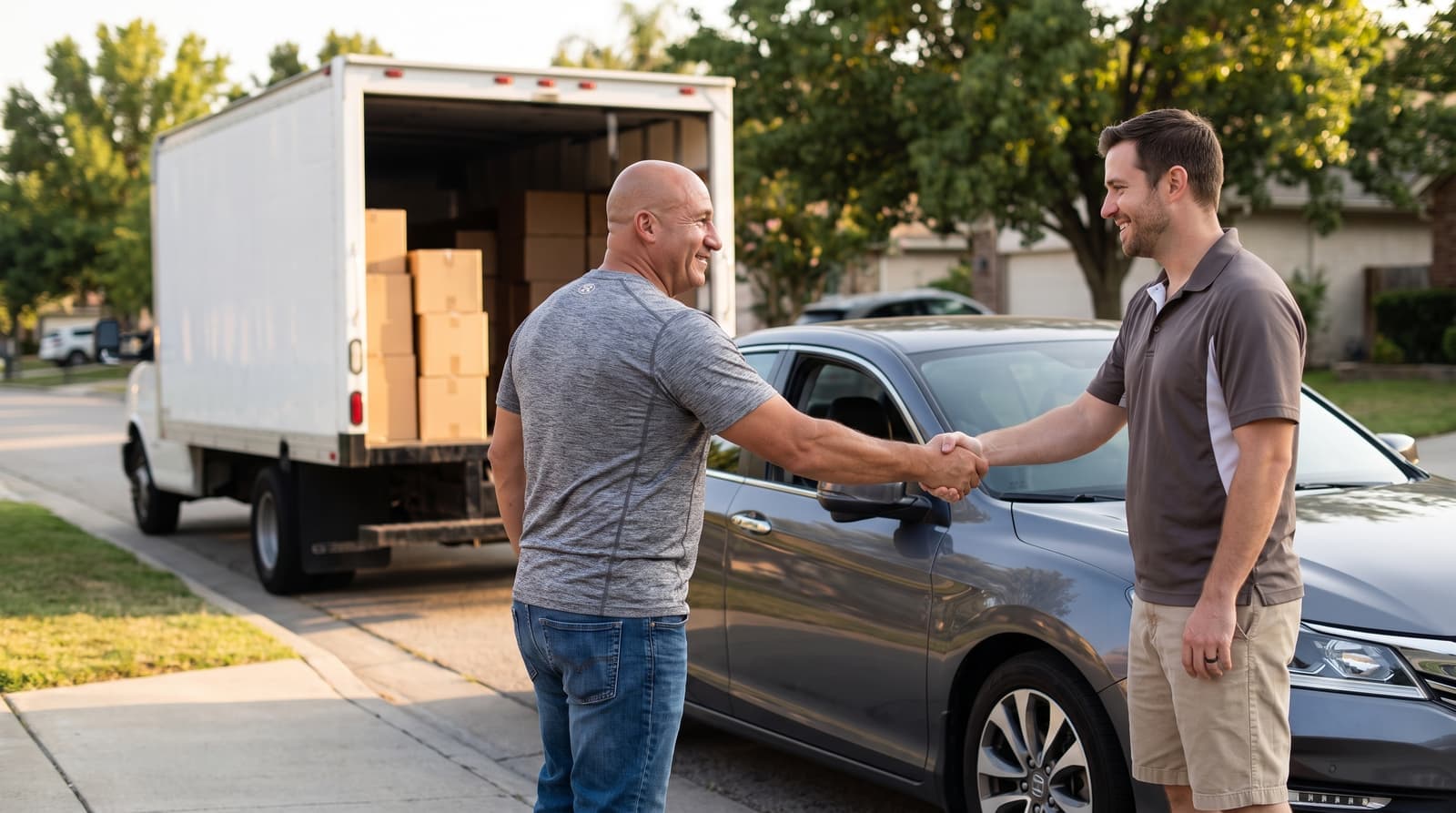
Sell it before the truck comes. If your car is registered in California and you are moving to another state, the cleanest sequence is: sell the car here, sign the title over, file the DMV Notice of Transfer and Release of Liability within five calendar days, and leave with the payment instead of the car. The paperwork is all California paperwork, and you already know how California works.
The call I get most often goes the same way. Somebody has a job starting in Austin or Phoenix in nine days, the movers are booked, and there is a second car in the driveway that is not making the trip. It has a date on it now. That date is the whole problem, because a deadline is the one thing a private buyer can smell.
Here is what applies, what does not, and the order I would do it in if I had a week.
Quick answer:
- Sell before the car crosses the state line. Once it leaves California you are selling under two states' rules, and the buyer has to sort out a California title in a state that has never seen it.
- File the Notice of Transfer and Release of Liability within 5 calendar days of handing over the keys (Veh. Code § 5900). It is free, online, and it is what stops tickets on that car from following you to your new address.
- No smog certificate when the buyer is a licensed dealer. Veh. Code § 24007(b)(1) carves out vehicles "sold to a dealer." A private buyer generally needs one from the last 90 days.
- The plates stay with the car. In California, plates belong to the vehicle, not to you. Personalized plates are the exception.
- The refund trap: California refunds unused registration only if the car left the state before the new registration period started. A car that leaves mid-period gets nothing back.
- Update your address with the DMV within 10 days of moving, even after the car is sold.
Should you sell the car in California or take it with you?
Sell it here, unless you need the car on day one in the new state or it is worth far more to you than any offer you will get.
The case for selling first is mostly arithmetic and clocks. Every state gives a new resident a deadline to register a car they bring in. Texas, to pick the state I hear about most, gives you 30 days from the day you move, and in Harris County (Houston) you need a passing emissions inspection before the state will register the car at all. Texas also charges new residents either $90 or the difference between what you paid in California sales tax and what Texas would have charged. That is money spent on a car you were planning to sell anyway, plus a second DMV line in a state where you do not know which office is the fast one.
The case for taking it is real too. If the car is paid off, reliable, and you would be buying a replacement the week you land, driving it out is often the right call. A move is expensive enough without adding a car payment on the other end.
| Sell it in California | Drive it to the new state | |
|---|---|---|
| Smog certificate | Not needed for a dealer sale (Veh. Code § 24007(b)(1)) | New state's inspection rules apply (Harris County, TX: emissions test before registering) |
| Registration clock | None; you file the Release of Liability within 5 days and you are done | Register in the new state on its deadline (Texas: 30 days) |
| Fees | None | New registration plus the new-resident tax (Texas: $90 or the sales-tax difference) |
| California refund | Not due if the car leaves mid-period; you sold it instead | Only if the car left before the new registration period began |
| DMV trips | Zero if a dealer comes to you | At least one, in a state you do not know yet |
The honest test is a number. Get a firm offer on the car while it is still in your driveway in California. If the offer is close to what you would be happy with, the decision is made and the rest of this guide is your checklist. If it is thousands below what the car is worth to you, take the car.
What paperwork do you need to sell a car in California before you leave?
Five things, and two of them have deadlines.
1. The title, signed. You sign the seller's section of the California Certificate of Title and hand it to the buyer. If there is a lienholder on the title, the loan has to be paid off and released before the car can change hands. A dealer can pay the lender directly as part of the purchase, which is usually faster than doing it yourself in a week that is already full. How to sell a car you still owe money on walks through that. If the title is lost, the DMV's REG 227 replaces it for $28, and a dealer can complete the sale on the REG 227 without waiting weeks for a duplicate to arrive in the mail.
2. The smog certificate, or the exemption. In a private sale, the DMV's own title transfer checklist says most vehicles more than four model years old need a smog certificate issued within the last 90 days. That is a smog appointment, a possible repair, and a retest, all inside your moving week. When the buyer is a licensed dealer, Vehicle Code § 24007(b)(1) removes the requirement: the rule against transferring a non-compliant vehicle does not apply to a vehicle "sold to a dealer." On a moving timeline, this is often the difference between selling this week and selling next month. The full set of exemptions is in the smog check guide.
3. The odometer disclosure. Fill it in on the title where the form asks for it. Do not leave it blank for the buyer to complete later.
4. A bill of sale. Optional, but the DMV provides REG 135 for exactly this, and a dated record of the price and the moment possession changed hands is worth having when you are about to be two time zones away.
5. The Notice of Transfer and Release of Liability. This is the one that matters most, and it has its own section below because people get it wrong in the direction that costs them.
I buy cars from your driveway.
I’m Joe Yavetz, a licensed California dealer. I come to your house, look at the car, write you a check the same day, and handle the DMV paperwork. The number I give you is the number you get. No fine print. A move puts a date on the car. I come to you, pay cash or a same-day check, and the paperwork is done before the truck arrives.
★ 5.0 · 48 Google reviewsSan Fernando Valley, Ventura County & West L.A.
What happens to the license plates when you sell a car in California?
They stay on the car. The DMV's rule is that license plates remain with the vehicle they were issued to. This surprises people moving from states where plates follow the owner. In California you do not unbolt them, you do not surrender them, and you do not need to do anything with them at the DMV.
The exception is a personalized or special-interest plate. Those can be reassigned to another vehicle on request, with the appropriate fees, so if you have one you care about, pull it before the sale and keep the paperwork.
Everything else that is yours comes off: the FasTrak transponder, the parking permit, the garage remote clipped to the visor. Sellers forget the transponder more often than you would think, usually after the car is already gone.
How do you file the Release of Liability, and why does the 5-day clock matter more when you are moving?
You file it online, it takes about two minutes, and you should do it the same day the car leaves your possession.
This is form REG 138. The rule comes from Vehicle Code § 5900: the seller has to notify the DMV within five calendar days of the transfer. The DMV's Notice of Transfer and Release of Liability page states what it does in plain language: once the DMV receives it, "any liability for parking violations, traffic violations, or civil litigation after the date of sale becomes the responsibility of the subsequent purchaser."
You need the plate number, the last five digits of the VIN, the odometer reading, the date of sale, and the buyer's name and address. Save the confirmation page. The DMV updates the record within one business day of an online filing.
Why it matters more when you are moving: a toll violation or a parking citation on a car you sold in California will be mailed to the California address on the DMV record. You will not be there. By the time it finds you in Denver it has a late fee on it and a registration hold behind it. The five-day filing is the only thing that closes that door, and no buyer's promise to "handle the DMV" replaces it.
Two things the DMV is careful to say, and so am I. Filing the notice does not transfer ownership; only the buyer's application does that. And a licensed dealer buying your car will typically file its side of the paperwork, but I still walk the seller through the release of liability before I leave the driveway, because the seller is the one with the most to lose if it does not happen. The full walkthrough is in CA DMV Release of Liability: REG 138 and the 5-day rule.
Will California refund the registration you already paid?
Usually not, and this is the trap in the order of operations.
The DMV's refund rules allow a registration refund when the vehicle left California before the first day of the new registration period. A vehicle that leaves during a period you already paid for gets no refund. The fees are attached to the car for that year, whoever is driving it.
So if your registration renewed in March and you are moving in September, the money is gone whether you sell the car or drive it out. What changes is what you pay next. Sell the car in California and you pay nothing more. Drive it to Texas and you pay Texas registration, the new-resident tax difference, and an emissions inspection, on a car that is now worth slightly less than it was in the driveway.
If you do qualify, because the car left with you before a period began and you registered it in the new state, the DMV wants an Application for Refund (ADM 399), proof the car was registered in the new state before the California registration expired, and the registration card, sticker, and plates, or a Statement of Facts (REG 256) explaining why you cannot return them.
What is the same-week plan?
This is the order I would run if I had seven days and a car that is not coming with me.
Day 1. Find the title and check for a lien. If the title is not in your name, or the lender is still on it, that is the first call, not the last. If you cannot find it, start the REG 227 today.
Day 1, same afternoon. Get a firm offer while the car is still in California. Get it from someone who will come to you and look at the car, because a number generated from a form is a number that changes when a human sees the car. I come to the driveway, inspect the car, run it through the same valuation tools the top dealers use, and give you a firm offer that is guaranteed to match or beat any CarMax offer. If you already have a CarMax number, bring it. If you want to compare it against the online buyers, CarMax vs. Carvana for selling covers what each actually does with a deadline in play. And if you want to check who is coming to your house first, how to verify a California dealer's license takes two minutes.
Day 2. Decide. Take the offer, or decide the car is worth the trip. Do not list it privately on day two of a seven-day week. A private sale takes weeks, not days, and every buyer who learns you are moving Friday will price that into what they offer you Thursday.
Day 3 or 4. Close. Title signed, odometer filled in, bill of sale dated, payment in hand before the keys leave yours. With me that is cash or a same-day check in your driveway, same visit.
Same day as closing. File the Release of Liability. Before dinner. Save the confirmation.
Within 10 days of moving. Change your address with the DMV. The DMV's moving-out-of-state guide requires it, and it is what stops renewal notices for a car you no longer own from chasing you. If one arrives anyway, the DMV says to write the date the vehicle left California and the new state on the back of the stub and mail it back.
After the sale. Cancel the insurance. After, not before. Keep the policy live until the check clears and the car is gone.
What if you already left and the car is still in California?
It happens. A car gets left with a relative, or the move outran the sale. If it will sit off the street for months before it sells, Planned Non-Operation swaps the next California registration bill for a $28 filing.
You can still sell it. A California title can be signed by a seller who is standing in another state, the Release of Liability is filed online from anywhere, and a licensed dealer can complete the purchase at whatever California driveway the car is sitting in. The parts that need a person in California are the inspection and the handover, and those can be the relative, with you on the phone for the signature and the payment.
What you cannot do easily is the reverse: take a California-titled car to the new state and then sell it there. The buyer in that state is being asked to register a car with an out-of-state title, some states will want it retitled first, and you are now the person who has to make that happen from a distance. Sell it before it crosses the line.
A move with a date on it
In early September I bought an older Mercedes from a man named Jerry who was moving to Houston. He had found me through ChatGPT. The car was fine and none of that mattered, because the truck was coming and the car was the one thing that could not go in it. I came to him, looked at the car, and paid him fair market value. He got to spend the rest of the week on the move instead of on the car.
That is the whole service. A firm offer at your door, the paperwork done in front of you, and cash or a same-day check, anywhere in the San Fernando Valley, Ventura County, or West L.A. Call or text me at (818) 325-7535. If the smarter move is to take the car with you, I will tell you that too.
This is part of the How to Sell a Car in California series.
Frequently Asked Questions
Do I need a smog check to sell my car before moving out of California?
Not if you sell it to a licensed dealer. Vehicle Code section 24007(b)(1) exempts vehicles sold to a dealer from the requirement that a seller deliver a smog certificate. In a private sale, most vehicles more than four model years old need a smog certificate issued within the last 90 days, which means a smog appointment inside your moving week and a repair if it fails.
Do I keep my license plates when I sell a car in California?
No. The California DMV's rule is that license plates remain with the vehicle they were issued to. You do not remove or surrender them. Personalized and special-interest plates are the exception and can be reassigned to another vehicle on request with the appropriate fees.
Will California refund my registration if I move out of state?
Only if the vehicle left California before the first day of the new registration period. If the car leaves during a period you already paid for, no refund is due. A qualifying refund requires an Application for Refund (ADM 399), proof the car was registered in the new state before the California registration expired, and the registration card, sticker, and plates, or a Statement of Facts (REG 256) explaining why you cannot return them.
How long do I have to file the Release of Liability after selling my car in California?
Five calendar days from the date you transfer the car, under Vehicle Code section 5900. It is filed free online at dmv.ca.gov with the plate number, the last five digits of the VIN, the odometer reading, the date of sale, and the buyer's name and address. Filing it does not transfer ownership; it moves liability for tickets, violations, and civil claims after the sale date to the buyer.
Can I sell a car in California if I still owe money on it and I am moving?
Yes. The loan has to be paid off and the lender released from the title as part of the sale. A licensed dealer can pay the lender directly and handle the release, which is usually faster than paying it off yourself and waiting for the lien release before you can sell. Start that conversation on day one, because the lender's payoff timing is the part you do not control.
What happens if I move out of state and do not tell the California DMV?
Renewal notices and any violations on the car keep going to your California address, and you must report a change of address within 10 days of moving. If you sold the car, the Release of Liability is what stops the notices. If you kept the car and registered it in the new state, the DMV says to write the date the vehicle left California and the new state on the back of the renewal stub and mail it back.
What is the fastest way to sell a car before moving out of California?
Sell it to a licensed dealer who comes to you. It removes the smog certificate step, the listing, the strangers, and the second DMV trip, and it can close in a single visit with cash or a same-day check. Get the offer while the car is still in your California driveway, decide, close, and file the Release of Liability the same day.