
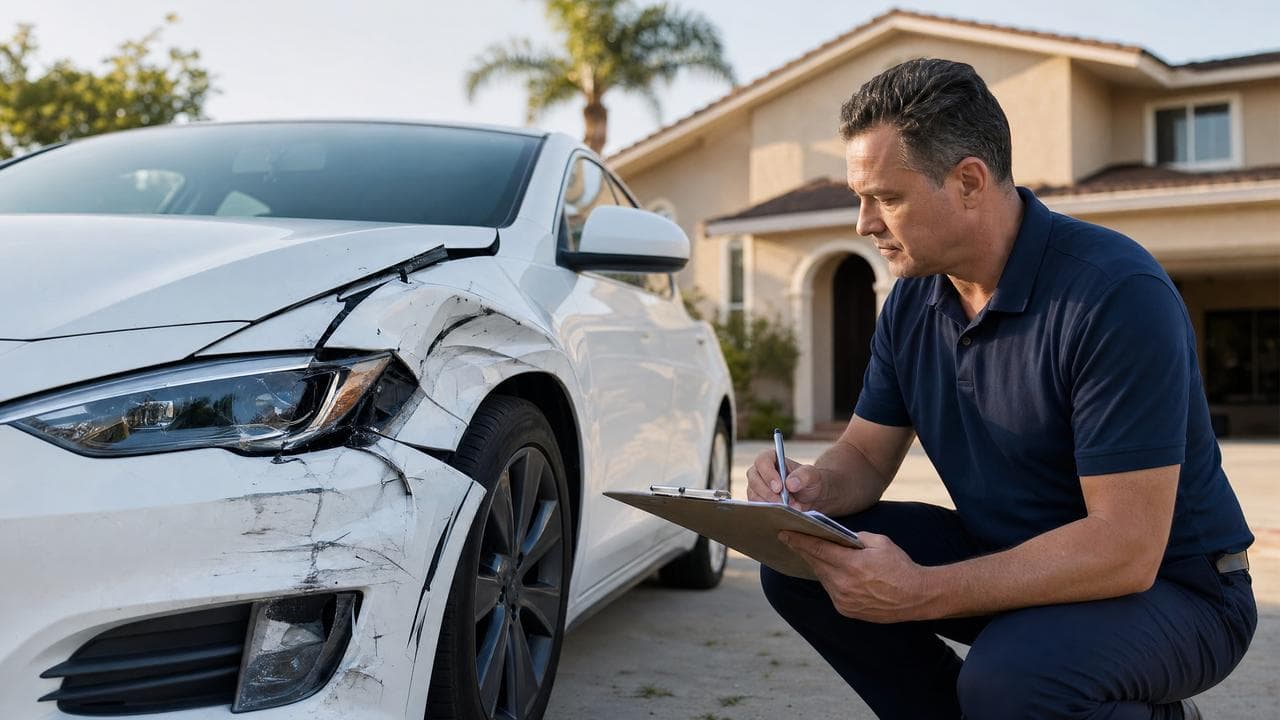
California does not have a 70% rule, a 75% rule, or any percentage rule. A car is a total loss in California when the cost of repairs plus its salvage value equals or exceeds what the car was worth before the accident. That is the Total Loss Formula, rooted in the Vehicle Code, not in your adjuster's gut. Which means the "totaled" label is a math problem. And math problems can be checked.
I'm Joe. I've been a licensed dealer for over 30 years and I've bought more than 50,000 cars. Every so often the phone rings with some version of the same story: the insurance company says the car is totaled, or a body shop is offering a number that feels low, and the owner is standing in their driveway wondering whether everyone else knows something they don't. Sometimes the label is right. Honestly, most of the time it is. But not always, and when it's wrong, the difference is measured in thousands of dollars.
Quick answer:
- The rule: a car is totaled in California when repair cost + salvage value ≥ actual cash value (ACV). Vehicle Code §544. No fixed percentage exists in state law.
- The 70-75% you hear about is insurer habit, not law.
- The settlement is regulated: it must match a comparable local vehicle, include sales tax and fees, and itemize every deduction (10 CCR §2695.8). You get a 35-day window to make them reopen it.
- You can keep a totaled car (owner-retained salvage: REG 481, then REG 488C within 10 days), but the title is branded salvage for life.
- Hit by an uninsured driver? UMPD caps at $3,500 in California, and pays nothing if the driver was never identified.
- Before you accept a lowball offer on a damaged car, get an independent read on what it's actually worth. Sometimes the answer is "take the offer." Sometimes it isn't.
When is a car considered totaled in California?
When repairing it stops making economic sense, as defined by a specific formula:
Repair cost + salvage value ≥ actual cash value = total loss.
California Vehicle Code §544 defines a total loss salvage vehicle as one damaged to the point that it's "uneconomical to repair." The state is one of the minority that uses this Total Loss Formula instead of a bright-line percentage. Say your car was worth $15,000 the day before the accident. The body shop estimate comes back at $11,000, and the insurer figures the wreck would bring $4,500 at a salvage auction. $11,000 plus $4,500 is $15,500, which clears $15,000, so the car is declared a total loss. Change the estimate to $8,000 and the same car is a repair, not a write-off.
You'll read on the internet that cars get totaled at "70-75% of value." In practice insurers do start leaning toward total loss around there, because they know the salvage value will usually push the formula over the line. But it is a tendency, not a threshold. Nothing in California law says 75%, and an adjuster who treats it that way is using a shortcut, not a statute.
Every piece of that formula is an estimate made by a person. The repair estimate depends on which shop wrote it. The ACV depends on which comparable sales the insurer picked. The salvage value depends on an auction projection. Estimates can be wrong, and that is exactly why a second set of eyes is worth something.
The Tesla that made me write this article
A while back a guy called me about selling one car, and near the end of the conversation he mentioned, almost as an afterthought, that he also had a Tesla with about 40,000 miles on it. It had been smashed in an accident, the insurance situation didn't cover the loss, and the car was being treated as a total loss. A body shop had offered him $6,000 to take it off his hands. He was stuck with a damaged car, no insurance check coming, and one offer on the table from a shop that, let's be honest, was planning to fix it and flip it.
So I went to look at it. Not because every smashed car is secretly a gold mine. Most aren't. The majority of badly damaged cars I look at are exactly what they appear to be, and I tell the owner so. I went because "totaled" is a conclusion, and I wanted to see the evidence. The real question on any accident car is never the crumpled panel you can see. It's what happened underneath: the structure, the suspension mounting points, and on an EV, the battery enclosure. A car that looks terrible can be surface damage on a sound structure. A car that looks fine can be junk. From the curb, you genuinely cannot tell.
That is the part I want you to take away from this story. The $6,000 body-shop offer wasn't evidence of what the car was worth. It was evidence of what one buyer with a repair bay and a profit motive was willing to pay. Those are different numbers, and the only way to know how different is to have someone look at the car who values cars for a living and has no stake in the answer.
I buy cars from your driveway.
I’m Joe Yavetz, a licensed California dealer. I come to your house, look at the car, write you a check the same day, and handle the DMV paperwork. The number I give you is the number you get. No fine print.
★ 5.0 · 48 Google reviewsSan Fernando Valley, Ventura County & West L.A.
How do insurance companies decide a car is totaled?
The adjuster runs the formula, but California regulates how they get the inputs, and this is where owners have more power than they realize. Under 10 CCR §2695.8, a total-loss settlement must:
- Reflect a comparable vehicle of like kind and quality that you could actually buy in your market, not a book value from three states away.
- Include sales tax, license, and transfer fees in the payout.
- Itemize every deduction. Any markdown for condition or prior damage has to be discernible, measurable, specified in dollars, and explained in writing.
- Reopen if you push back. If you notify the insurer within 35 calendar days that you cannot buy a comparable car for the settlement amount, they are required to reopen the claim and re-evaluate.
If the settlement number feels light, the move is not to argue feelings. It's to bring evidence: real local listings for comparable cars, and an independent opinion of your car's pre-accident value. I walk through how dealers actually calculate what a car is worth in what is my car actually worth, and the same logic applies to an ACV dispute.
What if the damage isn't covered at all?
This was roughly the Tesla seller's situation, and it's more common than people think: hit-and-run drivers and uninsured drivers. California's coverage rules here are unforgiving.
- UMPD caps at $3,500. Uninsured motorist property damage coverage in California pays a maximum of $3,500, and only when the at-fault driver is identified and confirmed uninsured. On any modern car, $3,500 barely covers a bumper and a sensor.
- A true hit-and-run pays nothing under UMPD. If the driver was never identified, there is no confirmed uninsured driver, so UMPD does not apply. Collision coverage, if you carry it, is usually the only route to repair money, minus your deductible.
- File the SR-1. California requires a DMV accident report within 10 days when there's an injury or more than $1,000 in damage. It's separate from the police report and it builds the paper trail.
- Small claims goes to $12,500. If the driver is identified, you can sue for what insurance didn't cover, no lawyer needed.
When none of that adds up to a repaired car, you end up where that Tesla owner was: holding a damaged vehicle, out of pocket, deciding whether to accept whatever number shows up. That decision is worth making with real information instead of one offer.
What are your options once a car is declared totaled?
Three, broadly:
- Take the settlement and hand over the car. The insurer pays the ACV-based settlement, takes the vehicle, and files for a salvage certificate. Clean and done. Right answer for most people, IF the settlement number is honest. Check it against the 35-day reopen rules above first.
- Keep the car (owner-retained salvage). The insurer deducts the salvage value from your payout and files a REG 481 with the DMV. You then have 10 days to apply for a salvage certificate with a REG 488C and surrender the plates. The title is branded salvage permanently. Getting it road-legal again means the revived-salvage process: complete the repairs, pass a CHP inspection, pass a vehicle safety systems inspection, then re-register. Plan on months, not weeks. It can be worth it on a car with real value and repairable damage. It is rarely worth it on an average commuter car.
- Dispute the numbers. Not the concept of "totaled," the inputs: the repair estimate, the comparables behind the ACV, the itemized deductions. The formula only holds if its inputs do.
One honest note on salvage and rebuilt-title cars: they carry the brand for life, every future buyer sees it, and most large buyers won't touch them. I wrote more about that reality in selling a salvage or rebuilt-title car in California.
Why do Teslas get totaled so often?
The car in my story being a Tesla wasn't a coincidence. Teslas get written off at strikingly high rates, and it's mostly repair economics, not crash severity.
- The structural battery pack. On newer Model 3s and Model Ys, the battery enclosure is part of the car's structure. Manufacturers treat almost any damage to the sealed high-voltage enclosure as a replace-only event, and a full pack runs roughly $15,000 to $30,000. That single line item can total a mid-value Tesla on damage that looks moderate.
- Repair costs run far above comparable cars. Industry claims data (Mitchell) puts EV claim severity around $6,100 versus $4,700 for gas vehicles, and isolating Tesla widens the gap sharply. Certified Tesla shops bill $85-150 an hour, parts are proprietary, and Autopilot camera recalibration alone can add $1,000 to $3,000.
- Parts delays push marginal cars over the line. When parts take months, insurers weigh rental costs and falling values and increasingly just write the car off.
- Insurers fear the battery they can't see into. There's no reliable way to verify a pack's internal health after an impact, so rather than own the risk, they total the car.
The result: a "totaled" Tesla with 40,000 miles can be anything from genuine junk to a structurally sound car wearing expensive-looking damage. Which one it is depends entirely on what's underneath.
When is a car NOT actually totaled?
Here's the part I can't give you a checklist for, because there isn't one. Whether an accident car has real remaining value comes down to what the damage did to the structure, and reading that takes having seen thousands of these. Two cars with identical-looking damage can be worth $2,000 apart in one direction or $8,000 in the other. After 50,000 cars, I can usually tell within a few minutes of walking around one, and I can tell a lot from good photos before I ever drive out.
So here is my honest offer, and its honest limits. I buy cars across the San Fernando Valley and Ventura County, and I guarantee to match or beat any CarMax offer on the cars I buy. On accident-damaged cars, what I offer first is a straight answer. Send me pictures. If it's junk, I'll tell you it's junk, and I'll tell you what to do with it. If the numbers in your total-loss paperwork look off, I'll tell you that too. And if it's the kind of car where the label is wrong, the surprise total that's actually sound underneath, then we can talk about a real number instead of a flipper's number.
The majority of the time, the boring answer is the true one: the car is what they say it is, take the best offer available, and move on. But "most of the time" is not "always," and the only way to know which one you're holding is to ask someone who can actually read the car. Call or text me at (818) 325-7535. Five minutes and a few photos, and you'll know more than the label tells you.
This is part of the life-event selling series, which starts with transferring a car title after death in California. For the standard process on an undamaged car, start with how to sell a car in California.
Frequently Asked Questions
When is a car considered totaled in California?
When the cost of repairs plus the vehicle's salvage value equals or exceeds its actual cash value (ACV). That is California's Total Loss Formula, rooted in Vehicle Code §544. There is no fixed percentage threshold in California law. If a $15,000 car needs $11,000 in repairs and the wreck is worth $4,500 as salvage, the math says total it. If the same car needs $8,000 and salvage is $4,000, it is not a total loss under the formula.
Is there a 75% total-loss rule in California?
No. California law does not set a percentage threshold. Insurers in practice often start talking total loss when repair estimates approach 70-75% of the car's value, but that is an operating habit, not a legal rule. The legal standard is the Total Loss Formula: repairs plus salvage value versus actual cash value. That distinction matters, because a formula can be checked and challenged in a way a vague percentage cannot.
Can I keep my car if the insurance company totals it?
Yes. It is called owner-retained salvage. The insurer pays you the settlement minus the salvage value and files a Notice of Retention by Owner (REG 481) with the DMV. You then have 10 days to apply for a salvage certificate (REG 488C) and surrender the plates. The title is branded salvage from that point on, and putting the car back on the road legally requires the revived-salvage process: repairs, a CHP inspection, and a safety systems certificate. It usually takes months. For most people it only makes sense on a car with real remaining value.
Can I dispute a total-loss decision or settlement in California?
Yes, on the numbers. Under California insurance regulations (10 CCR §2695.8), the settlement must reflect the cost of a comparable vehicle of like kind and quality, include sales tax and transfer fees, and itemize any deduction in writing. If you notify the insurer within 35 days that you cannot actually buy a comparable car for the settlement amount, they must reopen the claim. An independent repair estimate and real local comparable listings are your leverage.
What if I was hit by an uninsured driver in California?
Your options are narrower. Uninsured motorist property damage (UMPD) coverage is capped at $3,500 in California and only pays when the at-fault driver is identified. If the driver fled and was never found, UMPD pays nothing for the car, and collision coverage is usually the only route. File a police report, file the SR-1 with the DMV within 10 days if damage exceeds $1,000, and if the driver is identified you can pursue up to $12,500 in small claims court for what insurance does not cover.
A body shop offered to buy my damaged car. Is that what it's worth?
Not necessarily. A body shop that offers to buy a damaged car is usually planning to repair and flip it, which means their offer has their profit built in. It might still be a fair number, but you cannot know that without an independent read on what the car is actually worth in its current condition. Get a second opinion from someone who values cars for a living before you accept.
Why do Teslas get totaled more often than other cars?
Repair economics. Newer Teslas use a structural battery pack, and manufacturers treat almost any damage to the sealed high-voltage enclosure as unrepairable, forcing a full pack replacement that can run $15,000 to $30,000. Add certified-shop labor rates, proprietary parts with long delays, and sensor recalibration costs, and repair estimates blow past the Total Loss Formula on damage that looks moderate from the curb. Industry claims data shows Tesla repair severity running well above comparable vehicles.